Showing posts with label Piano Teacher Resources. Show all posts

September 19, 2017

Music Notes Themed I Spy Game {Free Printable for Kids}

This free printable music notes I spy game for kids is a wonderful teaching tool for music classrooms or piano teachers. It is a fun music theory game for kids!

I have a couple of new piano students this year and I have always incorporated fun music activities and games into the lessons. This year I am introducing some music theory  I spy games to make learning theory a bit more interesting.

For instance, there's this game that works on learning piano keys. There's also this one that works on music symbols like rests and clefs. Below you will find one that focuses on different types of note values.

So turn on your printer, grab a pencil, and get ready to try this free printable music notes I spy game! It's so much better than a traditional music theory worksheet.

Free printable music notes themed I spy game - a fun music theory game for kids

I Spy Games are Versatile!

I spy games are tons of fun and great for kids of all ages. You can use them with toddlers or preschoolers or even preteens and teens. I know that lots of people have even used my I spy games with elderly people and those with dementia.

What I love about I spy games is how versatile they are, even beyond appealing to various age groups. There are lots of different ways to use them (there's a section below with some ideas) and they can also be used in different settings.

For example, I spy games are perfect to use as a quick boredom buster activity at home when the kids are saying, "I'm bored!" Or to keep kids busy while you're cooking supper.

They can also be used in the classroom as part of a learning center or included in a specific lesson or unit. You could also use them as filler activities for those kids who finish their classwork quickly.

You could also print off a bunch of the I spy games, package them up into a binder, and create a busy book for road trips or plane rides. You could even laminate them first (here's the laminator I use and love) or put them into sheet protectors and use a dry erase marker so that the book could be reused over and over.

I spy games are also a great activity to use in speech or occupational therapy since they can be used to target a variety of skills, which we'll touch on in the next section.

Since this game is music themed, it is perfect for piano and music teachers. It can be used during lessons to teach music theory or assigned as music theory homework instead of traditional music theory worksheets. Parents can also use this game at home as a way to supplement what the child is learning in lessons.

The Benefits of I Spy Games for Kids

There are lots of benefits to playing I spy games like this music theory themed one.

For instance, they're great for developing visual tracking skills and improving visual discrimination. After all, these printable games require kids to visually scan through the objects, compare and contrast them, and find all the ones that are the same.

Then there's obviously the math benefits. I spy games are a great way to practice and develop math skills such as sorting, counting, comparing, etc.

You can also work on fine motor skills using I spy games. You might cross off items, cover them in play dough, or use tongs to place pom poms to cover the items (see the next section for other ideas for how to use I spy games).

Furthermore, you could work on handwriting skills with I spy games. After all, there is an answer sheet to record your answers and kids can practice writing numbers or drawing tally marks.

Playing I spy games with your kids is also a great way to work on speech and language skills. You could target articulation and vocabulary for instance. All of my I spy games include written words to accompany the images to aid in comprehension, especially for hyperlexic learners.

I spy games can also be a great way to work on executive functioning related skills and working memory.

See, lots of benefits! Now, let's take a look at some different ways to use this I spy game.

How to Use this I Spy Game

The most obvious way to use this I spy game is to simply print and play (you'll be able to download your copy below). Just grab a pencil, start counting, and record the number of items you found on the answer key (write the number or use tally marks, if you'd prefer). 

Maybe you also want to cross off or circle items on the game sheet with a pencil as you find them.

Another option would be to use bingo dabbers or dot markers. You could also use pom poms or counters to cover the items as you count. You could even pair pom poms with tongs or tweezers to target different fine motor skills.

You could also laminate the I spy game first to make them reusable. Simply use dry erase markers to cross off the items as you find them and fill in the answer key. 

You could also use play dough instead of dry erase markers to cover the items on the laminated game sheet. That way you add an additional sensory component.

Finally, you can go digital by playing this I spy game right on the computer or tablet. You can also pull it up during a Zoom meeting, teletherapy session, or similar using the screenshare function. Then use the annotate tool to cross off the items.

Download the Free Printable Music Notes I Spy Game

This music notes I spy game has three pages: a game sheet, a page to record the answers, and an answer key. Both the answer sheet and answer key include the image as well as written words to describe the object.

To get a copy of this I spy game, click the link below:

>> Click here to download the free printable


Want More Music I Spy Games?

You'll find even more themes in the music I spy games bundle!
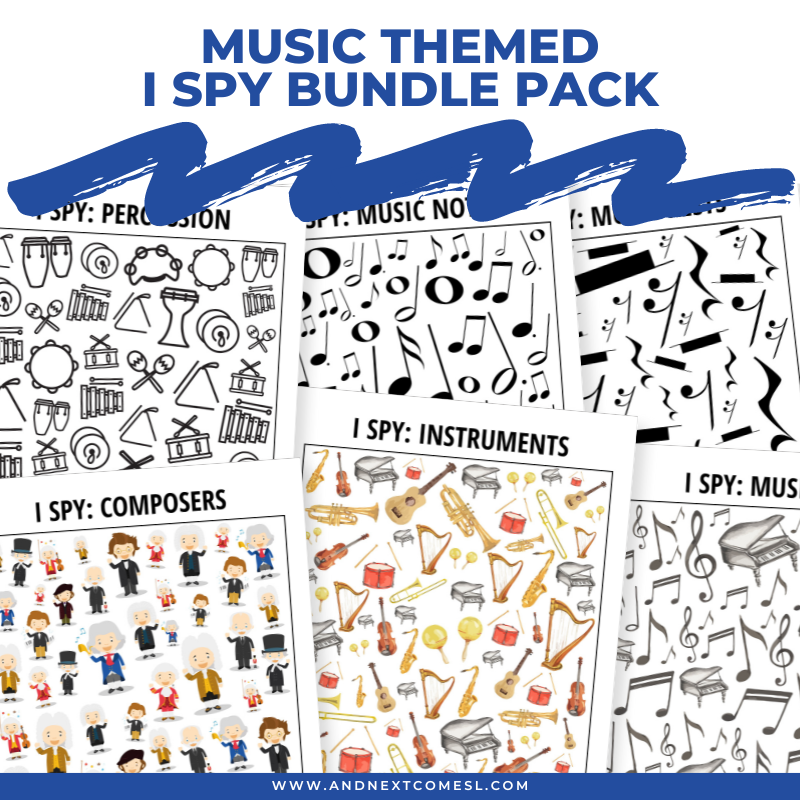
Printable music themed I spy games for kids

Click here to get your copy of the I spy games bundle

Free printable music notes themed I spy game - a fun music theory game for kids

Continue reading "Music Notes Themed I Spy Game {Free Printable for Kids}"

September 15, 2017

Piano Keys Themed I Spy Game {Free Printable for Kids}

This free printable piano keys I spy game for kids is a wonderful teaching tool for music classrooms or piano teachers. It is a fun piano theory and music game for kids!

I'm officially back into the swing of things with my piano teaching schedule and I have a couple of new beginner students this year, which I'm really excited about. And one of my favorite ways to connect with new students is by using fun music games.

So, I created this free printable piano keys I spy game with these new beginner piano students in mind. That way we could review some of the most important things they'll learn in the first few weeks and months.

This I spy game provides a different and unique way to practice finding and naming the keys on the piano. And it's much better than traditional piano theory worksheets and books, which can be a tad boring sometimes.

So I'm hoping my new beginners will enjoy playing this fun music themed I spy game.

Free printable piano keys music themed I spy game for kids - a great piano theory and music game for kids

I Spy Games are Versatile!

I spy games are tons of fun and great for kids of all ages. You can use them with toddlers or preschoolers or even preteens and teens. I know that lots of people have even used my I spy games with elderly people and those with dementia.

What I love about I spy games is how versatile they are, even beyond appealing to various age groups. There are lots of different ways to use them (there's a section below with some ideas) and they can also be used in different settings.

For example, I spy games are perfect to use as a quick boredom buster activity at home when the kids are saying, "I'm bored!" Or to keep kids busy while you're cooking supper.

They can also be used in the classroom as part of a learning center or included in a specific lesson or unit. You could also use them as filler activities for those kids who finish their classwork quickly.

You could also print off a bunch of the I spy games, package them up into a binder, and create a busy book for road trips or plane rides. You could even laminate them first (here's the laminator I use and love) or put them into sheet protectors and use a dry erase marker so that the book could be reused over and over.

I spy games are also a great activity to use in speech or occupational therapy since they can be used to target a variety of skills, which we'll touch on in the next section.

Since this game is music themed, it is perfect for piano and music teachers. It can be used during lessons to teach music theory or assigned as music theory homework instead of traditional music theory worksheets. Parents can also use this game at home as a way to supplement what the child is learning in lessons.

The Benefits of I Spy Games for Kids

There are lots of benefits to playing I spy games like this piano theory themed one.

For instance, they're great for developing visual tracking skills and improving visual discrimination. After all, these printable games require kids to visually scan through the objects, compare and contrast them, and find all the ones that are the same.

Then there's obviously the math benefits. I spy games are a great way to practice and develop math skills such as sorting, counting, comparing, etc.

You can also work on fine motor skills using I spy games. You might cross off items, cover them in play dough, or use tongs to place pom poms to cover the items (see the next section for other ideas for how to use I spy games).

Furthermore, you could work on handwriting skills with I spy games. After all, there is an answer sheet to record your answers and kids can practice writing numbers or drawing tally marks.

Playing I spy games with your kids is also a great way to work on speech and language skills. You could target articulation and vocabulary for instance. All of my I spy games include written words to accompany the images to aid in comprehension, especially for hyperlexic learners.

I spy games can also be a great way to work on executive functioning related skills and working memory.

See, lots of benefits! Now, let's take a look at some different ways to use this I spy game.

How to Use this I Spy Game

The most obvious way to use this I spy game is to simply print and play (you'll be able to download your copy below). Just grab a pencil, start counting, and record the number of items you found on the answer key (write the number or use tally marks, if you'd prefer). 

Maybe you also want to cross off or circle items on the game sheet with a pencil as you find them.

Another option would be to use bingo dabbers or dot markers. You could also use pom poms or counters to cover the items as you count. You could even pair pom poms with tongs or tweezers to target different fine motor skills.

You could also laminate the I spy game first to make them reusable. Simply use dry erase markers to cross off the items as you find them and fill in the answer key. 

You could also use play dough instead of dry erase markers to cover the items on the laminated game sheet. That way you add an additional sensory component.

Finally, you can go digital by playing this I spy game right on the computer or tablet. You can also pull it up during a Zoom meeting, teletherapy session, or similar using the screenshare function. Then use the annotate tool to cross off the items.

Download the Free Printable Piano Keys I Spy Game

This piano keys I spy game has three pages: a game sheet, a page to record the answers, and an answer key. Both the answer sheet and answer key include the image as well as written words to describe the object.

To get a copy of this I spy game, click the link below:

>> Click here to download the free printable


Want More Music I Spy Games?

You'll find even more themes in the music I spy games bundle!

Printable music themed I spy games for kids

Click here to get your copy of the I spy games bundle

Free printable piano keys music themed I spy game for kids - a great piano theory and music game for kids

Continue reading "Piano Keys Themed I Spy Game {Free Printable for Kids}"

November 08, 2016

Music Games for Kids Using LEGO

Looking for music activities for kids? Then look no further than this fun music game for kids using LEGO.

At the end of all my piano lessons, especially with my young beginners, I ditch the theory worksheets in favor of some hands-on music games for kids. Sometimes we play board games. Sometimes we use our feet on my giant floor piano. Sometimes we do other activities like these LEGO ones.

The kids love these kind of music games. Especially the extra wiggly and fidgety kids who find sitting for 30 minutes difficult.

These LEGO music games for kids are perfect for beginning music students to work on a variety of music concepts and I will show you three of the ways that I use them in my lessons.

Music activities for kids using LEGO - perfect for elementary students

Music Activities for Kids Using LEGO

These musical activities for kids are so simple and make learning music theory a bit more interesting and fun. They're a great way to explore note value, rhythm, composition, and more! My piano students enjoy these simple games and they're a much more effective way to learn music theory than boring worksheets and workbooks (although we still do those from time to time too!).

{Click here to read the full post on CBC Parents.}

Music activities for kids using LEGO perfect for elementary students

Continue reading "Music Games for Kids Using LEGO"

July 26, 2014

How to Encourage Kids to Practice Piano

How to encourage your kids to practice piano. Tips from a piano teacher!

One of the most difficult things about being a piano teacher is encouraging students to continue practicing piano over breaks. Whether it is a break around Christmas time or a break during the summer, I know that my students are likely not practicing as much as they need or as much as I would like. And honestly, as a kid growing up, I remember rarely touching the piano during the summer months. So I get it. However, lack of practice during this time can really affect progress.

So how can you encourage your kids to practice piano (or any instrument really!) during school breaks?

Ideas and tips for encouraging children to practice piano - includes review of 101 Piano Practice Tips ebook from And Next Comes L

This post contains affiliate links for your convenience. I received a copy of 101 Piano Practice Tips in exchange for an honest review. All opinions expressed are my own and were not influenced by the free product.

Piano Practice Tips for Kids

The book 101 Piano Practice Tips by Tracy Capps Selle offers lots of amazing practice ideas. It's a valuable guide for parents to keep on hand in order to find the right practice suggestions for your child. There were even plenty of fun ideas that I had never heard of before! And the chapter filled with tips from kids is completely adorable. I also particularly enjoyed how the book reinforced three key ideas about practicing piano:
  • It should be fun.
  • It should be part of a daily routine.
  • Not all piano practice needs to occur at the piano.

Tip 1: Make Practicing Piano Fun!

During the summer, kids want to just play. As a result, they view practicing piano as a chore or as work. So you may have to look for creative ways to make practicing piano fun. Here are some ways to make practicing piano fun:
  • Host a teddy bear concert. In 101 Piano Practice Tips, Tracy mentions this adorable idea of having your child playing a concert for their favorite stuffed animals. Encouraging a child to perform for their stuffed animals will not only make practicing piano more fun, but it will help them develop the confidence needed to participate in performances. So it helps them prepare for piano recitals too!
  • Come up with games to encourage practice. Another fun idea from Tracy's book is the game called "Penny Practice." It involves moving pennies from one side of the piano to the other each time a child plays a difficult section correctly. Play it wrong and a penny moves back to the original side. Once all the pennies move to the other side, the child not only wins the game, but they get to keep the pennies (or candies or whatever else you may substitute).
  • Record you child playing the piano. They will love watching the video afterwards!
  • Encourage your child to play their favorite songs as they will be more likely to want to practice if it's songs that they enjoy.

Tip 2: Make Practicing Piano Part of the Daily Routine

You may have to remind your child to brush their teeth or wash their hands. That means you may have to remind them to practice piano as well. 

It may be helpful to find a time of day that is designated to practicing piano. When I was a teenager, I used to wake up at 6 AM so that I could practice piano. It worked perfect for our family, even for my two brothers who would sleep through it all. So find a time that works for your child and stick to it!

Tip 3: Not All Piano Practice Needs to Occur at the Piano

Piano is more than just playing notes at the piano. Important skills such as working on rhythms or practicing note reading can be done away from the piano keyboard. 

In 101 Piano Practice Tips, Tracy suggests many wonderful apps and websites for practicing music theory, including some that are free. However, I prefer to encourage music theory learning with hands on activities. Here are some creative ways to practice piano without actually practicing at the piano. Just click on the link above the photo to read more about it.


Music theory games for kids - practice note reading with cars from And Next Comes L


Music theory games for kids using chalk from And Next Comes L


DIY Music Rocks for learning about music theory from And Next Comes L


Explore music theory with these simple drum games from And Next Comes L


Music theory games for kids from And Next Comes L


Music theory games for kids with a DIY grand staff from And Next Comes L


Music theory game for kids on the light table from And Next Comes L

Want More Piano Practice Tips?

I highly recommend downloading 101 Piano Practice Tips as it offers lots of creative ideas for encouraging piano practice. I particularly enjoyed the chapter with the tips from kids because, let's face it, kids say some pretty awesome (and hilarious) things. I also loved the section on music apps because I frequently have parents asking for suggestions. Now I have a great resource to suggest to them. I also love that the book is easy to read, making it a great book to reference, especially if you need a fresh new practicing strategy for your child.

101 Piano Practice Tips is available for Kindle. And don't worry if you don't have a Kindle! You can read this book on your computer or on mobile devices using the free Kindle app.

Continue reading "How to Encourage Kids to Practice Piano"

June 07, 2014

Starting Piano Lessons: When is a Child Ready for Piano Lessons?

As a piano teacher, I am frequently asked, "What is a good age to start piano lessons?"  Truthfully, the answer is that it depends on the child.  Ideally, I prefer to start with kids around age 6-8 due to reading skills, but I have taught quite a few kids younger than this age group as well.

Although there is no clear-cut answer to this question, there are numerous signs that indicate whether or not your child is ready to begin piano lessons.

Tips from a piano teacher: 8 signs that your child is ready for piano lessons from And Next Comes L

8 Signs That Your Child is Ready for Piano Lessons

Here are the readiness signs that I look for when interviewing potential new students:

  1. Does your child know the difference between left and right?  Playing the piano requires the use of both hands, so being able to distinguish one hand from the other is an important skill.
  2. Does your child know the alphabet, specifically the first seven letters (A-B-C-D-E-F-G)? The musical alphabet is made of seven letters.  It is important for your child to be able to identify and name these letters in order to read music.
  3. Can your child count to ten?  With really young beginners (age 4-5), I focus on counting to four.  The note values and time signatures in beginner music focus on one count, two counts, three counts, or four counts.  However, it is ideal if a child can count to a higher number as music is heavily based in math.  Distance between notes (intervals) rely on counting the number of notes that separate them.  Even the basic scale patterns are mathematically based.
  4. Can your child focus and pay attention for 30 minutes?  All of my beginner lessons are 30 minutes in length.  However, I usually reserve ten minutes of each lesson to do more hands on music activities, especially for really young beginners.  As a result, I need students to be able to focus and pay attention for a minimum of 20 minutes.
  5. Has your child expressed an interest in taking music lessons?  Children who have expressed an interest in taking piano are more likely to be motivated to practice.
  6. Can your child follow basic instructions? Your child needs to be able to follow simple instructions for practicing the assigned material.
  7. How are the child's fine motor skills?  Can your child hold a pencil or cut with scissors?  Playing the piano requires a lot of fine motor dexterity, so having well tuned fine motor skills makes a huge difference.
  8. Can your child read?  Teaching piano to a child who can read makes a lot of things easier, including practicing more independently and reading practice instructions on their own.  Plus, beginner piano music tends to have lyrics for the child to sing while they practice.  Being able to read allows the child to sing the lyrics while they play which can increase their rhythmic accuracy and timing.

Parents Need to Be Ready Too!

Parents also need to consider the following when assessing whether or not their child is ready for piano lessons:

  • Are you willing to help your child practice?  Young beginners (ages 4-6) will need help reading instructions, practice suggestions, counting, and more.
  • Do you own an appropriate instrument?  If not, are you willing to purchase one?
  • Are you prepared for the cost and time commitment?

Once you've decided that you and your child are ready for piano lessons, then it's time to find the perfect teacher!  So stay tuned for tips on finding a piano teacher for your child.


Other Ideas You'll Love

11 Ways to Encourage a Love for Music in Kids

How to Encourage Kids to Practice Piano

99 Fine Motor Ideas to Strengthen the Hands
Continue reading "Starting Piano Lessons: When is a Child Ready for Piano Lessons?"