Showing posts with label Reading Comprehension. Show all posts

March 06, 2024

How to Use the Picture Walk Reading Strategy to Build Comprehension Skills

Looking to improve your hyperlexic child's comprehension? Try the picture walk strategy for reading! Below you'll find out how to do a picture walk and why it is important.

There are so many different ways to work on comprehension skills before, during, and after reading a book. However, many people tend to focus more on the after portion of the reading, asking questions to check if the child understood what they were reading or not.

But what you do before reading can make a huge difference in your child's overall comprehension of the book.

That's where the picture walk reading strategy comes in. It's a quick and simple activity that you can do before reading the book.

But what is the picture walk strategy exactly? And how does it improve comprehension? Well, let's find out!

About the picture walk reading strategy, including how to do a picture walk and why it is important for improving comprehension.

What is the Picture Walk Reading Strategy?

A picture walk is a shared activity between a child and an adult that occurs prior to reading the book where you flip through the pages one by one as a way to preview the story.

What is a picture walk? The reading comprehension strategy defined

Picture walks allows the child to become more familiar with the book before actively reading the text. Think of a picture walk as a "before reading strategy."

Picture walks are prereading activities

Why are Picture Walks Important?

This reading strategy is important for building comprehension, a skill many hyperlexic children need extra help with. But here is a list of the benefits of doing a picture walk:

  • Improves comprehension
  • Introduces new vocabulary prior to reading
  • Increases interest and engagement in the story
  • Allows the child to practice asking and answering WH questions
  • Teaches the child about the different parts, structure, and format of a book
  • Gives the child a better idea of what the book will be about
  • Provides the child a chance to practice making predictions
  • Teaches the child that the pictures can be used as clues to understand what is happening in the story, what unfamiliar words might mean, etc.

How to use the picture walk reading strategy to build comprehension skills

How to Do a Picture Walk

A picture walk takes place before reading the book to activate background knowledge and improve comprehension, but how do you actually do a picture walk?

A picture walk is a prereading strategy

Well, basically, you start with the cover and start flipping through the pages, one by one. You point out important picture clues on each page and talk about what you see together with your child, asking them questions along the way. You don't really need to worry about the words on the pages quite yet as the goal is to focus on the pictures at this stage (hence the name of the strategy).

How to do a picture walk

The picture walk should only take a few minutes to complete and isn't hard to do. This video shows some tips and tricks for doing a picture walk and what to point out. You might also find this free printable list of sample questions to ask when doing a picture walk helpful.

And now that you have a better understanding of what a picture walk is and how to do it, let's see it in action! Here is a video of an example picture walk:

Once you've completed the picture walk, you can go ahead and read the book itself.

A Quick Recap of the Picture Walk Reading Strategy

Here's a quick summary of what you learned above regarding picture walks:

  • It's a shared activity that occurs prior to reading the book
  • It involves flipping through the pages one by one as a way to preview the story
  • It's important for building comprehension as it activates schema and background knowledge, gives the child a better idea of what the book will be about, introduces new vocabulary, and more
  • It only takes a few minutes to do a picture walk so it's definitely worth the effort

Now that you know how easy this strategy is and how helpful it can be, you'll hopefully give this picture walk reading strategy a try.

About the picture walk reading strategy, including how to do a picture walk and why it is important for improving comprehension.

Continue reading "How to Use the Picture Walk Reading Strategy to Build Comprehension Skills"

March 05, 2024

How to Use the Making Connections Reading Strategy

Looking for comprehension reading strategies to use with your hyperlexic child? Try using this making connections reading strategy to boost comprehension and understanding.

The most common questions I receive about hyperlexia are often related to hyperlexia and reading comprehension. That's because comprehension issues are common in hyperlexic children and it's an area that many families need help addressing, both at home and at school.

Now, I know it would be nice to have an all-in-one solution to help with this area. But, the reality, though, is that reading comprehension isn't just one thing.

There's a variety of skills that can be targeted and a variety of strategies that can be used to help. There's things like visualizing, making predictions, making inferences, and so on.

Another strategy is to work on building background knowledge and schema. 

And another strategy is to practice making connections between the text and your background knowledge. That's our focus here.

So, let's take a closer look at this making connections reading strategy. What is it? How does it work? And how can you use this strategy with your hyperlexic child?

Looking for strategies for reading comprehension? Try using this making connections reading strategy

What is the Making Connections Reading Strategy?

This strategy for reading comprehension is all about using what you know to make sense of what you're reading. Basically, making connections between your background knowledge and the text you are reading.

Think of it this way. How much easier is it to understand something when you can personally relate it to something you already know about, are familiar with, or have experienced? It makes a big difference, right? Well, that's essentially what this reading comprehension strategy is all about.

This strategy is great because it encourages the reader to get involved and actually interact with the text instead of just reading the words on the page. While reading is what hyperlexic kids do best, we do need to help support them with understanding what those words mean.

What is the making connections reading comprehension strategy? A definition

Parts of the Text that You Can Make Connections With

The great thing about this strategy is that it can be used before, during, or after reading. You can encourage your kid to use various parts of the book or text to make these connections, including the:

  • Cover
  • Title
  • Author
  • Characters
  • Pictures
  • Chapter Titles
  • Actions of the characters
  • Relationships between characters
  • Emotions of the characters
  • Choices the characters make
  • Problem or conflict that needs to be resolved
  • Solution to the problem or conflict
  • Style in which the book is written
  • Words or phrases the characters say
  • Overall theme of the book

As you can see from this list, there's lots of opportunities to practice making connections. So how do you go about making those connections? Well, first, let's discuss what types of connections can be made.

Parts of the text that you can make connections with to boost comprehension and understanding

3 Types of Connections That Can Be Made

There are three different types of connections that can be made and they're all powerful ways to boost comprehension and understanding of a text.

1. Text-to-self connections

This type of connection is all about connecting the text on a personal level, relating what they are reading to their own experiences, memories, and feelings. Basically, connecting the story with their own life.

For instance, this might mean:

  • The character reminds the reader of their sister
  • The setting reminds the reader of a place they went to on a recent vacation
  • The character is in grade two just like the reader
  • The character is dealing with the death of a pet and the reader remembers how sad they felt when their dog died

2. Text-to-text connections

This type of connection is all about connecting the text to another story or text that they have read before.

But, what does this look like exactly? Well, text-to-text connections include:

  • The topic of the text reminds them of another text that they've read
  • The reader notices that the books have the same author
  • The books share a similar genre (e.g., they're both fantasy stories)

3. Text-to-world connections

This final type of connection is all about making connections between the text and the events in the community and the world around you. It may include comparing the text to movies, TV shows, newspapers, world events (historical or current), social issues, or similar.

So these types of connections might mean that:

  • The plot reminds the reader of the devastation caused by Hurricane Katrina
  • The reader notices that the setting of the story is in a different time period than they currently live in and thinks about how difficult it would be to live in that time period vs now
  • The reader remembers learning about the first man on the moon while reading a book about an astronaut going to space

3 types of connections to make when reading

Tips for How to Use this Strategy with Hyperlexic Readers

Not every connection your child will make will be deep, but once they make a connection, you can always prompt them to go deeper. Here are some ideas on how to start using this strategy:

  • Use picture books that are similar in theme or have similar characters like this video from Play to Learn Preschool discusses how to do (for hyperlexic kids, this might mean reading an ABC book about animals and then reading a fact book about animals or it might mean reading Elephant & Piggie books back to back - things you might already be doing anyway)
  • Model using the strategy yourself by pointing to parts of the book and telling your child what it reminds you of
  • Ask your child questions before, during, and after reading that would encourage them to make connections (for a hyperlexic child, you'll want to also use a visual cue for this - see below)

For hyperlexic readers, it is really important to include some written or visual cues. Here are some ideas for using visual supports while working on this making connections reading strategy with hyperlexic kids:

  • Explain the reading strategy to them by writing out the "rules" of using this strategy and writing out the three types of connections
  • Use a graphic organizer for your child to fill in the different types of connections
  • Write out questions (or prompts) on a piece of paper or on a whiteboard that will encourage them to think about what possible connections there might be (for example, you could write the question "Does this remind you of anything?")
  • Write down any connections you and your child make so they can see what connections they have made (remember, if it isn't written down, it might not exist to them!)

Tips for using the making connections reading comprehension strategy with hyperlexic learners

Start Making Connections with these Printable Resources

These printable resources will help you start using this comprehension strategy right away. They're perfect for hyperlexic learners in particular.

Grab your copy of these scripts here

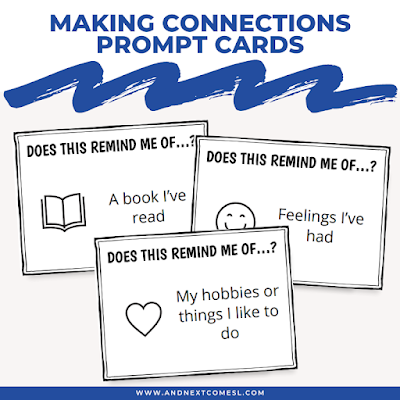
Making connections prompt cards

Grab your copy of these prompt cards here

A Quick Summary of the Making Connections Reading Strategy

Since that was quite a bit of information, lets do a quick recap of this reading comprehension strategy.

  • This strategy is all about making sense of what you're reading by making connections between your background knowledge and the text that you are reading.
  • You can make connections with any part of the text: cover, title, author, characters, plot, and more!
  • There are three different types of connections that can be made: text-to-self, text-to-text, and text-to-world.
  • To use this strategy with hyperlexic readers, you'll want to model the strategy explicitly and use written or visual cues to support them while they make connections.

As you learned, this comprehension strategy can be quite helpful, especially for hyperlexic learners. So are you going to give this making connections reading strategy a try?

Looking for strategies for reading comprehension? Try using this making connections reading strategy

Continue reading "How to Use the Making Connections Reading Strategy"

March 04, 2024

What are Signal Words? What You Need to Know

What are signal words? Here's what you need to know about signal words and why they're important for comprehension and even writing. Plus, grab the free printable list of signal words.

Given that comprehension challenges are common amongst hyperlexic learners, it's important to prioritize and support comprehension from a young age. That includes explicitly teaching them different comprehension strategies and using visual supports to do so.

One strategy that can be particularly helpful is to teach them about signal words or key words or phrases that can help boost understanding of a text. (Although you can use these signal words to help writing writing assignments too!)

But what are signal words? Why are they important? And how do you use signal words at home or in the classroom? Well, that's what we'll cover below.

You'll also find a free printable list of signal words because visual supports are so important to use with hyperlexic readers.

What are signal words? Why are they important? Plus, free printable signal words cards

So...What are Signal Words?

Signal words are specific key words or phrases in a text that give you clues or hints about what is going to happen next, the structure of the text, and/or the relationships between ideas.

These signal words are used to show cause and effect, compare and contrast ideas, help us determine fact from opinion, show a specific sequence, allow us to transition to a new idea, and more.

We'll go through specific examples in a bit, but, in the meantime, let's take a closer look at the benefits of signal words and why we want to use them.

What are signal words? A definition

Why are Signal Words Important? A Look at the Benefits

First of all, signal words can boost comprehension and understanding of a text. Something that is incredibly important if you have a hyperlexic learner, given their difficulties with comprehension.

Signal words can boost comprehension for hyperlexic learners

By the way, signal words can also help with understanding math word problems, especially if you know what math signal words to watch out for.

You can also use signal words to help with writing assignments. Another area that many hyperlexic learners need support with too (learn more here). After all, using signal words can give kids a bit more structure for communicating their ideas.

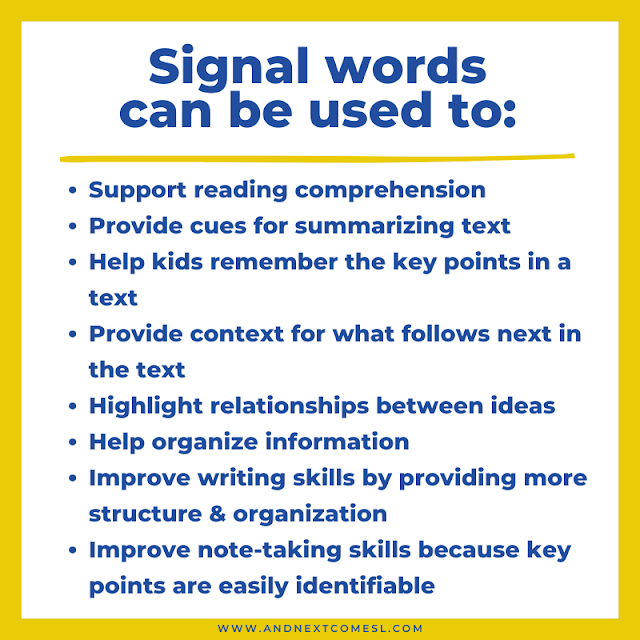
Here's a more detailed list of why signal words can be important for all learners, not just hyperlexic ones:

  • Supports reading comprehension
  • Provides cues for summarizing text
  • Helps kids remember the key points in a text
  • Provides context for what follows next in the text
  • Highlights relationships between ideas
  • Helps organize information
  • Improves writing skills by providing more structure and organization
  • Improves note-taking skills because key points are easily identifiable
Why signal words are helpful for reading comprehension and writing

How to Use Signal Words for Reading, Comprehension, &/or Writing

Okay, signal words seem important for both reading and writing, but how do you use them exactly?

Well, let's imagine you are reading a story with your child. While reading, you can point out the signal words that you see and explain their meaning. That might mean explaining that the word "because" tells us why something happened or that the phrase "the next day" tells us that we're reading about a sequence of events.

You can also use signal words to help with summarizing or retelling a story. For instance, you might summarize a story like so: First, the girl did this. Then, this event happened. Next, she did this. Then finally, she did this to solve the problem. It's similar to using something like this somebody wanted but so then graphic organizer.

Another idea is to do a signal word scavenger hunt. Before reading, quickly scan the text and point out or highlight any signal words that you spot. Do the words seem to be related to an opinion or are they showing a sequence of events? Do the words seem to be more factual in nature or are they comparing something? A quick glance through the words can usually give you an idea of the text before you read it closely.

How about for writing though?

Well, you can use signal words to format and organize your ideas that you are going to write about. Let's say you're writing an opinion piece. You can start off with a signal phrase such as "I believe" and then follow it up with "one reason" or "another reason." Or let's imagine you are writing a short story. You could rely on sequence words like first, next, then, and finally to sequence the events of the story.

You probably remember being taught this type of method for writing back when you were in school...

Now that you know what signal words are, why they're important, and how to use them, let's take a look at some of the actual key words to watch out for. There's also a free resource that you'll want to print off and keep handy.

It is worth noting, though, that some signal words can indicate more than one type of relationship. For example, a word like "also" could signal that a comparison is happening, but it could also highlight part of a sequence or that something is being described in more detail. So it's important to look for multiple key words in a text to help narrow things down.

And, obviously, these lists are not-exhaustive. There are lots of other example signal words that you can look out for, which is why there's lots of empty space to write your own on the free cards.

Ideas for how to use signal words

Words that Signal Compare & Contrast

Sometimes a writer wants to show how some things are the same or different. Maybe something is bigger or wider. Maybe two items use the same materials or are similar in shape. Whatever it is, the following list of words can indicate that two or more ideas or items are being compared and contrasted.

  • Same
  • Also
  • Like
  • Both
  • Alike
  • Similar
  • Similarly
  • As well as
  • More
  • Less
  • Different
  • Difference
  • But
  • Unlike
  • However
  • While
  • On the other hand
  • In contrast
  • Compared to

List of signal words for compare and contrast

Sequencing Signal Words

Sometimes there are key words or phrases that tell the specific order of events or give you a better idea of the structure of the text. For instance, here's the first reason why you should do something and here's the next one. And finally, here's the last one. That kind of idea. Either way, you can learn a lot about the sequence of the text by looking out for the following words.

  • First
  • To begin
  • In the beginning
  • It all began
  • To start with
  • One day
  • Next
  • Secondly
  • Afterwards
  • After a while
  • Later that day
  • Suddenly
  • Then
  • Also
  • Additionally
  • All of a sudden
  • The next day
  • Last
  • At last
  • Finally
  • Eventually
  • In conclusion
  • After that

List of signal words for sequencing

Signal Words for Facts

It's important to be able to tell the difference between a fact and an opinion in a text. In order to spot facts in particular, you can look for mentions of specific numbers, names, places, dates, and times. Or watch out for any of these signal words.

  • Numbers
  • Names
  • Places
  • Dates
  • Times
  • The fact that
  • In fact
  • Indeed
  • The truth is
  • As a matter of fact
  • It is proven
  • True

List of signal words for facts

Signal Words for Opinions

There are also lots of clues you can look for when it comes to whether something's an opinion or not. Just look for one of these example signal words.

  • Think
  • Believe
  • In my opinion
  • Best
  • Worst
  • Favorite
  • Good
  • Bad
  • Love
  • Hate
  • Probably
  • Should
  • Hard
  • Easy
  • Greatest
  • Seems
  • I am convinced
  • I am confident that
  • Prefer
  • Guess
  • Point of view
  • Interpretation
  • I'm sure that
  • It's likely that

List of signal words for opinions

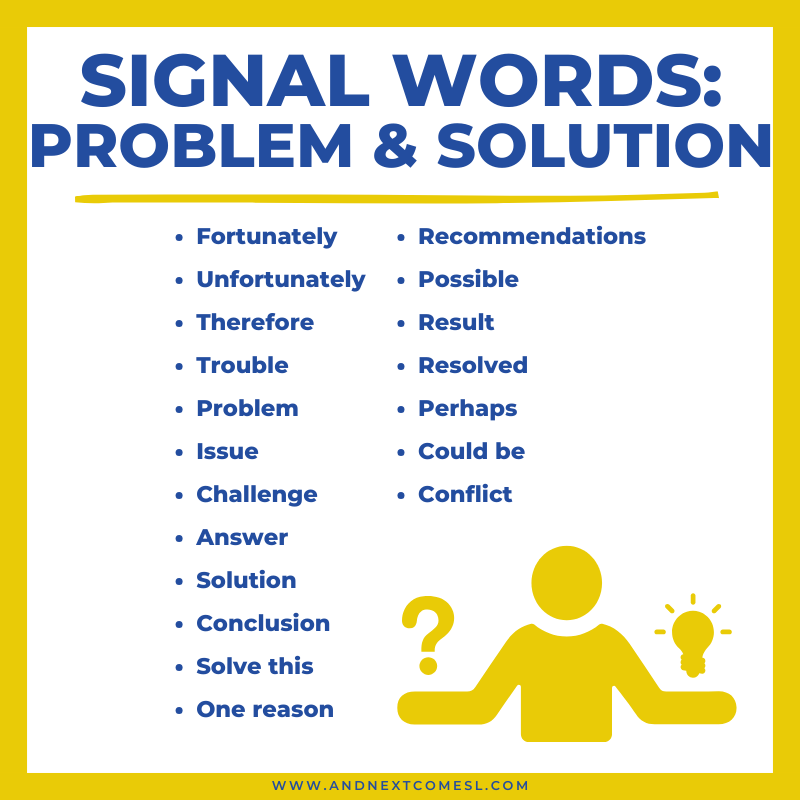
Signal Words for Problem & Solution

Sometimes you need to be able to identify the problem and solution in a text, but how do you do that? Well, you look for words like these that can indicate whether something is a problem or solution.

  • Fortunately
  • Unfortunately
  • Therefore
  • Trouble
  • Problem
  • Issue
  • Challenge
  • Answer
  • Solution
  • Conclusion
  • Solve this
  • One reason
  • Recommendations
  • Possible
  • Result
  • Resolved
  • Perhaps
  • Could be
  • Conflict

List of signal words for problem and solution

Signal Words for Descriptions & Details

There are also lots of words that can be used as evidence to support things like a fact or an opinion. And that's where these signal words for descriptions and details come in handy. Keep your eyes open for the following words that can indicate that something is being described in more detail.

  • For example
  • For instance
  • In addition
  • Also
  • Too
  • Some
  • Most
  • All
  • Other
  • Means
  • Specifically
  • Such as
  • Furthermore
  • Characteristics
  • Appears to be

List of signal words for description and details

Cause & Effect Signal Words

Sometimes ideas in a text are related in a causal relationship. Not sure if they are or not? Well, looking for the following words can help you determine what is the cause and what is the effect.

  • Because
  • Since
  • If...then...
  • Due to
  • So
  • Therefore
  • Thus
  • As a result
  • Consequently
  • In order to

List of cause and effect signal words

Download the Free Printable Signal Words Cards

This two page printable contains 8 cards, including a cover page and 7 cards with the above signal words.

Free printable list of signal words cards

There is room to write any other words or phrases on all of the cards. That way you can add any that you think should be included. Simply print, cut, and arrange into a little booklet and keep them handy while reading with your child. Feel free to laminate for durability too.

To get a copy of the free signal words list, click the link below:

>> Click here to download this free printable


Free printable list of signal words cards

What are signal words? Why are they important? Plus, free printable signal words cards

Continue reading "What are Signal Words? What You Need to Know"

November 03, 2022

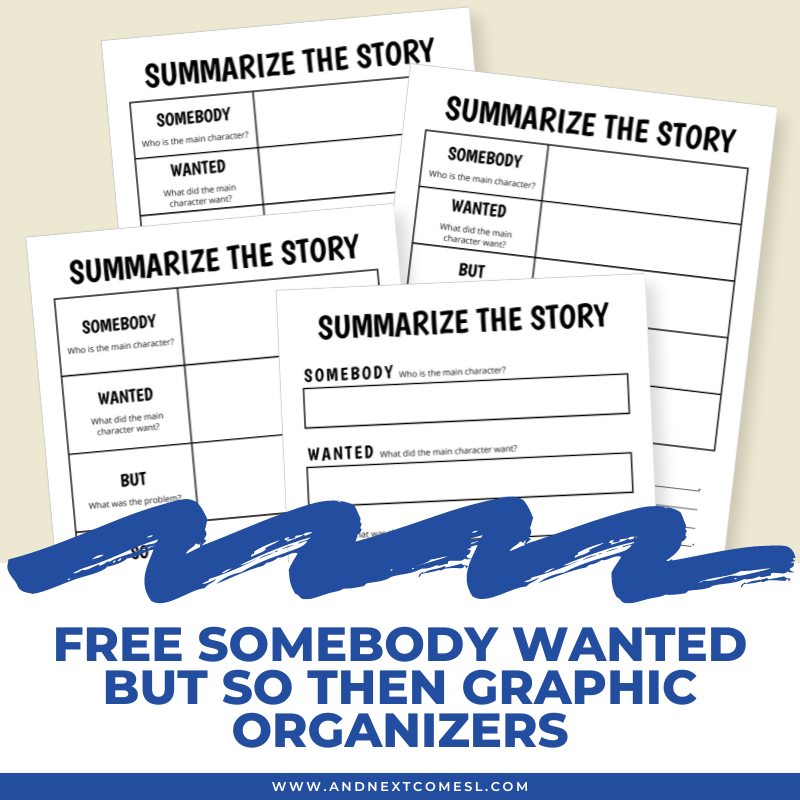
Free Somebody Wanted But So Then Graphic Organizers

Help your child summarize stories with these somebody wanted but so then graphic organizers. You'll learn all about this reading comprehension and summarizing strategy below.

It's no secret that hyperlexic kids need some extra support with comprehension. Especially as they enter the middle school years. Grade four in particular is a big challenge because task demands increase and reading for meaning becomes the priority. There's a shift to more novels and chapter books and having more background knowledge. That kind of thing.

So often our hyperlexic kids might need a bit of extra help with making inferences, summarizing a story, identifying the main idea, synthesizing important information, and so on...

One invaluable tool, though, for helping hyperlexic kids (not just with comprehension!) is to use visual supports, such as graphic organizers (see tip #1 here). 

We've been using graphic organizers with my son for a number of years with great success. We use them for writing, comprehension, brainstorming, organizing information, and a variety of other things. They have been a complete game-changer for my son.

For instance, we use these somebody wanted but so then graphic organizers to help with summarizing a text or story. It breaks everything down into 5 simple parts and can be used with a variety of texts.

Below you'll learn more about this particular comprehension strategy and see an example of how to use it. Then you can grab these graphic organizers and give them a try yourself. They're great for at home or school. So let's dig in! 

Free somebody wanted but so then graphic organizers to help with summarizing a story and reading comprehension

About the Somebody Wanted But So Then Strategy (SWBST)

Somebody Wanted But So Then (or SWBST for short) refers to a summarizing strategy that can be used to check a student or child's comprehension. It is often used after reading a story, but you could probably use it during reading as well. 

Somebody wanted but so then strategy defined

Basically, you summarize a story using the following set of prompts (the same prompts that make up the name of this strategy). They are:

  • SOMEBODY: Who is the main character?
  • WANTED: What did the main character want?
  • BUT: What was the problem?
  • SO: How did the main character try to solve the problem?
  • THEN: How does the story end?

An overview of the prompts used for the somebody wanted but so then strategy

You can see where this reading comprehension strategy gets its name from, right? 

Anyway, what's great about this technique is that it helps kids break down the story into its different parts or story elements. They have to think about who the main character is, what the main idea of the story is, recognize cause and effect, and more. It's an important skill students need when it comes to summarizing.

Summarizing a story or novel is less daunting when you can break it down into smaller parts like this. Something that many hyperlexic kids find helpful. Then, once it's all broken down, you can easily give a brief summary of the plot or entire text in just a simple sentence or two.

Somebody Wanted But So Then Examples: Let's See this Key Comprehension Strategy in Action!

Now that you know what the strategy is, let's apply it to a familiar text or popular fiction story, such as the classic fairy tale of Little Red Riding Hood. That way you can see how this summarizing strategy is used.

You'll quickly see how we can form a simple sentence summary when we use this technique. For instance, here's how we would break down this particular story:

  • SOMEBODY: Little Red Riding Hood
  • WANTED: To bring some treats to her grandma who was sick
  • BUT: The wolf got to grandma's house first
  • SO: The wolf pretended to be grandma
  • THEN: (1) The wolf eats both the girl and her grandma. (2) A woodsman/axeman saves the girl and her grandma. or (3) The girl runs away. There may be some other variation depending on which version you're reading. 

Somebody wanted but so then example using Little Red Riding Hood

Now that you've answered all the prompts above, you can easily write a plot summary. For this fairy tale that might look like...

Little Red Riding Hood wanted to bring some treats to her grandma who was sick, but a wolf got to grandma's house first and pretended to be Little Red Riding Hood's grandma. Then just when the wolf was going to eat Little Red Riding Hood and her grandma, a woodsman saves the day. Yay!

Did you notice how this summary strategy gives you a bit of a plug-and-play script for kids to fill in? All they have to do is fill in the blanks by identifying those few important story features. Then summarizing the story is fairly easy and straightforward to do.

Somebody Wanted But So Then strategy makes it easy to summarize stories

Now that you have a better idea of how this strategy works, let's talk about the free graphic organizers.

About the Somebody Wanted But So Then Graphic Organizers

 Below you will find multiple variations of the somebody wanted but so then graphic organizers. Some are digital and perfect for Google Classroom. Others are printable and can be used at home or in the classroom. Some include lines to write a summary sentence after you've filled in all of the boxes and others do not.

If you're going to print off one of the graphic organizers, you might want to consider laminating it. That way you can reuse it as much as you want or need. Plus, it will save you some precious planning time because you can wipe it clean and save it for the next time it's needed. By the way, here's the laminator that I use and love.

Laminated or not, to use any of the graphic organizers, simply fill in the boxes with the appropriate information. For instance, in the somebody box, you'll identify who the main character is and write their name down. Then you'll think about what it is the character wanted and write it down in the wanted box. And so on.

Once you've filled in the boxes on the corresponding graphic organizer, you'll be able to summarize the story. You might summarize it into one big long sentence (if the story is shorter) or into one short paragraph (if the story is longer). Regardless, it makes summary writing a breeze because you've already identified all the important story features.

For the digital graphic organizer versions, text boxes are already inserted into the document. So you simply click one of the boxes and start typing. Easy, peasy!

Quickly summarize stories and texts with these free somebody wanted but so then graphic organizers (includes printable and digital versions!)

Download the Free Graphic Organizers

This freebie includes 4 printable graphic organizers and 4 digital versions for Google Slides. Simply pick the version and format that suits your child best.

To get your copy of the somebody wanted but so then graphic organizers, click the link below.

>> Click here to download the free printable


Looking for More Graphic Organizers?

You'll find even more graphic organizers for reading and writing in the graphic organizers bundle pack.

Graphic Organizers Bundle Pack

Click here to get your copy of the graphic organizers bundle pack

Free somebody wanted but so then graphic organizers to help with summarizing a story and reading comprehension

Continue reading "Free Somebody Wanted But So Then Graphic Organizers"

June 08, 2022

Comprehension Masking in Hyperlexia: What You Should Know

Hyperlexic children have comprehension issues that are often hidden or masked by their strengths. Below we'll take a closer look at comprehension masking in hyperlexia and what that means.

Quite a few people have misconceptions about the comprehension issues that accompany hyperlexia. Even though it's a core trait that has been well documented in the research for the last 50-ish years.

Part of the reason that there are these misconceptions though is that our hyperlexic readers can be really, really good at masking - or hiding - their comprehension issues. 

Their strength in decoding usually overshadows all of these other issues or weaknesses that are there, whether or not you see the signs yet. So while you might not see any obvious comprehension difficulties at age two or three, that doesn't mean you won't see these issues further down the line like at age 8 or 10 or 12. 

So let's take a look at comprehension masking in hyperlexia and what that means.

A look at the masking of comprehension issues in hyperlexia

Why it's Important to Understand Comprehension Masking in Hyperlexia

There are many well-meaning parents who argue that their hyperlexic child's comprehension is "fine" and others who flat out deny that there are bigger issues at play. 

But the reality is that comprehension issues are a key trait of hyperlexia, as much as the early reading piece is. In fact, it's a core feature of hyperlexia that's been outlined even when the term hyperlexia was first proposed in the 1960s by Silberberg and Silberberg.

Quote: comprehension issues are a key trait of hyperlexia, as much as the early reading piece is

Hyperlexia was first defined in the 1960s and the original definition included those comprehension difficulties

So to deny that there are problems with comprehension is to also reject the heart of what hyperlexia is. You can't accept that the definition of hyperlexia fits your child just by picking and choosing only certain characteristics. You must accept the whole definition. And that whole definition includes issues with comprehension.

A look at how comprehension difficulties are a core part of the definition of hyperlexia

In fact, "many argue that hyperlexia in young children is a red flag for future reading comprehension difficulties rather than a sign of advanced reading proficiency." (Robertson, 2019). Or, as Iland (2011) writes, "if a young reader is known to have hyperlexia, or if he has ASD and is a good decoder, parents and professionals should consider the child at risk for comprehension issues from the start."

Quote: "many argue that hyperlexia in young children is a red flag for future reading comprehension difficulties rather than a sign of advanced reading proficiency"

In other words, the presence of hyperlexia also means the presence of comprehension issues. The two go hand-in-hand. The comprehension difficulties are also what separates a hyperlexic reader from a precocious one, by the way.

What makes things tricky though is that these comprehension issues in hyperlexia are often masked by their strengths or, as Robertson (2019) suggests is "overshadowed by precocious decoding skills." Essentially, "strong skills in some areas [are] masking weaknesses in others." (Iland, 2011)

As a result, many hyperlexic kids may "fly under the radar for a long time" (Iland, 2011) until, one day down the road, the comprehension issues rear their head in higher grades. As Robertson (2019) writes, "the comprehension deficit was there all along - hiding in plain sight but overlooked by parents and educators who may have been blinded by the students' early reading strengths."

Quote: "the comprehension deficit was there all along - hiding in plain sight but overlooked by parents and educators who may have been blinded by the students' early reading strengths"

🔎Is it Hyperlexia?

You've seen the signs: the letters, the early reading, the unique way they learn. Now to find out if hyperlexia is the name for what you've been seeing and finally make sense of it all.

So part of the reason why we need to discuss comprehension masking in hyperlexia is to highlight the importance of focusing on comprehension skills from a young age. Yes, even if your hyperlexic child's comprehension seems fine right now. 

Because, like we've touched on above, these issues can be hidden, overshadowed, and masked, ultimately leaving the hyperlexic child lagging even further behind in their comprehension once they hit the higher grades. And, as a result, they might not get the support they need to succeed.

But how are these issues masked exactly? Well, that's what we'll explore next.

Hyperlexic readers can be really, really good at masking - or hiding - their comprehension issues

How Comprehension Issues are Masked by Hyperlexic Learners

In the book Drawing a Blank, Iland points out that hyperlexic kids "learned to compensate for their lack of understanding by using a variety of strategies and strengths." So their comprehension abilities can be masked by:

  • Strong decoding and fluency skills
  • How comprehension is measured
  • Use of short or limited responses
  • Good memory for specific facts
  • Understanding of concrete content
  • Incomplete or surface-level understanding
  • Task demands that match the level of basic comprehension
  • Being retaught at home or in tutoring

Robertson (2019) also noted that a hyperlexic child's comprehension skills can be masked by their:

  • Exceptional visual memory skills

Hopper (2003) also discussed comprehension masking in hyperlexia and noted the following could be masking comprehension abilities:

  • Choice of test instrument used
  • How answers for some tests are echolalic in nature
  • Using information verbatim from the text to answer a literal question

It's important to note that hyperlexic kids "can test in the "average" range on many types of language or academic tests, yet still have a comprehension problem" (Iland, 2011) because they've learned to mask their issues well. As Hopper (2003) points out, hyperlexic kids will continue to have these comprehension deficits, it's just that many tests can hide the fact that they're indeed struggling.

A list of ways in which hyperlexic learners may mask their comprehension difficulties

Some Final Notes on Comprehension Masking in Hyperlexia

You're probably wondering what's next. What can you do with this information? Well...

  • Make note of the ways in which their problems can be masked and keep them in mind. Make sure teachers and therapists are aware of the possibility that the hyperlexic learner may mask their comprehension difficulties.
  • Recognize that there are underlying comprehension issues that will appear eventually (usually the fourth grade is when these issues become quite noticeable) instead of minimizing or dismissing these issues because things seem "fine."
  • Prioritize comprehension as soon as possible. Start building skills and supporting your hyperlexic learner with their comprehension.

Hopefully you've found this information about comprehension masking in hyperlexia helpful. I really encourage you to read the book Drawing a Blank for a more in-depth look at comprehension in hyperlexia.

A look at the masking of comprehension issues in hyperlexia

Continue reading "Comprehension Masking in Hyperlexia: What You Should Know"