Showing posts with label Echolalia. Show all posts

August 02, 2024

Tips for Picking Potential Gestalts for Gestalt Language Processors

Tips for picking potential gestalts for gestalt language processors, such as hyperlexic or autistic learners, who are in NLA stage 1.

When it comes to picking potential gestalts to model to your gestalt language processors, there are a few things to keep in mind that will greatly increase your success.

Using these basic structures are a great starting point, but it might still be a bit overwhelming to know where to go from there. Especially if you're new to the whole concept of gestalt language processing and are just getting started with modeling language in this new way.

Perhaps you need a bit more guidance. Well, that's where these tips for picking potential gestalts come into play.

Below you will find some suggestions of things to keep in mind when you start to model gestalts to a gestalt language processor. And, don't forget that when you have a hyperlexic learner, in particular, you want to write potential gestalts down for them. Consider that your bonus tip.

Tips for picking potential gestalts for gestalt language processors in NLA stage 1

Tips for Picking Potential Gestalts

Here are some things you should consider when thinking about potential gestalts in stage 1:

1. Gestalts should sound natural. That means they should make sense for the situation and even be age appropriate and kid-friendly (see tip #7 for more on that). For example, you wouldn't model something like, "Shall we commence our drawing activity?" when "Let's draw!" or "Wanna draw?" is much more natural sounding. Besides, children are more likely to use language that feels natural and comfortable to them.

2. Gestalts should be meaningful and relevant to the gestalt language processor. If they're not meaningful or relevant, then they likely won't stick.

3. Gestalts should be tailored to the gestalt language processor's interests and what gestalts they already have. Not only does this increase engagement and aid in retention, but it makes the gestalts more meaningful to them.

Not sure what gestalts your child already has? Consider tracking their echolalia.

4. Gestalts should be modeled from the child's perspective (e.g., I), a joint perspective (e.g., we or let's), and/or a neutral perspective (e.g., it's or that's). These perspectives help kids learn to advocate for themselves, communicate feelings, promote social interaction, narrate and comment, describe the world around them, and so much more.

Try modeling gestalts from the child's perspective, a joint perspective, or a neutral perspective

5. Gestalts should avoid using "you" and your" to avoid pronoun reversals and confusion. Remember, gestalt language processors will echo back things exactly as they hear them.

6. Gestalts should consider and cover a wide range of communicative functions, such as protesting, commenting, asking for help, and so on. Doing so will give the child a wide range of ways to communicate and make it easier for them to communicate effectively.

7. Gestalts should be age appropriate and use kid-friendly language. It's okay to say things like "wanna" or "hafta" or "gotta" because that's how kids their age would typically talk. Also, it is worth noting that age appropriate language often tends to be simpler and easier to understand.

8. Gestalts should be easy to mix and match or trim down in later stages of Natural Language Acquisition. The goal is to try and build a flexible foundation that will grow with your child.

The goal is to try and build a flexible foundation that will grow with your child

9. While gestalts can take the form of questions, it's important to note that they shouldn't be used for eliciting answers until later stages of Natural Language Acquisition. For example, question gestalts such as "What's next?" or "What's that?" are pretty useful and versatile. On the other hand, something like "What sound does a cat make?" isn't particularly useful as a gestalt and can be stressful for some kids because it involves a demand. We want to use questions without expecting answers.

10. Questions and answers can be modeled as a unit. For example, "Where is it? There it is!" can be a great one to model because it's helpful for a wide variety of situations.

Tips for picking potential gestalts for gestalt language processors in NLA stage 1

Tips for picking potential gestalts for gestalt language processors in NLA stage 1

Need More Help with Picking Potential Gestalts? Grab this Bundle!

Tips like the ones above are nice and all, but sometimes it's helpful to have more concrete examples of potential gestalts to model, right? Well, that's where this bundle of example gestalts for NLA stage 1 comes in handy!

You'll find tons of potential gestalts to model for a wide variety of settings and activities, from potty training to bedtime and everything in between. Plus, you will find a copy of the above tips in the bundle as well.

Potential gestalts for NLA stage 1 bundle

Grab your copy of the potential gestalts bundle

Need More Help with Modeling Gestalts? Grab this Ebook!

Feel like you need a bit more guidance when it comes to modeling gestalts? Then the Gestalt on the Go Handbook is for you!

Or, if you're a teacher, then check out Intro to Gestalt Language Processing for Teachers.

Inside both of these handbooks, you'll get 10 quick tips for supporting your gestalt language processor at home (or in the classroom). You can use coupon code DYAN to get 10% off.

Gestalt on the Go Handbook for Parents

Grab your copy of the Gestalt on the Go Handbook

Intro to GLP for Teachers Handbook

Grab your copy of the Intro to GLP for Teachers Handbook 

Hopefully, these tips for picking potential gestalts will help make it easier to start supporting your gestalt language processors at home, at school, or in therapy.

Tips for picking potential gestalts for gestalt language processors in NLA stage 1

Continue reading "Tips for Picking Potential Gestalts for Gestalt Language Processors"

April 11, 2024

Basic Structures for Potential Gestalts {Free Printable List!}

Grab this free printable list of basic structures for potential gestalts to model for gestalt language processors in stage one of Natural Language Acquisition.

When you first learn about gestalt language processing and learn that your child is a gestalt language processor, it can be quite the lightbulb moment.

After all, you know that your child uses a lot of echolalia to communicate and learns language differently. And a different way of learning language requires a different approach to building language skills.

So, for our gestalt language processors (i.e., our hyperlexic/autistic learners), that means picking and modeling gestalts that will be helpful for them as they progress through the stages of Natural Language Acquisition (NLA).

There are a few tips to keep in mind (e.g., tailoring them to the individual child) when it comes to deciding and picking gestalts for your gestalt language processor in the early stages of Natural Language Acquisition. There are also some things that you want to avoid (e.g., "you" and "your" pronouns). So it can be helpful to have some little formulas to get you started.

That's where this list of basic structures for potential gestalts comes in. They're great for kids in stage one (and even stage two).

However, it is worth noting that gestalts don't always have to follow these structures. After all, you can have gestalts that don't use any of these structures, such as "All done!" or "Open it!" or "Not that one!"

So it's best to think of the basic structures below as a starting point.

Free printable list of basic structures for potential gestalts to model for gestalt language processors in NLA stage 1

Basic Structures for Potential Gestalts for Stage 1

When it comes to picking a potential gestalt to model to a child, try these sentence starters:

  • I... (e.g., I did it)
  • I'm... (e.g, I'm hungry)
  • Let's... (e.g., Let's have a snack)
  • We... (e.g., We need toothpaste)
  • We're... (e.g., We're almost there!)
  • It's... (e.g., It's raining, it's pouring...)
  • That's... (e.g., That's amazing!)
  • There's... (e.g., There's so many!)
  • How about...? (e.g., How about another show?)
  • Where's...? (e.g., Where's letter Q?)
  • What...? (e.g., What now?)
  • What's...? (e.g., What's next?)
  • Wanna... (e.g., Wanna go again?)
  • Don't... (e.g., Don't touch that!)

Basic structures for potential gestalts for gestalt language processors in NLA stage 1

The reason that these structures work so well is that they're versatile and can serve different communicative functions (e.g., protesting, commenting, asking for help). These structures or formulas are also easy to mix and match in later stages. Plus, they reduce the likelihood of pronoun reversals by avoiding those tricky "you" and "your" pronouns.

Why these basic structures for stage one gestalts work well

Now that you know some basic formulas for gestalt language processors in stage one, let's look at that printable list.

Download the Free Printable

This printable is one page and includes all of the basic structures for picking and modeling potential gestalts that are listed above. It's great to print off as is and share with clients, family members, or anyone else who is new to gestalt language processing and wants to best support your gestalt language processor.

To get your copy of this printable list, click the link below:

>> Click here to download the free printable


Free printable list of basic structures for potential gestalts to model for gestalt language processors in NLA stage 1

Need More Help with Picking Potential Gestalts? Grab this Bundle!

Knowing the basic structures is one thing, but it's nice to have more concrete examples of potential gestalts to model, right? Well, that's where this bundle of example gestalts for NLA stage 1 comes in handy! You'll find tons of potential gestalts to model for a wide variety of settings and activities, from potty training to bedtime and everything in between.

Potential gestalts for NLA stage 1 bundle

Grab your copy of the potential gestalts bundle

Hopefully, you found this free printable list of basic structures for potential gestalts helpful!

Free printable list of basic structures for potential gestalts to model for gestalt language processors in NLA stage 1

Continue reading "Basic Structures for Potential Gestalts {Free Printable List!}"

November 06, 2023

Tips for Tracking Echolalia & Scripts

Interested in tracking a child's echolalic phrases and scripts? Here are some useful tips for tracking echolalia.

If you have a gestalt language processor or hyperlexic child, then you know that echolalia is an important part of their language development.

You might also know that you can't always take echolalia literally. Sometimes, you have to do some detective work to find out the underlying meaning and communicative functions.

That's why it's so important to track echolalia and the scripts a child uses in the first place. It can provide you with so much valuable information.

But how to do you go about tracking echolalia or language gestalts? What kind of information should you include when making notes? How should you organize the information? It might seem a bit overwhelming to get started.

Well, that's where these tips for tracking echolalia come in. They should help you get started with documenting a child's language skills.

Tips for tracking echolalia and scripting in gestalt language processors, hyperlexic children, and autistic children

Tips for Tracking Echolalia & Scripts

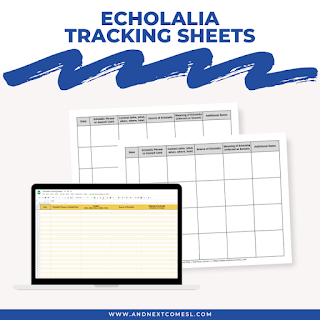
The best place to start tracking is to simply observe and start documenting. You can use something like these echolalia tracking sheets or a notebook. You could also try a note taking app, Google doc, or Google spreadsheet to make notes. These methods will allow you to track echolalia while on the go, which can be handy.

When documenting the scripts that a gestalt language learner uses, you'll want to take detailed notes. Try to include as much specific information as possible, such as or including the following:

  • The exact words or phrases that were spoken
  • Whether the script is something new or something they've said before
  • How many times the script was said
  • How it was said (e.g., consider intonation and speed, was it all clear?)
  • Date and time
  • Location or environment where echolalia occurred
  • What the child was doing (i.e., the activity or context)
  • Who else was present, if applicable
  • Who the script might have been directed to, if applicable
  • The child's sensory needs
  • Any accommodations or interventions that were being used
  • The child's emotional state (e.g., were they anxious, sad, angry, happy, playful, etc.?)
  • What the function of the script might have been (e.g., to regulate, to label, or to protest)
  • Any potential sources for the script (e.g., something someone said, a line from a book or movie, a recent event)
  • Any possible triggers (e.g., a change in routine)
  • Any alternative communication attempts (e.g., gestures, sign language, an AAC device)
  • How others responded to the script and how the child responded back (e.g., repeated the script back to the child and then the child made eye contact or smiled)
  • What stage of Natural Language Acquisition the script might fall into (you might want to consult with an experienced speech therapist for this)
  • Anything else that may be relevant

How to take detailed notes when tracking a child's echolalia and scripts

You might also want to consider recording, either audio or video, any play sessions (if you are a parent) or therapy sessions (if you are a therapist). That way you could transcribe or re-watch the sessions later. Who knows, you might pick up on more subtle cues or information that you might otherwise miss. It will also let you review the musicality, intonation, pitch, and speed of the echolalic phrases.

You might also find it helpful to collaborate with others. For instance, you might want to consult with a speech therapist, especially one familiar with gestalt language processing and Natural Language Acquisition.

Your notes can be helpful for therapists to determine what stage of language development a child is in and help the therapist better connect with the child during speech therapy sessions. And you might be able to help them determine the source of any scripts used in therapy that they might not be familiar with.

You might also want to chat with the child's teacher, classroom aide, daycare workers, other professionals, family members, or anyone else who might regularly interact with the child. They might be able to help determine where specific scripts come from, their possible functions, and their possible meanings.

It can also be helpful to keep in mind a child's interests and media consumption. Are there specific shows, songs, movies, or books that they watch or read quite frequently? Knowing this information can make it so much easier to identify the possible source for some of the scripts a child uses. So you might find it helpful to make a list of things they watch, read, or listen to on a regular basis.

Need an Easy Way to Track Echolalia & Scripted Phrases?

That's where these echolalia tracking sheets come in handy. There's even a digital spreadsheet version included if you'd prefer to be able to do it while on the go.

Grab your copy of the echolalia tracking sheets

A Quick Summary of Tracking Echolalia

Just to recap, here are the main echolalia tracking tips to keep in mind:

  • Observe & document
  • Take detailed notes
  • Use an echolalia tracking sheet, a notebook, an app, a Google Doc, a spreadsheet, or whatever works best for you
  • Consider recording sessions, either audio or visual
  • Collaborate with others
  • Consider the child's interests and media consumption

Basic tips for tracking a child's echolalia and scripts

I hope you found these tips for tracking echolalia and scripts helpful.

Tips for tracking echolalia and scripting in gestalt language processors, hyperlexic children, and autistic children

Continue reading "Tips for Tracking Echolalia & Scripts"

November 04, 2023

Why You Should Track Echolalia & Scripts

Reasons why you should track echolalia and the scripts a child uses.

Echolalia is meaningful communication. Full stop.

Historically, however, it wasn't always viewed this way. And, sadly, many still think that echolalia is meaningless.

Yet, for a lot of kids, like our gestalt language processors and hyperlexic learners, their language simply develops differently and echolalia is a big part of how they communicate.

The problem is that it's not always easy to determine what these kids might be trying to communicate with their echolalia.

That's why you should track echolalia and the scripts that a child uses. It gives you better insight into the child's language development and the echolalic phrases themselves. So let's take a closer look at some other reasons why tracking echolalia is so important.

Reasons why you should track echolalia and the scripts a child uses

Reasons Why You Should Track Echolalia & Scripts

As you'll see shortly, there are a wide range of reasons why you might find it helpful to track a child's echolalic speech and the scripts that they use on a daily basis. Sure it might seem like a lot of work at first, but doing so will provide you with plenty of useful information that will make it 100% worth it.

Remember, echolalia isn't meaningless. It communicates. It just requires some detective work. And tracking it can help make that detective work go a little bit easier.

Echolalia isn't meaningless - it communicates!

So here are some reasons you should consider tracking a child's echolalic phrases and scripted language:

  • To get a better understanding of the child's language development and which stage of Natural Language Acquisition (NLA) they're in
  • To know which scripts to model (i.e., you want to model something that makes sense for which stage they're in)
  • To determine what the child is trying to communicate, the function of the echolalia, and the meaning of a script
  • To ensure goals and therapy targets are appropriate (e.g., targeting WH- questions only when they get to stage 4+ of NLA)
  • To monitor progress (i.e., checking that the scripts you are modeling are a good fit and/or that the child is moving to the next stage)
  • To identify language patterns (e.g., the child says the same script every night before bed)
  • To better understand the child's communication style and profile (take pronoun reversals for instance)
  • To better collaborate with therapists, teachers, etc. who work with the child (i.e., you'll be able to provide them with more insight into what certain scripts might mean, what stage they might be in, etc.)
  • To gain insights into the child's emotional state (remember, a lot of scripts stick because they are emotionally charged!)
  • To understand which situations may be stressful or cause anxiety to the child (e.g., maybe you notice an increase in scripting when the child is feeling anxious)
  • To better understand behaviors
  • To better connect and communicate with the child
  • To better support the child

You can see there are lots of positives to tracking echolalia. Essentially, it leads to better understanding and better support for the child. And who doesn't want that?

Reasons why you should track echolalia and the scripts a child uses

Need an Easy Way to Track Those Echolalic Phrases?

Now that you know why you might want to track your child's echolalic phrases, you need an easy way to do so. That's where these echolalia tracking sheets come in handy (there's even a digital spreadsheet version included if you'd prefer to go paperless).

Grab your copy of the echolalia tracking sheets

A Recap of Reasons to Track a Child's Echolalic Speech

As you can see, tracking a child's language samples can provide you with so much insight and context, from which stage of development they're in to how they're progressing or even what their emotional state is. It's far from meaningless information, no?

Tracking a child's language samples can provide you with so much insight and context

You can use the knowledge you gain from tracking the child's scripts to develop better goals and model appropriate scripts. Again, pretty useful information.

You can use the knowledge you gain from tracking the child's scripts to develop better goals and model appropriate scripts

Seriously, there are so many wonderful reasons why you should track echolalia and scripted language. So now only one question remains...will you be giving it a try? If so, these tips for tracking echolalia might help.

Reasons why you should track echolalia and the scripts a child uses

Reasons why you should track echolalia and the scripts a child uses

Continue reading "Why You Should Track Echolalia & Scripts"

February 05, 2022

Echolalia in Hyperlexia: Terms You Should Know

What is echolalia? Below you'll learn all about echolalia, including the definition of echolalia, what immediate and delayed echolalia refer to, and its relation to hyperlexia.

Most children repeat and imitate phrases that they hear, especially in the first two years of life. So really some echolalia is a part of normal language development. 

However, some kids continue to use echolalia speech patterns beyond the toddler years. 

Many of these kids are autistic or hyperlexic and are gestalt processors. For them, echolalia plays a key role in their natural language development. They simply learn language a bit differently.

But what is echolalia exactly? 

And did you know that there are different types of echolalia? 

Well, we're going to break down all of these terms about echolalia below and discuss its relation to hyperlexia.

Echolalia in hyperlexia: terms you should know

So What is Echolalia?

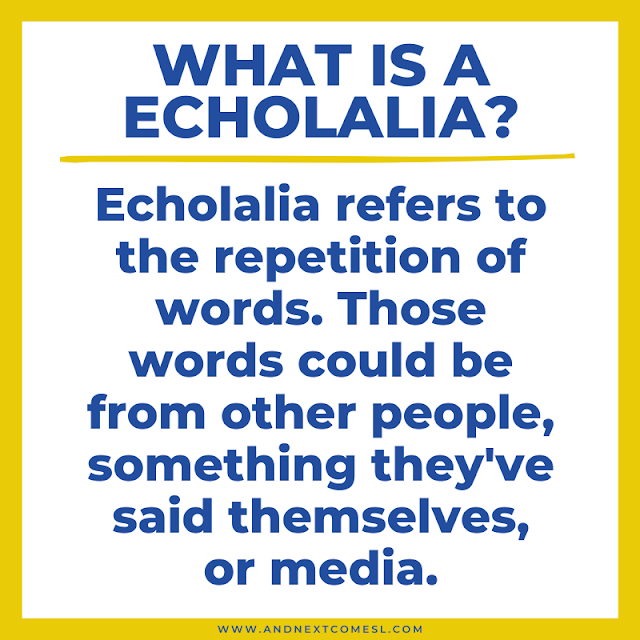
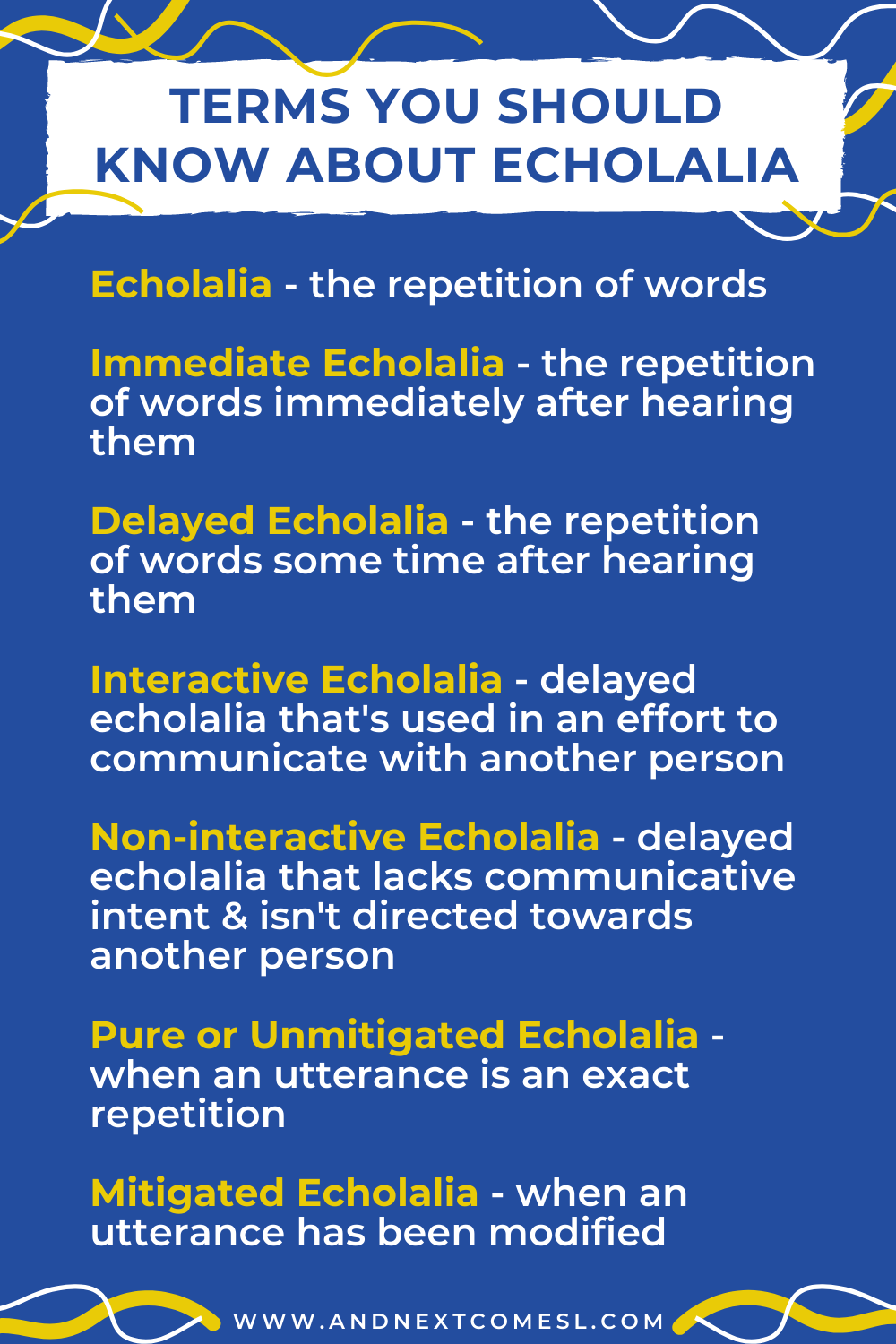
Echolalia refers to the repetition of words. 

Those words could be from other people, something they've said themselves, or media (books, TV shows, songs, etc.). They might be repeating a word, a phrase, a whole sentence, or something longer. 

Basically, echolalia describes when an individual repeats or imitates something that someone else has said.

In the past, it was thought that echolalia was meaningless and that it wasn't functional communication. So, unfortunately, you might come across outdated definitions that refer to echolalia as such. 

But please know that echolalia isn't meaningless. In fact, it's a good sign that communication is developing.

What is echolalia? A definition of echolalia

Types of Echolalia

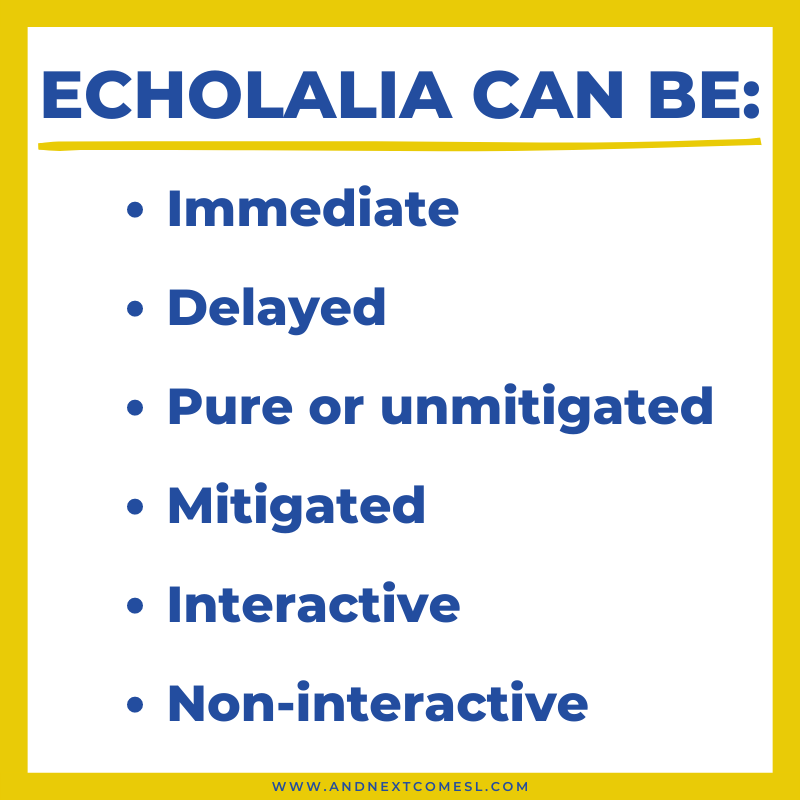
There are two types of echolalia to be aware of:

  • Immediate echolalia
  • Delayed echolalia

These types of echolalia can either be classified as:

  • Pure or unmitigated
  • Mitigated

Delayed echolalia can also be broken down further as:

  • Interactive
  • Non-interactive

So let's take a closer look at what these types and terms mean, as well as some examples of echolalia.

Types of echolalia

What is Immediate Echolalia?

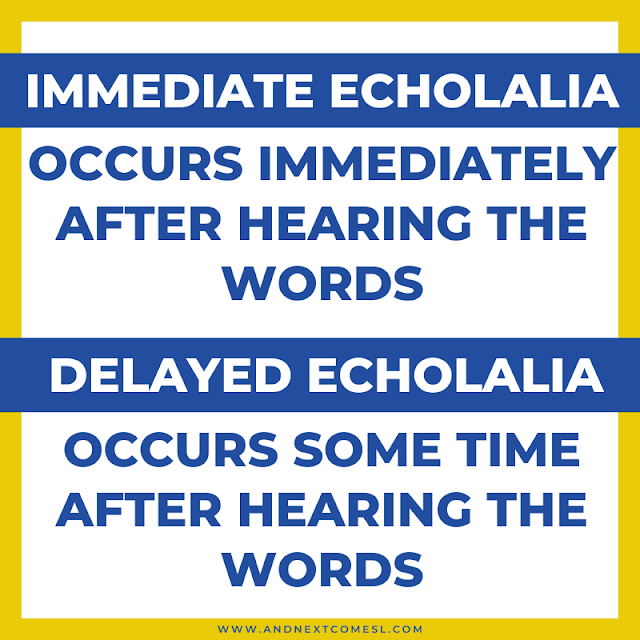
Immediate echolalia refers to the repetition of words or phrases immediately after hearing them or shortly after hearing them. 

For example, you might ask your child, "What do you want for a snack?" and they might reply by asking, "What do you want for a snack?"

What is Delayed Echolalia?

Delayed echolalia is when the repetition of words or phrases occurs some time after hearing them. Basically, there's a distance (sometimes hours, days, weeks, or months later) between hearing the phrase and using the words.

For example, your child might quote a line from a movie they watched a few weeks ago.

Immediate echolalia vs delayed echolalia

Interactive & Non-Interactive Delayed Echolalia

It's also important to note that delayed echolalia can also be classified as interactive echolalia or non-interactive echolalia. 

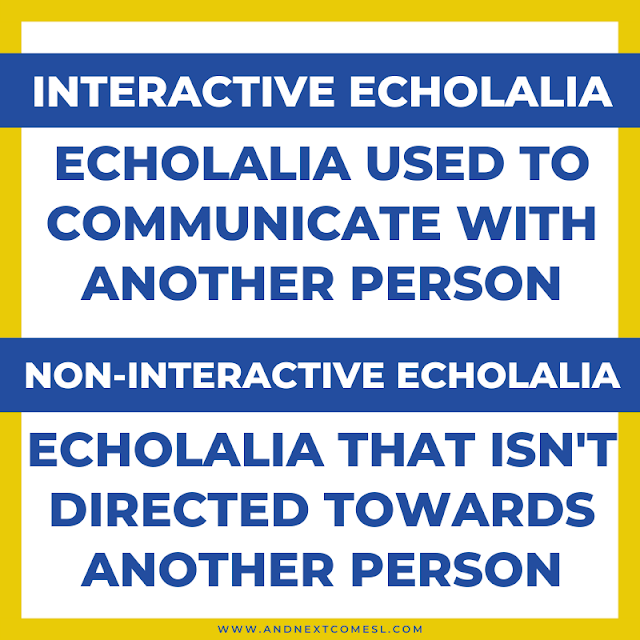
It's considered interactive if the echolalia is being used in an effort to communicate with another person. On the flip side, if it lacks communicative intent and isn't directed towards another person, it's considered non-interactive.

Interactive delayed echolalia vs non-interactive delayed echolalia

Pure vs Mitigated Echolalia

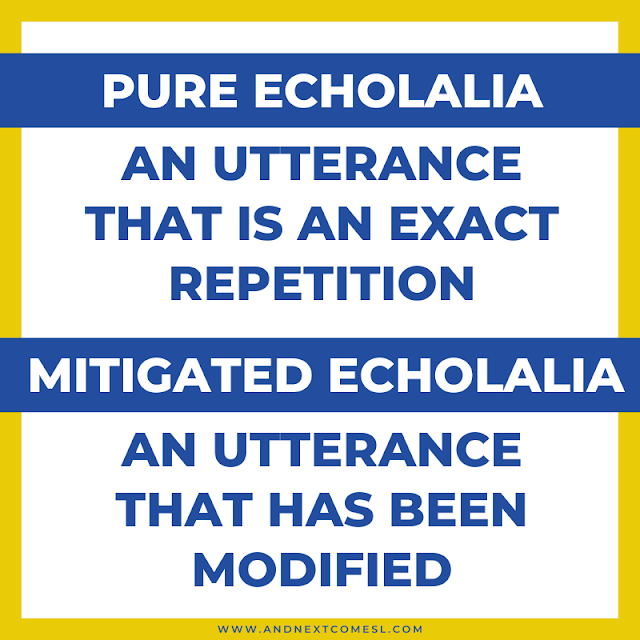
When an utterance or series of words are repeated exactly the same as they were heard (aka the phrase they utter is an exact repetition or verbatim), it is referred to as pure or unmitigated. For example, you say, "Want some milk?" and they repeat, "Want some milk?"

When some of the words are changed or modified, then we call that a mitigation. We would say that the utterance is mitigated. An example would be the phrase "Let's go outside!" turning into "Let's go home!"

Pure or unmitigated echolalia vs mitigated echolalia

Echolalia in Hyperlexia

You likely know that echolalia is common in hyperlexia. You've probably witnessed and experienced it yourself with your child. 

You likely also know that hyperlexic kids learn via gestalt processing.

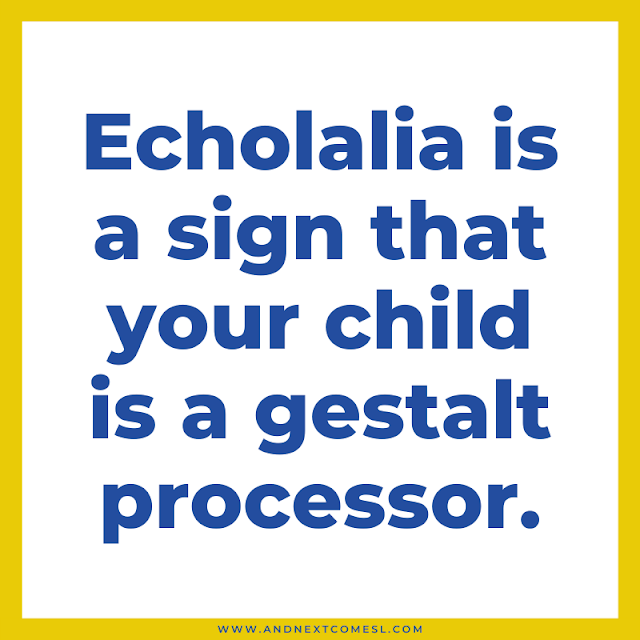
Well, that's not surprising given that echolalia is a sign of gestalt processing. After all, gestalt language learners learn language in chunks and guess what echolalia is? Chunks of language!

Echolalia is a sign of gestalt processing

Since our hyperlexic kids can read, their repeated phrases are more likely to come from books they've read. But they will also echo phrases from other sources like YouTube videos or TV shows. Sometimes in other languages too...

As I mentioned earlier, echolalia is a sign that your child's communication is developing. 

Echolalia is a sign that your child's communication is developing

When your child repeats a phrase, they're showing an intent to communicate. Sometimes what they're trying to communicate might not be immediately clear, but with a little investigation, you can often figure out the meaning behind their echoed utterance.

As Sussman says in the book More than Words, "The words your child learns from echolalia open the door to meaningful communication." 

Historically though, echolalia has been referred to as non-functional communication. Yet, echolalia absolutely is functional communication. A child might be using echolalia to calm themselves, practice talking, express emotions, request things, answer questions...really a number of things! And I think we can both agree that using repeated phrases to communicate those things is indeed functional.

For example, a hyperlexic child might recite the alphabet over and over to help them regulate. Or they might say a line from a Numberblocks episode to communicate that they are feeling happy because the Numberblock was happy when they said that particular phrase. Or your child might repeat your question back immediately after you asked it as a way to mean yes. Or they might say "Chicka Chicka Boom Boom" when something falls down.

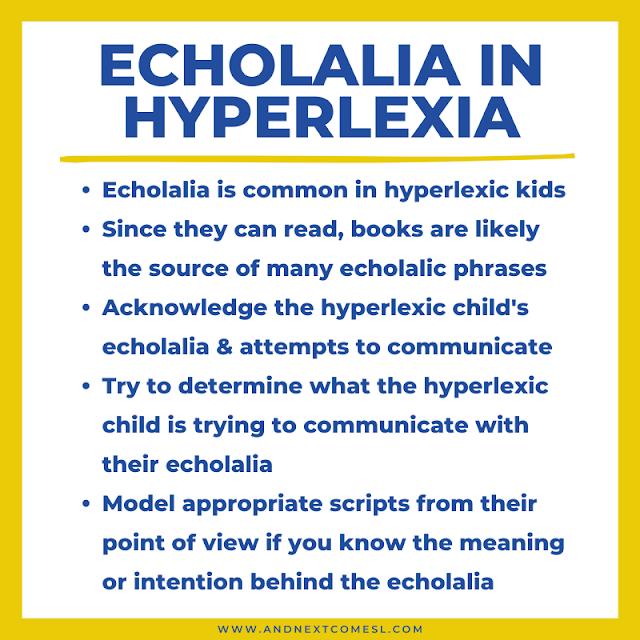
So when it comes to echolalia in hyperlexia, it is important to acknowledge their attempts to communicate, not ignore it. Try to respond to their echolalia in a way that makes sense. 

You also should try to dig deeper to see if you can determine what your hyperlexic child is communicating and then try to communicate back that you do indeed understand their intention. You can do this by modeling an appropriate script and giving them the words they need to communicate that. Just be sure to phrase your modeled script as if they were saying it themselves. For instance, say "I want juice" vs "Oh, you want juice."

Echolalia in hyperlexia

Want to Learn More About Echolalia and Natural Language Acquisition?

If you'd like to learn more about echolalia and how to help a hyperlexic child move from echolalia to novel, spontaneous language, I highly recommend checking out the Meaningful Speech courses and their Gestalt Language Processing Handbook. Learning about the stages of Natural Language Acquisition is a complete gamechanger! Use coupon code DYAN to save 5% on the handbook or courses.

Gestalt Language Processing Handbook & courses available from Meaningful Speech

Learn more about the Gestalt Language Processing Handbook & Courses

So Let's Recap...What is Echolalia & How Does it Relate to Hyperlexia

  • Echolalia refers to the repetition of words
  • It can be immediate (occurs immediately after hearing the words) or delayed (occurs some time after hearing the words)
  • Delayed echolalia can be broken down into interactive (the echolalia is used to communicate with another person) and non-interactive (the echolalia is used for personal use and isn't directed towards another person)
  • Echolalia can be pure/unmitigated (an exact repetition) or mitigated (a modified version of the phrase)
  • Echolalia is a good sign that communication is developing
  • It is not meaningless despite what other definitions might say (those definitions are outdated)
  • Echolalia is functional communication (again, despite what other definitions might say)
  • The presence of echolalia means that they are a gestalt learner
  • Echolalia is common in hyperlexic kids, which isn't surprising because hyperlexic kids are also gestalt learners
  • The echolalic phrases that hyperlexic kids use are more likely to be from books since they can read
  • You should acknowledge and respect your hyperlexic child's echolalia and attempts to communicate
  • You should dig deeper to try and figure out what the hyperlexic child is trying to communicate when they use echolalia
  • You should model appropriate scripts from the hyperlexic child's point of view if you've figured out the meaning or intention behind their echolalia

So, hopefully you found this information on echolalia in hyperlexia helpful!

Other Hyperlexia & Language Development Resources You'll Love

Gestalt Learning & Hyperlexia: What Does it Mean to be a Gestalt Learner?

40 Language Skills that Hyperlexic Kids Might Need Support With

Hyperlexia & Auditory Processing: 5 Strategies to Help

Echolalia in hyperlexia: A look at what echolalia is, the different types of echolalia, and its role in hyperlexia

Continue reading "Echolalia in Hyperlexia: Terms You Should Know"