Showing posts with label Gestalt Language Processing. Show all posts

October 01, 2025

Free Printable Mealtime Communication Boards for Gestalt Language Processors

Free printable mealtime and food communication boards for gestalt language processors and hyperlexic learners.

Mealtime can be a stressful experience for some kids, especially if they have food sensitivities to taste, texture, smell, etc.

Or, perhaps you have a hyperlexic child who doesn't ask for things like food or water due to their expressive language difficulties.

Well, you can use these mealtime communication boards as a way to help them communicate their needs and preferences when it comes to food and meals. They can echo the phrases they see by reading it and speaking it. Or they can also point to the picture or phrase.

Free printable mealtime & food communication boards for gestalt language processors & hyperlexic learners

About the Free Mealtime Communication Boards

This set of communication boards is designed with gestalt language processors and hyperlexic learners in mind and are great for kids, teens, and adults to use. Below you will find five versions included:

  • One with 16 colorful clipart images paired with a written phrase or potential gestalt
  • One with 13 colorful clipart images paired with a written phrase or potential gestalt and 3 blank boxes to write and draw your own
  • One with 16 blank boxes to write or draw your own
  • One with 16 written phrases or potential gestalts
  • One with 13 written phrases or potential gestalts and 3 blank boxes to write and drawn your own

Simply print off the page that will be the best fit for your needs, fill in any blank boxes (if applicable), and laminate for durability. Be sure to keep these tips in mind, though, when writing your own phrases or potential gestalts.

Once printed, customized, and laminated, display it somewhere in your kitchen (e.g., on the fridge, pantry door, or table), pack it in your child's lunchbox, attach it to a lanyard to take on the go (you might want to print it off at half the size in this case), add it to communication binder, etc.

The phrases can then be read and/or pointed to as a way to communicate one's needs. And parents or caregivers can point and model different phrases during mealtimes.

Download the Free Printable Mealtime & Food Communication Boards

This printable pack is five pages total and contains five communication boards to pick from. Feel free to pick the one that best suits your needs. Once printed, I highly recommend laminating for durability.

To get your copy of the mealtime communication boards, click the link below:

>> Click here to download the free printable


Free printable mealtime & food communication boards for gestalt language processors & hyperlexic learners

Continue reading "Free Printable Mealtime Communication Boards for Gestalt Language Processors"

October 15, 2024

Free Printable Trick or Treating Communication Boards for Gestalt Language Processors

Free printable Halloween trick or treating communication boards for gestalt language processors and hyperlexic learners.

Trick or treating can be an overwhelming experience for lots of kids, regardless of neurotype, sensory sensitivities, age, and abilities.

But visual aids and tools can be a great way to support kids who get overwhelmed during Halloween. Especially with our hyperlexic or autistic learners in particular who may be non-speaking, minimally speaking, and/or use augmentative and alternative communication (AAC).

And that's where these trick or treating communication boards come into play!

The following AAC boards feature a variety of potential Halloween themed gestalts that could be modeled while trick or treating and are an awesome way to give hyperlexic learners and gestalt language processors the language they need to express themselves and communicate their needs.

Free printable Halloween trick or treating communication boards for gestalt language processors & hyperlexic learners

About the Free Trick or Treating Communication Boards

As mentioned above, this set of communication boards is designed with gestalt language processors and hyperlexic learners in mind and are great for kids of all ages and abilities to use. Below you will find five versions included:

  • One with 16 colorful clipart images paired with a written phrase or potential gestalt
  • One with 13 colorful clipart images paired with a written phrase or potential gestalt and 3 blank boxes to write and draw your own
  • One with 16 blank boxes to write or draw your own
  • One with 16 written phrases or potential gestalts
  • One with 13 written phrases or potential gestalts and 3 blank boxes to write and draw your own

Simply print off the page that will be the best fit for your needs, fill in any blank boxes (if applicable), and laminate for durability. Be sure to keep these tips in mind, though, when writing your own phrases or potential gestalts.

Once printed, customized, and laminated, attach it to a lanyard to take on the go (you might want to print it off at half the size in this case) or simply carry it while you walk around.

The phrases can then be read and/or pointed to as a way to communicate while trick or treating. And parents and caregivers can point and model different phrases as they go from door to door with their child on Halloween.

Download the Free Printable Halloween Communication Boards

This printable pack is five pages total and contains five communication boards to pick from. Feel free to pick the one that best suits your needs. Once printed, I highly recommend laminating for durability.

To get your copy of the trick or treating communication boards, click the link below:

>> Click here to download the free printable


Free printable Halloween trick or treating communication boards for gestalt language processors & hyperlexic learners

Continue reading "Free Printable Trick or Treating Communication Boards for Gestalt Language Processors"

September 24, 2024

Free Printable Bedtime Communication Boards for Gestalt Language Processors

Free printable bedtime communication boards for gestalt language processors and hyperlexic learners.

Need help with bedtime routines and sleep?

Not sure which gestalts to model when it comes to bedtime?

Well, remember, hyperlexic learners thrive on routine, benefit from writing things down, and are gestalt language processors who use a lot of echolalia to communicate.

So, these bedtime communication boards are a great way to help hyperlexic learners and gestalt language processors get ready for sleep time, build a routine, and develop language skills, while also playing to their strengths in decoding/reading.

Let's take a closer look at these communication boards!

Free printable bedtime communication boards for gestalt language processors & hyperlexic learners

About the Free Bedtime Communication Boards

As mentioned above, this set of communication boards is designed with gestalt language processors and hyperlexic learners in mind. Below you will find five versions included:

  • One with 16 colorful clipart images paired with a written phrase or potential gestalt
  • One with 13 colorful clipart images paired with a written phrase or potential gestalt and 3 blank boxes to write and draw your own
  • One with 16 blank boxes to write or draw your own
  • One with 16 written phrases or potential gestalts
  • One with 13 written phrases or potential gestalts and 3 blank boxes to write and draw your own

Simply print off the page that will be the best fit for your needs, fill in any blank boxes (if applicable), and laminate for durability. Be sure to keep these tips in mind, though, when writing your own phrases or potential gestalts.

Once printed, customized, and laminated, display it somewhere in your child's bedroom. That way it's nice and handy for your child's bedtime routine.

The phrases can then be read and/or pointed to as a way to communicate. And parents or caregivers can point and model different phrases during the bedtime routine.

Download the Free Printable Bedtime Communication Boards

This printable pack is five pages total and contains five communication boards to pick from. Feel free to pick the one that best suits your needs. Once printed, I highly recommend laminating for durability.

To get your copy of the bedtime communication boards, click the link below:

>> Click here to download the free printable


Free printable bedtime communication boards for gestalt language processors & hyperlexic learners

Continue reading "Free Printable Bedtime Communication Boards for Gestalt Language Processors"

September 17, 2024

Free Printable It's Time to Go Communication Boards for Gestalt Language Processors

Free printable it's time to go communication boards for gestalt language processors and hyperlexic learners.

Hyperlexic learners thrive on routine and structure so transitions can often be challenging.

For instance, transitioning from one activity to another at school, leaving the house for errands, or leaving the playground can be quite stressful and overwhelming for them.

But, using visual supports, using augmentative and alternative communication (AAC), and writing things down can go a long way to support hyperlexic learners. Especially if you also factor in that they're gestalt language processors and use a lot of echolalia to communicate.

And that's where these it's time to go communication boards can come in handy. They are a great way to support hyperlexic learners with transitions while also giving them the language they need to communicate their needs.

Free printable it's time to go communication boards for gestalt language processors & hyperlexic learners

About the Free It's Time to Go Communication Boards

As mentioned above, this set of communication boards is designed with gestalt language processors and hyperlexic learners in mind and are great for kids, teens, and adults to use. Below you will find five versions included:

  • One with 16 colorful clipart images paired with a written phrase or potential gestalt
  • One with 13 colorful clipart images paired with a written phrase or potential gestalt and 3 blank boxes to write and draw your own
  • One with 16 blank boxes to write or draw your own
  • One with 16 written phrases or potential gestalts
  • One with 13 written phrases or potential gestalts and 3 blank boxes to write and draw your own

Simply print off the page that will be the best fit for your needs, fill in any blank boxes (if applicable), and laminate for durability. Be sure to keep these tips in mind, though, when writing your own phrases or potential gestalts.

Once printed, customized, and laminated, tape it to a door at home or in the classroom, attach it to a lanyard to take on the go (you might want to print it off at half the size in this case), add it to a communication binder, etc.

The phrases can then be read and/or pointed to as a way to communicate one's needs. And parents or caregivers can point and model different phrases as they get ready to leave.

Download the Free Printable It's Time to Go Communication Boards

This printable pack is five pages total and contains five communication boards to pick from. Feel free to pick the one that best suits your needs. Once printed, I highly recommend laminating for durability.

To get your copy of the it's time to go communication boards, click the link below:

>> Click here to download the free printable


Free printable it's time to go communication boards for gestalt language processors & hyperlexic learners

Continue reading "Free Printable It's Time to Go Communication Boards for Gestalt Language Processors"

August 02, 2024

Tips for Picking Potential Gestalts for Gestalt Language Processors

Tips for picking potential gestalts for gestalt language processors, such as hyperlexic or autistic learners, who are in NLA stage 1.

When it comes to picking potential gestalts to model to your gestalt language processors, there are a few things to keep in mind that will greatly increase your success.

Using these basic structures are a great starting point, but it might still be a bit overwhelming to know where to go from there. Especially if you're new to the whole concept of gestalt language processing and are just getting started with modeling language in this new way.

Perhaps you need a bit more guidance. Well, that's where these tips for picking potential gestalts come into play.

Below you will find some suggestions of things to keep in mind when you start to model gestalts to a gestalt language processor. And, don't forget that when you have a hyperlexic learner, in particular, you want to write potential gestalts down for them. Consider that your bonus tip.

Tips for picking potential gestalts for gestalt language processors in NLA stage 1

Tips for Picking Potential Gestalts

Here are some things you should consider when thinking about potential gestalts in stage 1:

1. Gestalts should sound natural. That means they should make sense for the situation and even be age appropriate and kid-friendly (see tip #7 for more on that). For example, you wouldn't model something like, "Shall we commence our drawing activity?" when "Let's draw!" or "Wanna draw?" is much more natural sounding. Besides, children are more likely to use language that feels natural and comfortable to them.

2. Gestalts should be meaningful and relevant to the gestalt language processor. If they're not meaningful or relevant, then they likely won't stick.

3. Gestalts should be tailored to the gestalt language processor's interests and what gestalts they already have. Not only does this increase engagement and aid in retention, but it makes the gestalts more meaningful to them.

Not sure what gestalts your child already has? Consider tracking their echolalia.

4. Gestalts should be modeled from the child's perspective (e.g., I), a joint perspective (e.g., we or let's), and/or a neutral perspective (e.g., it's or that's). These perspectives help kids learn to advocate for themselves, communicate feelings, promote social interaction, narrate and comment, describe the world around them, and so much more.

Try modeling gestalts from the child's perspective, a joint perspective, or a neutral perspective

5. Gestalts should avoid using "you" and your" to avoid pronoun reversals and confusion. Remember, gestalt language processors will echo back things exactly as they hear them.

6. Gestalts should consider and cover a wide range of communicative functions, such as protesting, commenting, asking for help, and so on. Doing so will give the child a wide range of ways to communicate and make it easier for them to communicate effectively.

7. Gestalts should be age appropriate and use kid-friendly language. It's okay to say things like "wanna" or "hafta" or "gotta" because that's how kids their age would typically talk. Also, it is worth noting that age appropriate language often tends to be simpler and easier to understand.

8. Gestalts should be easy to mix and match or trim down in later stages of Natural Language Acquisition. The goal is to try and build a flexible foundation that will grow with your child.

The goal is to try and build a flexible foundation that will grow with your child

9. While gestalts can take the form of questions, it's important to note that they shouldn't be used for eliciting answers until later stages of Natural Language Acquisition. For example, question gestalts such as "What's next?" or "What's that?" are pretty useful and versatile. On the other hand, something like "What sound does a cat make?" isn't particularly useful as a gestalt and can be stressful for some kids because it involves a demand. We want to use questions without expecting answers.

10. Questions and answers can be modeled as a unit. For example, "Where is it? There it is!" can be a great one to model because it's helpful for a wide variety of situations.

Tips for picking potential gestalts for gestalt language processors in NLA stage 1

Tips for picking potential gestalts for gestalt language processors in NLA stage 1

Need More Help with Picking Potential Gestalts? Grab this Bundle!

Tips like the ones above are nice and all, but sometimes it's helpful to have more concrete examples of potential gestalts to model, right? Well, that's where this bundle of example gestalts for NLA stage 1 comes in handy!

You'll find tons of potential gestalts to model for a wide variety of settings and activities, from potty training to bedtime and everything in between. Plus, you will find a copy of the above tips in the bundle as well.

Potential gestalts for NLA stage 1 bundle

Grab your copy of the potential gestalts bundle

Need More Help with Modeling Gestalts? Grab this Ebook!

Feel like you need a bit more guidance when it comes to modeling gestalts? Then the Gestalt on the Go Handbook is for you!

Or, if you're a teacher, then check out Intro to Gestalt Language Processing for Teachers.

Inside both of these handbooks, you'll get 10 quick tips for supporting your gestalt language processor at home (or in the classroom). You can use coupon code DYAN to get 10% off.

Gestalt on the Go Handbook for Parents

Grab your copy of the Gestalt on the Go Handbook

Intro to GLP for Teachers Handbook

Grab your copy of the Intro to GLP for Teachers Handbook 

Hopefully, these tips for picking potential gestalts will help make it easier to start supporting your gestalt language processors at home, at school, or in therapy.

Tips for picking potential gestalts for gestalt language processors in NLA stage 1

Continue reading "Tips for Picking Potential Gestalts for Gestalt Language Processors"

April 11, 2024

Basic Structures for Potential Gestalts {Free Printable List!}

Grab this free printable list of basic structures for potential gestalts to model for gestalt language processors in stage one of Natural Language Acquisition.

When you first learn about gestalt language processing and learn that your child is a gestalt language processor, it can be quite the lightbulb moment.

After all, you know that your child uses a lot of echolalia to communicate and learns language differently. And a different way of learning language requires a different approach to building language skills.

So, for our gestalt language processors (i.e., our hyperlexic/autistic learners), that means picking and modeling gestalts that will be helpful for them as they progress through the stages of Natural Language Acquisition (NLA).

There are a few tips to keep in mind (e.g., tailoring them to the individual child) when it comes to deciding and picking gestalts for your gestalt language processor in the early stages of Natural Language Acquisition. There are also some things that you want to avoid (e.g., "you" and "your" pronouns). So it can be helpful to have some little formulas to get you started.

That's where this list of basic structures for potential gestalts comes in. They're great for kids in stage one (and even stage two).

However, it is worth noting that gestalts don't always have to follow these structures. After all, you can have gestalts that don't use any of these structures, such as "All done!" or "Open it!" or "Not that one!"

So it's best to think of the basic structures below as a starting point.

Free printable list of basic structures for potential gestalts to model for gestalt language processors in NLA stage 1

Basic Structures for Potential Gestalts for Stage 1

When it comes to picking a potential gestalt to model to a child, try these sentence starters:

  • I... (e.g., I did it)
  • I'm... (e.g, I'm hungry)
  • Let's... (e.g., Let's have a snack)
  • We... (e.g., We need toothpaste)
  • We're... (e.g., We're almost there!)
  • It's... (e.g., It's raining, it's pouring...)
  • That's... (e.g., That's amazing!)
  • There's... (e.g., There's so many!)
  • How about...? (e.g., How about another show?)
  • Where's...? (e.g., Where's letter Q?)
  • What...? (e.g., What now?)
  • What's...? (e.g., What's next?)
  • Wanna... (e.g., Wanna go again?)
  • Don't... (e.g., Don't touch that!)

Basic structures for potential gestalts for gestalt language processors in NLA stage 1

The reason that these structures work so well is that they're versatile and can serve different communicative functions (e.g., protesting, commenting, asking for help). These structures or formulas are also easy to mix and match in later stages. Plus, they reduce the likelihood of pronoun reversals by avoiding those tricky "you" and "your" pronouns.

Why these basic structures for stage one gestalts work well

Now that you know some basic formulas for gestalt language processors in stage one, let's look at that printable list.

Download the Free Printable

This printable is one page and includes all of the basic structures for picking and modeling potential gestalts that are listed above. It's great to print off as is and share with clients, family members, or anyone else who is new to gestalt language processing and wants to best support your gestalt language processor.

To get your copy of this printable list, click the link below:

>> Click here to download the free printable


Free printable list of basic structures for potential gestalts to model for gestalt language processors in NLA stage 1

Need More Help with Picking Potential Gestalts? Grab this Bundle!

Knowing the basic structures is one thing, but it's nice to have more concrete examples of potential gestalts to model, right? Well, that's where this bundle of example gestalts for NLA stage 1 comes in handy! You'll find tons of potential gestalts to model for a wide variety of settings and activities, from potty training to bedtime and everything in between.

Potential gestalts for NLA stage 1 bundle

Grab your copy of the potential gestalts bundle

Hopefully, you found this free printable list of basic structures for potential gestalts helpful!

Free printable list of basic structures for potential gestalts to model for gestalt language processors in NLA stage 1

Continue reading "Basic Structures for Potential Gestalts {Free Printable List!}"

November 06, 2023

Tips for Tracking Echolalia & Scripts

Interested in tracking a child's echolalic phrases and scripts? Here are some useful tips for tracking echolalia.

If you have a gestalt language processor or hyperlexic child, then you know that echolalia is an important part of their language development.

You might also know that you can't always take echolalia literally. Sometimes, you have to do some detective work to find out the underlying meaning and communicative functions.

That's why it's so important to track echolalia and the scripts a child uses in the first place. It can provide you with so much valuable information.

But how to do you go about tracking echolalia or language gestalts? What kind of information should you include when making notes? How should you organize the information? It might seem a bit overwhelming to get started.

Well, that's where these tips for tracking echolalia come in. They should help you get started with documenting a child's language skills.

Tips for tracking echolalia and scripting in gestalt language processors, hyperlexic children, and autistic children

Tips for Tracking Echolalia & Scripts

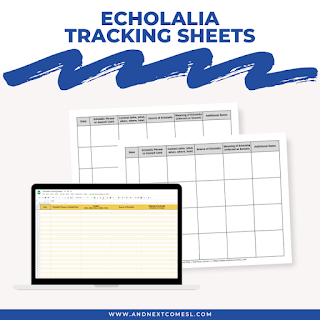
The best place to start tracking is to simply observe and start documenting. You can use something like these echolalia tracking sheets or a notebook. You could also try a note taking app, Google doc, or Google spreadsheet to make notes. These methods will allow you to track echolalia while on the go, which can be handy.

When documenting the scripts that a gestalt language learner uses, you'll want to take detailed notes. Try to include as much specific information as possible, such as or including the following:

  • The exact words or phrases that were spoken
  • Whether the script is something new or something they've said before
  • How many times the script was said
  • How it was said (e.g., consider intonation and speed, was it all clear?)
  • Date and time
  • Location or environment where echolalia occurred
  • What the child was doing (i.e., the activity or context)
  • Who else was present, if applicable
  • Who the script might have been directed to, if applicable
  • The child's sensory needs
  • Any accommodations or interventions that were being used
  • The child's emotional state (e.g., were they anxious, sad, angry, happy, playful, etc.?)
  • What the function of the script might have been (e.g., to regulate, to label, or to protest)
  • Any potential sources for the script (e.g., something someone said, a line from a book or movie, a recent event)
  • Any possible triggers (e.g., a change in routine)
  • Any alternative communication attempts (e.g., gestures, sign language, an AAC device)
  • How others responded to the script and how the child responded back (e.g., repeated the script back to the child and then the child made eye contact or smiled)
  • What stage of Natural Language Acquisition the script might fall into (you might want to consult with an experienced speech therapist for this)
  • Anything else that may be relevant

How to take detailed notes when tracking a child's echolalia and scripts

You might also want to consider recording, either audio or video, any play sessions (if you are a parent) or therapy sessions (if you are a therapist). That way you could transcribe or re-watch the sessions later. Who knows, you might pick up on more subtle cues or information that you might otherwise miss. It will also let you review the musicality, intonation, pitch, and speed of the echolalic phrases.

You might also find it helpful to collaborate with others. For instance, you might want to consult with a speech therapist, especially one familiar with gestalt language processing and Natural Language Acquisition.

Your notes can be helpful for therapists to determine what stage of language development a child is in and help the therapist better connect with the child during speech therapy sessions. And you might be able to help them determine the source of any scripts used in therapy that they might not be familiar with.

You might also want to chat with the child's teacher, classroom aide, daycare workers, other professionals, family members, or anyone else who might regularly interact with the child. They might be able to help determine where specific scripts come from, their possible functions, and their possible meanings.

It can also be helpful to keep in mind a child's interests and media consumption. Are there specific shows, songs, movies, or books that they watch or read quite frequently? Knowing this information can make it so much easier to identify the possible source for some of the scripts a child uses. So you might find it helpful to make a list of things they watch, read, or listen to on a regular basis.

Need an Easy Way to Track Echolalia & Scripted Phrases?

That's where these echolalia tracking sheets come in handy. There's even a digital spreadsheet version included if you'd prefer to be able to do it while on the go.

Grab your copy of the echolalia tracking sheets

A Quick Summary of Tracking Echolalia

Just to recap, here are the main echolalia tracking tips to keep in mind:

  • Observe & document
  • Take detailed notes
  • Use an echolalia tracking sheet, a notebook, an app, a Google Doc, a spreadsheet, or whatever works best for you
  • Consider recording sessions, either audio or visual
  • Collaborate with others
  • Consider the child's interests and media consumption

Basic tips for tracking a child's echolalia and scripts

I hope you found these tips for tracking echolalia and scripts helpful.

Tips for tracking echolalia and scripting in gestalt language processors, hyperlexic children, and autistic children

Continue reading "Tips for Tracking Echolalia & Scripts"

November 04, 2023

Why You Should Track Echolalia & Scripts

Reasons why you should track echolalia and the scripts a child uses.

Echolalia is meaningful communication. Full stop.

Historically, however, it wasn't always viewed this way. And, sadly, many still think that echolalia is meaningless.

Yet, for a lot of kids, like our gestalt language processors and hyperlexic learners, their language simply develops differently and echolalia is a big part of how they communicate.

The problem is that it's not always easy to determine what these kids might be trying to communicate with their echolalia.

That's why you should track echolalia and the scripts that a child uses. It gives you better insight into the child's language development and the echolalic phrases themselves. So let's take a closer look at some other reasons why tracking echolalia is so important.

Reasons why you should track echolalia and the scripts a child uses

Reasons Why You Should Track Echolalia & Scripts

As you'll see shortly, there are a wide range of reasons why you might find it helpful to track a child's echolalic speech and the scripts that they use on a daily basis. Sure it might seem like a lot of work at first, but doing so will provide you with plenty of useful information that will make it 100% worth it.

Remember, echolalia isn't meaningless. It communicates. It just requires some detective work. And tracking it can help make that detective work go a little bit easier.

Echolalia isn't meaningless - it communicates!

So here are some reasons you should consider tracking a child's echolalic phrases and scripted language:

  • To get a better understanding of the child's language development and which stage of Natural Language Acquisition (NLA) they're in
  • To know which scripts to model (i.e., you want to model something that makes sense for which stage they're in)
  • To determine what the child is trying to communicate, the function of the echolalia, and the meaning of a script
  • To ensure goals and therapy targets are appropriate (e.g., targeting WH- questions only when they get to stage 4+ of NLA)
  • To monitor progress (i.e., checking that the scripts you are modeling are a good fit and/or that the child is moving to the next stage)
  • To identify language patterns (e.g., the child says the same script every night before bed)
  • To better understand the child's communication style and profile (take pronoun reversals for instance)
  • To better collaborate with therapists, teachers, etc. who work with the child (i.e., you'll be able to provide them with more insight into what certain scripts might mean, what stage they might be in, etc.)
  • To gain insights into the child's emotional state (remember, a lot of scripts stick because they are emotionally charged!)
  • To understand which situations may be stressful or cause anxiety to the child (e.g., maybe you notice an increase in scripting when the child is feeling anxious)
  • To better understand behaviors
  • To better connect and communicate with the child
  • To better support the child

You can see there are lots of positives to tracking echolalia. Essentially, it leads to better understanding and better support for the child. And who doesn't want that?

Reasons why you should track echolalia and the scripts a child uses

Need an Easy Way to Track Those Echolalic Phrases?

Now that you know why you might want to track your child's echolalic phrases, you need an easy way to do so. That's where these echolalia tracking sheets come in handy (there's even a digital spreadsheet version included if you'd prefer to go paperless).

Grab your copy of the echolalia tracking sheets

A Recap of Reasons to Track a Child's Echolalic Speech

As you can see, tracking a child's language samples can provide you with so much insight and context, from which stage of development they're in to how they're progressing or even what their emotional state is. It's far from meaningless information, no?

Tracking a child's language samples can provide you with so much insight and context

You can use the knowledge you gain from tracking the child's scripts to develop better goals and model appropriate scripts. Again, pretty useful information.

You can use the knowledge you gain from tracking the child's scripts to develop better goals and model appropriate scripts

Seriously, there are so many wonderful reasons why you should track echolalia and scripted language. So now only one question remains...will you be giving it a try? If so, these tips for tracking echolalia might help.

Reasons why you should track echolalia and the scripts a child uses

Reasons why you should track echolalia and the scripts a child uses

Continue reading "Why You Should Track Echolalia & Scripts"

May 18, 2023

Why Speech Therapy Might Not be Working for Your Hyperlexic Child

Why speech therapy might not be working for your hyperlexic child.

Does it seem like your hyperlexic child isn't making progress as expected in speech therapy?

Maybe you've tried so many approaches and different therapists over the years, but nothing's working.

Perhaps your child has been attending therapy for years and it seems like your child is still stuck where they were when you first started. 

It might even feel like you're just wasting money at this point.

But there's a simple explanation for why things might not be progressing as expected.

And it all has to do with the fact that most hyperlexic kids are gestalt language processors.
Why speech therapy might not be working for your hyperlexic child

This post is an expanded version of this collaborative Instagram post that I did with @bohospeechie. It's an important topic that deserved a permanent place on the blog as well.

Why Speech Therapy Might Not Be Working for Your Hyperlexic Child

More often than not, the therapy that a hyperlexic child is receiving doesn't match how they learn and process language.

Speech therapy might not be working for your hyperlexic child because the therapy that they're receiving doesn't match how they learn and process language

Remember, most (if not all) hyperlexic kids are gestalt language processors so they learn language in chunks.

Therefore, their therapy should focus on helping them break down those chunks (called gestalts) into smaller chunks and then eventually into single words. It's only at this point that they can they start to generate spontaneous language and use beginning grammar. This process is called Natural Language Acquisition.

The problem is though that hyperlexic kids often aren't receiving therapy that's tailored to their gestalt language learning. 

Instead, they're frequently being treated as if they are an analytic language processor (they learn language in single words versus chunks).

Hyperlexic learners are often being treated as if they are analytic language processors instead of receiving therapy that's tailored to their gestalt learning style

When hyperlexic kids are treated as if they are an analytic language processor, important steps in the Natural Language Acquisition process end up being skipped. 

As a result, a lot of the goals a therapist might set are inappropriate because they don't match the stage that the hyperlexic learner is actually in. 

That means the therapist might set a goal that can only be achievable once the child is able to generate spontaneous language. However, the problem is that they've skipped the earlier stages of helping hyperlexic learners break down chunks into smaller chunks and single words and the child isn't yet ready to generate spontaneous language. 

So, essentially the goals being set are for later stages in their language acquisition process even though the child is still in the first or second stage. In other words, they're not meeting the child where they actually are.

But why is this happening? Why aren't hyperlexic kids receiving the right approach to therapy?

Why Aren't Speech Therapists Using the Right Approach for Hyperlexic Kids Then?

Well, part of the problem is that a lot of speech therapists are still unfamiliar with gestalt language processing and the Natural Language Acquisition process. Unfortunately, it's not something they learned about during their education.

Many speech therapists aren't yet aware of gestalt language development and Natural Language Acquisition

In other words, your child's speech therapist might not be aware of this type of language development. They're instead only familiar with how to treat analytic language processors, not gestalt language processors.

They've likely even been taught that echolalia is meaningless (it's not!) and should be ignored or discouraged (it shouldn't!). 

So what now?

What Can You Do When Your Hyperlexic Child Isn't Making Progress as Expected?

Most importantly, parents and therapists need to recognize that echolalia is indeed meaningful communication and that communicating with echolalia is a sign that a child is learning language differently (i.e., they're a gestalt language processor).

Echolalia is meaningful communication and a sign that a child is learning language differently

You can't just use the methods you'd normally use for analytic language processors with these types of learners. They're not going to be effective.

Instead, hyperlexic kids need a different approach to therapy because they learn language differently.

Hyperlexic kids need a different approach to therapy because they learn language differently

Not only should the therapeutic approach consider how gestalt language processors develop language, but it should also incorporate the interests and strengths of the hyperlexic learner

More specifically, the fact that hyperlexic kids can read should be leveraged during therapy. That means writing things down to support spoken language models. And that's not always happening.

With these points in mind, parents should look for a therapist who is familiar with gestalt language processing, Natural Language Acquisition, and hyperlexia. Parents themselves should also make sure they understand these three topics as well. It makes it easier to advocate and know what to look for when they do. 

Now, if parents can't find a therapist familiar with gestalt language processing, then they can always talk to the therapist they currently do have and see if they would be interested in learning more about gestalt language processing. Perhaps both the parents and the therapist could take the Meaningful Speech course together, for instance (be sure to use coupon code DYAN to save 5%), as a way to learn more about it.

Parents should also request that the therapist set goals that are appropriate for their hyperlexic child and their stage of language development. If the parent notices inappropriate goals, then they should speak up and advocate accordingly.

Finally, parents should make sure that the therapist is incorporating the hyperlexic child's interests into therapy. Those interests shouldn't be withheld, discouraged, and/or used as rewards (learn more here). Instead, the therapist should look for ways to include those letters or numbers into therapy (tips here).

A Quick Recap of The Hyperlexic Child & a Lack of Progress in Speech Therapy

I know it can be frustrating to see your hyperlexic child not making progress as expected, but, when you find the right therapist and approach, it really makes a big difference. Here's a recap of what was discussed above:

  • A hyperlexic child might not be making progress in speech therapy as expected because there's a mismatch between how they learn language and the therapy approached being used.
  • Hyperlexic kids are gestalt language processors, but they often receive therapy that's geared towards analytic language processors, not gestalt processors.
  • More often than not, this is happening because many speech therapists are still unfamiliar with gestalt language processing and even hyperlexia, for that matter.
  • Parents and therapists need to recognize that echolalia is indeed meaningful communication and that a different way of learning language requires a different approach to therapy.
  • Finding a speech therapist familiar with hyperlexia and gestalt language processing can be a challenge. But, if parents can't find a therapist familiar with these areas, they can always collaborate with their current speech therapist and learn about these topics together. Work as a team!
  • Speech therapy for hyperlexic kids should focus on the Natural Language Acquisition process, leverage the child's strengths (especially their ability to read), incorporate their interests, and be tailored to how gestalt language processors learn language.

The right therapist and the right approach really makes a difference. And they can be the two biggest factors behind why speech therapy might not be working for your hyperlexic child.

The right therapist and the right approach really makes a difference for hyperlexic learners

Want to Learn More About Gestalt Language Processing?

If you'd like to learn more about gestalt language processing and Natural Language Acquisition, I highly recommend checking out the Meaningful Speech courses and their Gestalt Language Processing Handbook. Use coupon code DYAN to save 5% on the handbook or courses.
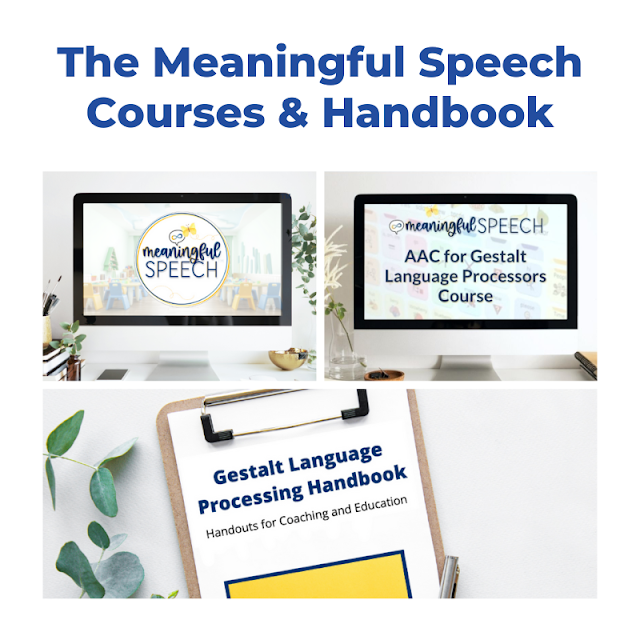
Gestalt Language Processing Handbook & courses available from Meaningful Speech

Learn more about the Gestalt Language Processing Handbook & Courses

Why speech therapy might not be working for your hyperlexic child

Continue reading "Why Speech Therapy Might Not be Working for Your Hyperlexic Child"