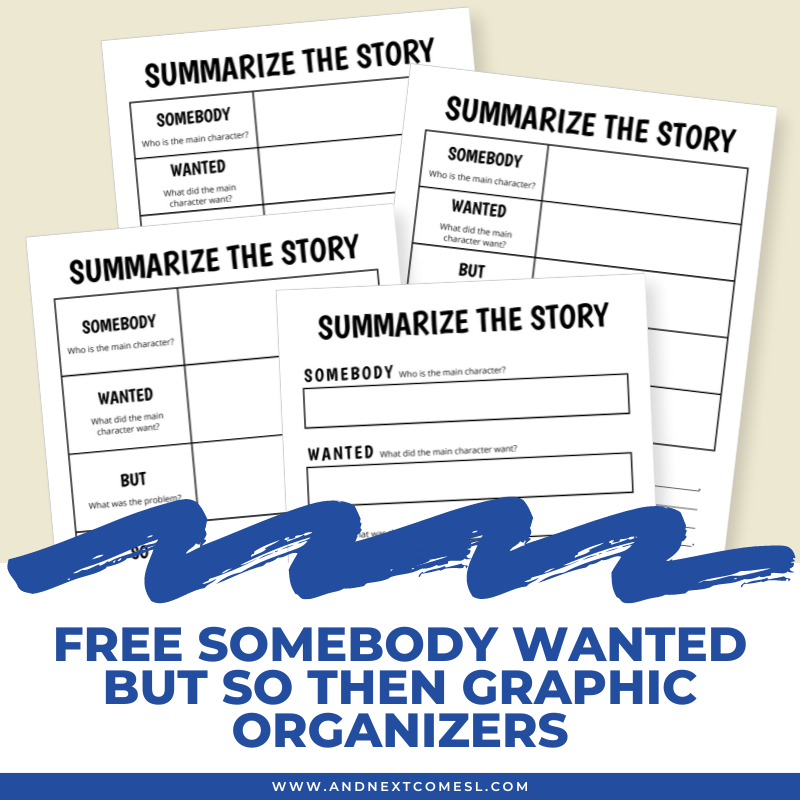
When it comes to supporting hyperlexic learners with comprehension, graphic organizers are an incredibly valuable tool because they play to their hyperlexic strengths. They also help break down and simplify tasks, as well as organize information.
The following graphic organizers are based on the Scaffolding Interrogatives Method (SIM), which, in recent research, has been shown to be an effective framework for supporting comprehension with hyperlexic readers. This method relies on using a chart or matrix to keep track of information while also translating WH questions into what statements (e.g., who = what person).
To help parents, teachers, and therapists quickly start using this method, I've put together some free printable SIM matrix graphic organizers. These templates will have you supporting your hyperlexic child's comprehension with a research-backed strategy in no time!

About the SIM Matrix Graphic Organizers
While you can certainly draw your own matrix when using the Scaffolding Interrogatives Method, sometimes having a printable template ready to go can be really useful, which is where these graphic organizers come in.
I've included a few variations of the matrix in this printable pack.
Two versions only allow up to five sentences, making them perfect for really short texts and introducing your child to the strategy.
The other two versions can be used for texts that are up to 10 sentences in length. Of course, you can always print additional pages based on your needs.
Additionally, two versions have five columns and cover four types of WH questions (who, what, where, and when), while the other two versions have 6 columns and cover five types of WH questions (who, what, where, when, and why). So feel free to pick the matrix that best fits your needs and the text you're working with.
How to Use these Graphic Organizers to Build Comprehension Skills
These graphic organizers can be used for any text or passage read at home or in the classroom. It works best with texts that are shorter in length (i.e., less than 10 sentences). Although you can certainly move to longer texts as your child gets more comfortable using the SIM strategy and the attached graphic organizers below.
Once you've chosen a text to examine, you will need to determine which version of the graphic organizer works best for your needs and the text that you're working with (e.g., if it has more than 5 sentences, use the one that goes up to 10 sentences).
Next, you'll need to number each sentence of the text or passage you will be reading.
Then you can start reading the text sentence by sentence while searching for: what person, what happened, what place, what time, and, if using one of the more complex matrices, what reason.
After reading the first sentence, you will fill in the corresponding columns of the matrix. If the sentence does not contain a specific detail, such as what time or place, then put an X in that spot. After all, not every sentence in a text will answer every question. Then repeat the process for the second sentence, then the third, and so on.
Once you've read the entire text, it's time to ask questions about the text to check for comprehension and understanding. The child can use the matrix to find the correct answers to the questions. You can see an example of what that would look like here.
Download the Free SIM Matrix Graphic Organizers