Showing posts with label Reading Comprehension. Show all posts

March 14, 2024

Helpful Reading Comprehension Videos for Kids

Short reading comprehension videos that help kids learn different reading comprehension strategies and skills.

Comprehension is an area that most hyperlexic kids need extra support with. And it's important to build these skills early as they will lead to greater success as they grow and the texts become more complex.

Now, since these kids are such strong visual learners, using videos is a great way to build skills in this particular area. Besides, videos are way more fun than just listening to a teacher explain or model different strategies.

That's why I compiled this list of reading comprehension videos. They're great for hyperlexic kids, English language learners, and really all kids who might need some help with their comprehension.

The following videos will help you teach your child different reading comprehension strategies and skills. They teach things such as keywords (or signal words) to watch out for. They also provide definitions of important concepts. They even go over things like WH question words, idioms, and metaphors that often confuse autistic and hyperlexic kids.

It's important to note that these educational videos focus on explaining different strategies explicitly or through song, both of which are helpful strategies when it comes to teaching hyperlexic kids.

Also, most of these videos already have built-in captions or subtitles. However, some do not. So remember to turn on closed captioning for any videos that don't have built-in captions as it aids in comprehension for hyperlexic kids. You can read more about the benefits of closed captioning for hyperlexic kids here.

And finally, I focused on picking videos that are short in length. After all, young children generally have short attention spans, especially when it comes to topics like reading comprehension that can often be dry and boring to teach. So all of these videos are under 5 minutes in length.

Reading comprehension strategies videos for kids with hyperlexia & autism

Build Comprehension Skills with these Helpful Reading Comprehension Videos

It's important to remember that comprehension isn't just one thing. It's made up of lots of little moving parts and different skills, which is why these videos cover a variety of important skills to work on and teach.

It's important to remember that comprehension is made up of lots of little moving parts and different skills

So, if you're interested in helping kids with reading comprehension, which you obviously are, then let's dig in!

1. Teaching Main Idea & How to Find it in a Story - Being able to figure out the main idea and summarize a story are important reading comprehension skills. The focus in this video is to teach kids how to find the main idea.

2. Cause & Effect: Keywords to Look For - Hyperlexic kids don't always pick up on cause and effect relationships. That can make it tricky to figure out the problem and solution in a story. Using signal words for comprehending cause and effect is a great reading strategy and this video covers some of these keywords.

3. Author's Purpose: How to Figure Out the Purpose of a Text - Knowing the author's purpose for writing a text can help you figure out the meaning of the story. It's also helpful for analyzing short films and other types of texts. So it's important to know how to figure it out and this video does just that.

4. Fact & Opinion with Practice Examples - Good comprehension skills involve being able to tell when something is a fact and something is an opinion, both in reading and in writing. This video shows the difference between the two.

5. Sequence of Events & Transition Words to Look For - Being able to summarize or retell a story involves knowing the sequence of events. But what's particularly helpful in this reading comprehension video is the list of transition words to look for. It gives kids an actionable plan for determining the order of events in the text.

6. Compare & Contrast: Keywords to Look For - Sometimes a text will compare and contrast two things. Here's an overview of keywords that elementary school kids can watch out for. Learn more about keywords (aka signal words) here.

7. How to Use Context Clues in Reading Comprehension - Sometimes readers will come across an unfamiliar word that impacts their understanding of the text. What you can do is look for context clues. This video explains how to use context clues in reading.

8. Suffixes & How they Change the Meaning of a Word - Teaching suffixes is a great way to boost language proficiency and comprehension.

9. Prefixes & How they Change the Meaning of a Word - Same idea as teaching suffixes. Prefixes can help kids understand the meaning of individual words that might be unfamiliar to them and boost comprehension.

10. Story Elements: How to Identify the Characters, Setting, & Events - When reading a book or short story, a good reader should be able to identify the characters, setting, and events. This video explains what to look for and how to identify these different story parts.

11. Story Elements: How to Identify Problem & Solution - It's important to be able to identify the main problem and solution in reading. This short video clip shows you how.

12. Story Elements Song About Character, Setting, & Plot - But there are more story elements to consider when it comes to reading comprehension and writing, including characters, setting, and plot. This catchy song explains it all.

13. Fact or Opinion for Kids: How to Tell the Difference - Learning about the difference between fact and opinion is a great comprehension skill to have, especially when reading on the internet. A lot of adults could probably benefit from a refresher on the difference between the two...

14. Strategies for Finding the Main Idea - This video covers a variety of different comprehension strategies you can use to figure out what the main idea of the text is.

Comprehension is an area that most hyperlexic kids need extra support with

15. Nonfiction Text Features & How They Help You Understand the Text - I really like how this video shows real life examples of these different features found in nonfiction texts. Kids can use the information in these features to boost their comprehension.

16. Differences Between Fiction vs Nonfiction - This video introduces the concept of genre and compares and contrasts fiction and nonfiction. It even breaks down these two types of reading resources into specific subtypes.

17. Pronoun Song - Comprehension of pronouns and pronoun mix-ups are quite common in hyperlexia (learn more about pronoun reversals here). Thankfully, this fun song teaches kids what pronouns are and how they're used. Don't be surprised if this song gets stuck in your head.

18. Subject Pronouns - Pronouns are used to refer to other things and can definitely impact comprehension. This video digs deeper into teaching pronouns by focusing specifically on subject pronouns.

19. Object Pronouns - Improve comprehension of pronouns further with this video on object pronouns.

20. That's an Idiom Song - Okay, this song is definitely catchy! Idioms and metaphors can cause all sorts of misunderstanding for kids (especially autistic and hyperlexic learners), but this video explains some common metaphors.

21. 10 Common Idioms: Examples & Meanings - This video explains 10 common idioms and what they really mean.

22. What are Metaphors? - This helpful video explains what metaphors are and why they're used. It also includes some examples of common metaphors.

23. Making Predictions Reading Strategy - This is such an important comprehension strategy to learn. And this video explains what predictions are and how to make predictions while reading.

24. Making Text Connections Reading Strategy - Making connections to other books, life experiences, and the world is an awesome way to boost comprehension. This video explains this strategy in detail, but you can read more about the making connections reading strategy here.

25. Parts of a Book Review - This video shows kids all the different parts of the book. This information can be useful for comprehension as it helps give clues about the main idea of the story.

26. 6 Questions to Ask for Reading Comprehension - A song that reviews different WH question words (who, what, when, where, how, and why) and how they relate to the story. These questions can also be used as a writing comprehension strategy as it shows kids different things to think about and include when writing.

27. The Five Ws Song - Hyperlexic kids find WH questions tricky to answer. That means that answering comprehension questions are also hard. This song goes over the 5 WH words: who, what, where, when, and why.

28. WH Question Words - This educational video explains various WH question words beside the main 5 WH question words.

Hyperlexia learners are strong visual learners so using videos can be a great way to build and develop their comprehension skills

Phew, I know that was a lot! But I hope you found this list of reading comprehension videos helpful for your kids, especially if you have a little hyperlexic learner.

These reading comprehension videos teach kids different comprehension strategies and skills

Continue reading "Helpful Reading Comprehension Videos for Kids"

March 08, 2024

The Role of Prior Knowledge & Schema in Reading Comprehension

How does background knowledge or schema affect reading comprehension? Find out the importance of activating prior knowledge or schema during reading.

The term schema came up again and again in some recent comprehension webinars and workshops that I attended and it really got me thinking about how I work with my own son on his comprehension skills. 

See, when it comes to improving the comprehension of hyperlexic kids, schema plays a huge role. It also makes a big difference in helping your kids make connections while reading.

But what is schema exactly? 

And what is the role of prior knowledge or background knowledge in reading comprehension?

Well, let's take a closer look at schema and reading comprehension and find out.

What is schema in reading comprehension? Learn how to use prior knowledge or schema to improve comprehension

What is Schema in Reading Comprehension?

Schema refers to the information we have stored in our brain, made up of the background knowledge and prior experiences that we have for different topics and ideas. It refers to everything we know (or, rather, everything we think we know) about those topics.

What is schema in reading? A definition

It's important to note that schemas are dynamic, constantly changing and growing as we learn and experience new things.

Schemas are dynamic and always changing

They also differ from person to person, meaning your schema on one topic will be different than my schema. So it's important to remember that everyone's schemas are different.

Schemas differ from person to person

How Does Background Knowledge or Schema Affect Reading Comprehension?

As much as my husband has tried to explain what he does for a job to me, I truly don't understand much of it because my schema is basically nil. I have no experience using the things he talks about and I don't really understand the jargon and language that accompanies it all. 

But talk to me about piano teaching repertoire, neuroscience, psychology, video games, hyperlexia, or autism? You bet I'll understand what you're talking about because I already have schemas built on these topics to aid in my understanding.

Not having the right amount of background knowledge can make it difficult to understand things. 

Not having the right amount of background knowledge can make it difficult to understand things

Like you might not have a clue what I'm talking about when it comes to piano teaching repertoire, right? But if you had some schema about how to teach piano, what piano method books exist, and had personal experience using some of those books yourself, then you could likely understand what the heck I was talking about.

You can see how being able to access and use your prior knowledge can build a greater depth of understanding. Using schema also allows kids to make connections while reading. And it even aids in visualizing what you read, a core component of the Visualizing and Verbalizing program (review here), because the schema is there to help you picture what it should look like.

Being able to access and use your prior knowledge can build a greater depth of understanding

So if you want to start improving your hyperlexic child's comprehension skills, then building and activating schema is extremely important. 

Building and activating schema is extremely important when it comes to improving your hyperlexic child's comprehension skills

So...How Do You Build Schema?

There are lots of different ways to build schema surrounding a topic, including:

  • Reading books
  • Watching videos or documentaries
  • Looking up information on the internet
  • Listening to a podcast
  • Offering sensory rich experiences
  • Trying something yourself
  • Talking to someone who you deem to be an expert or more knowledgeable
  • Discussing the topic with someone else
  • Asking questions when you're unfamiliar with something

For example, if you don't know anything about sharks, you might read a nonfiction book about sharks, watch videos on YouTube about different types of sharks, read the Wikipedia entry on sharks, make a shark sensory bin, and/or go to a local aquarium to see sharks in person. All of the tidbits of information you gather from these sources will contribute to your knowledge - or schema - of sharks.

How to build schema

Ideas for Activating Background Knowledge & Schema for Reading Comprehension

You now recognize how important it is to build and activate schema, but how do you actually activate schema when reading? Here are some suggestions of things you can do before reading:

  • Share the topic with your child and ask them what they already know about it (you can write these things down or have them just share it verbally, up to you)
  • Ask them questions related to the topic or the book/text you will be reading to help awaken and ready their brain (using a graphic organizer for this step can be super helpful!)
  • Introduce vocabulary words and provide definitions
  • Look at photos or watch a short YouTube video that is related to topics, situations, or experiences that will be discussed in the text

Ideas for activating background knowledge and schema

A Recap of the Role of Prior Knowledge in Reading Comprehension

Let's just recap all that we discussed above regarding schema and background knowledge.

  • Schema refers to the information that we have for different topics and ideas that are stored in our brain.
  • Schemas are dynamic and differ from person to person.
  • Being able to access and use your schema and prior knowledge can boost comprehension by building a greater depth of understanding, helping kids make connections, and aiding in visualizing, among many other things.
  • You can build schema by reading books, watching videos, doing some research, engaging in sensory rich experiences, trying something out, and more!
  • You can activate schema by doing picture walks, introducing vocabulary words, asking questions, and various other activities.

This video would be helpful to show your kids (especially autistic and hyperlexic kids who find social stories helpful!) as it explains how to use schema or prior knowledge when reading. It also includes some concrete examples. Definitely check it out for more info!

I also highly recommend reading how high interest books improve comprehension for hyperlexic learners, as it digs a bit deeper into some of the research on hyperlexia and schema.

So, that's an overview of schema in reading comprehension. Hopefully, you can recognize how important building schema and background knowledge is.

What is schema in reading comprehension? Learn how to use prior knowledge or schema to improve comprehension

Continue reading "The Role of Prior Knowledge & Schema in Reading Comprehension"

March 07, 2024

How High Interest Books Boost Reading Comprehension

How using high interest books can boost reading comprehension in hyperlexic kids.

I know you're wondering how to improve your hyperlexic child's reading comprehension skills. I mean, why else would you be here, right?

Comprehension is definitely an area that our hyperlexic kids need some extra support with, especially as they get into the higher grades and the texts become harder. Grade four seems to be the key turning point. See these important hyperlexia milestones for more information.

So what can you do to build good reading comprehension skills with hyperlexic kids? Is there an easy way to do it?

Well, you can start by using high interest books to boost reading comprehension. Below you'll learn how something as simple as selecting a high interest reading material can drastically impact a child's comprehension skills.

Hyperlexia and reading comprehension: how using high interest books can boost reading comprehension skills

Comprehension is an area that hyperlexic kids need some extra support with

High Interest Books: What Does that Mean?

A high interest book means selecting a reading material that is of high interest to the child, just like the name implies. It includes books that are on topics that are related to your child's interests. It also includes certain book types or formats. For instance, if your kid prefers graphic novels over chapter books. Basically, a high interest book is something that is interesting and appealing to your child.

And just to clarify, we're not discussing reading level difficulty or anything here. 

Instead, we're focusing purely on selecting books that will be the most appealing to your child during a reading session.

A definition of a high interest book

So How Do High Interest Books Affect Reading Comprehension Skills?

There are two ways in which high interest books affect your hyperlexic child's reading comprehension skills and it has to do with:

  • Reading motivation
  • Better background knowledge and schema

We'll dive deeper into these two points below and how they help build good reading comprehension skills.

Two ways in which high interest books affect your hyperlexic child's comprehension

1. High Interest Books Lead to an Increase in Reading Motivation and Better Buy-in

In the book Drawing a Blank, Emily Iland writes, "the reader must also be motivated to read and interested in the material." That means that your child is more likely to be interested in reading a book when it's about a topic that they're actually interested in and motivated to read. You're probably the same way, right? I mean it just makes sense that our motivation to read enhances text comprehension.

Your child is more likely to be interested in reading a book when it's about a topic that they're actually interested in

As Lester (2003) points out in her thesis on comprehension in hyperlexia, "children need to be motivated and interested in order to use strategies for learning. Interest in a topic has been shown to increase a child's comprehension."

Quote about interest in a topic increasing comprehension

So we know that high interest means better comprehension, which is exactly what Lester found. She notes that, "students with hyperlexia had better comprehension on more difficult reading passages with high interest compared to their low interest passages...[suggesting] that when motivation to comprehend is very high, these students can focus enough to understand what they are reading." (source)

Quote about hyperlexia, high interest passages, and improved comprehension

Ostrolenk et al. (2017) highlighted similar in their review of the hyperlexia literature, pointing out that "reading comprehension is improved in autistic children when their interests are embedded in text."

Quote about improved comprehension for autistic children when interests are embedded

At this point, it's pretty clear that using books based on your child's interests creates better buy-in (aka they're more likely to want to read it). And better buy-in leads to better comprehension.

So if you want to work on improving your hyperlexic child's comprehension, then always start by picking a book that is of high interest and motivating for them to read.

Work on improving your hyperlexic child's comprehension by starting with high interest books

If they're simply not interested in reading it, then how can you expect them to want to practice comprehension strategies or answer questions about the text? So picking a book on a topic that they're interested in is just one of those effective comprehension strategies.

2. High Interest Books Mean Better Background Knowledge, Which Means Better Comprehension

Another reason why you want to use books that are related to your child's interest has to do with schema and background knowledge. Something that's really important when it comes to comprehension.

The book Drawing a Blank points out that "background knowledge is another important part of understanding what is read."

"Background knowledge is another important part of understanding what is read."

Even if your general reading comprehension is good, it is much harder to understand a text when you don't have some kind of prior knowledge about what it's about. Again, you're probably the same way, right?

Interestingly enough, it's even been suggested that, "the poor comprehension of children with hyperlexia may be due in part to a lack of schema for topics read or difficulties activating relevant schema." (Lester, 2003), which I think is a fascinating theory.

Quote about poor comprehension in hyperlexia being due in part to a lack of schema

Regardless, increasing schema and background knowledge leads to better comprehension for all readers, not just hyperlexic ones. Learn more here.

Increasing schema and background knowledge leads to better comprehension

In fact, "many studies have shown that prior knowledge or schemata influence a reader's comprehension." (Lester, 2003)

"Many studies have shown that prior knowledge or schemata influence a reader's comprehension."

Now, your hyperlexic child likely already has good background knowledge on quite a few subjects already, whether that's related to planets and their moons, the periodic table, countries of the world, previous US presidents, or the entire history of the video game industry. Their comprehension for books on these subjects will be much higher because they have the schema to reference and draw from while they read.

As a side note...I think this could be the reason why there are so many parents of hyperlexic children who are adamant that their child's reading comprehension is just fine. They've only checked comprehension on these high interest books and not the low interest ones. So I'd be curious to see what happens when they swap that book for something that is of low interest and/or that the child has minimal background knowledge on. But anyway that's not the focus here...

Summary of High Interest Books, Hyperlexia, & Comprehension

To recap, high interest books often mean better background knowledge and schema, which, in turn, means better comprehension.

So, naturally you'll see better comprehension from all readers, not just our hyperlexic readers, when they have background knowledge on the subject.

High interest books often mean better background knowledge and schema, which, in turn means better comprehension

Hopefully, you can now see why schema and background knowledge are necessary for good reading comprehension skills (more on how to build schema here) and how high interest books can help boost comprehension. After all, there is better schema and background knowledge when you use high interest books and texts.

Hyperlexia and reading comprehension: how using high interest books can boost reading comprehension skills

Continue reading "How High Interest Books Boost Reading Comprehension"

March 06, 2024

How to Use the Picture Walk Reading Strategy to Build Comprehension Skills

Looking to improve your hyperlexic child's comprehension? Try the picture walk strategy for reading! Below you'll find out how to do a picture walk and why it is important.

There are so many different ways to work on comprehension skills before, during, and after reading a book. However, many people tend to focus more on the after portion of the reading, asking questions to check if the child understood what they were reading or not.

But what you do before reading can make a huge difference in your child's overall comprehension of the book.

That's where the picture walk reading strategy comes in. It's a quick and simple activity that you can do before reading the book.

But what is the picture walk strategy exactly? And how does it improve comprehension? Well, let's find out!

About the picture walk reading strategy, including how to do a picture walk and why it is important for improving comprehension.

What is the Picture Walk Reading Strategy?

A picture walk is a shared activity between a child and an adult that occurs prior to reading the book where you flip through the pages one by one as a way to preview the story.

What is a picture walk? The reading comprehension strategy defined

Picture walks allows the child to become more familiar with the book before actively reading the text. Think of a picture walk as a "before reading strategy."

Picture walks are prereading activities

Why are Picture Walks Important?

This reading strategy is important for building comprehension, a skill many hyperlexic children need extra help with. But here is a list of the benefits of doing a picture walk:

  • Improves comprehension
  • Introduces new vocabulary prior to reading
  • Increases interest and engagement in the story
  • Allows the child to practice asking and answering WH questions
  • Teaches the child about the different parts, structure, and format of a book
  • Gives the child a better idea of what the book will be about
  • Provides the child a chance to practice making predictions
  • Teaches the child that the pictures can be used as clues to understand what is happening in the story, what unfamiliar words might mean, etc.

How to use the picture walk reading strategy to build comprehension skills

How to Do a Picture Walk

A picture walk takes place before reading the book to activate background knowledge and improve comprehension, but how do you actually do a picture walk?

A picture walk is a prereading strategy

Well, basically, you start with the cover and start flipping through the pages, one by one. You point out important picture clues on each page and talk about what you see together with your child, asking them questions along the way. You don't really need to worry about the words on the pages quite yet as the goal is to focus on the pictures at this stage (hence the name of the strategy).

How to do a picture walk

The picture walk should only take a few minutes to complete and isn't hard to do. This video shows some tips and tricks for doing a picture walk and what to point out. You might also find this free printable list of sample questions to ask when doing a picture walk helpful.

And now that you have a better understanding of what a picture walk is and how to do it, let's see it in action! Here is a video of an example picture walk:

Once you've completed the picture walk, you can go ahead and read the book itself.

A Quick Recap of the Picture Walk Reading Strategy

Here's a quick summary of what you learned above regarding picture walks:

  • It's a shared activity that occurs prior to reading the book
  • It involves flipping through the pages one by one as a way to preview the story
  • It's important for building comprehension as it activates schema and background knowledge, gives the child a better idea of what the book will be about, introduces new vocabulary, and more
  • It only takes a few minutes to do a picture walk so it's definitely worth the effort

Now that you know how easy this strategy is and how helpful it can be, you'll hopefully give this picture walk reading strategy a try.

About the picture walk reading strategy, including how to do a picture walk and why it is important for improving comprehension.

Continue reading "How to Use the Picture Walk Reading Strategy to Build Comprehension Skills"

March 05, 2024

How to Use the Making Connections Reading Strategy

Looking for comprehension reading strategies to use with your hyperlexic child? Try using this making connections reading strategy to boost comprehension and understanding.

The most common questions I receive about hyperlexia are often related to hyperlexia and reading comprehension. That's because comprehension issues are common in hyperlexic children and it's an area that many families need help addressing, both at home and at school.

Now, I know it would be nice to have an all-in-one solution to help with this area. But, the reality, though, is that reading comprehension isn't just one thing.

There's a variety of skills that can be targeted and a variety of strategies that can be used to help. There's things like visualizing, making predictions, making inferences, and so on.

Another strategy is to work on building background knowledge and schema

And another strategy is to practice making connections between the text and your background knowledge. That's our focus here.

So, let's take a closer look at this making connections reading strategy. What is it? How does it work? And how can you use this strategy with your hyperlexic child?

Looking for strategies for reading comprehension? Try using this making connections reading strategy

What is the Making Connections Reading Strategy?

This strategy for reading comprehension is all about using what you know to make sense of what you're reading. Basically, making connections between your background knowledge and the text you are reading.

Think of it this way. How much easier is it to understand something when you can personally relate it to something you already know about, are familiar with, or have experienced? It makes a big difference, right? Well, that's essentially what this reading comprehension strategy is all about.

This strategy is great because it encourages the reader to get involved and actually interact with the text instead of just reading the words on the page. While reading is what hyperlexic kids do best, we do need to help support them with understanding what those words mean.

What is the making connections reading comprehension strategy? A definition

Parts of the Text that You Can Make Connections With

The great thing about this strategy is that it can be used before, during, or after reading. You can encourage your kid to use various parts of the book or text to make these connections, including the:

  • Cover
  • Title
  • Author
  • Characters
  • Pictures
  • Chapter Titles
  • Actions of the characters
  • Relationships between characters
  • Emotions of the characters
  • Choices the characters make
  • Problem or conflict that needs to be resolved
  • Solution to the problem or conflict
  • Style in which the book is written
  • Words or phrases the characters say
  • Overall theme of the book

As you can see from this list, there's lots of opportunities to practice making connections. So how do you go about making those connections? Well, first, let's discuss what types of connections can be made.

Parts of the text that you can make connections with to boost comprehension and understanding

3 Types of Connections That Can Be Made

There are three different types of connections that can be made and they're all powerful ways to boost comprehension and understanding of a text.

1. Text-to-self connections

This type of connection is all about connecting the text on a personal level, relating what they are reading to their own experiences, memories, and feelings. Basically, connecting the story with their own life.

For instance, this might mean:

  • The character reminds the reader of their sister
  • The setting reminds the reader of a place they went to on a recent vacation
  • The character is in grade two just like the reader
  • The character is dealing with the death of a pet and the reader remembers how sad they felt when their dog died

2. Text-to-text connections

This type of connection is all about connecting the text to another story or text that they have read before.

But, what does this look like exactly? Well, text-to-text connections include:

  • The topic of the text reminds them of another text that they've read
  • The reader notices that the books have the same author
  • The books share a similar genre (e.g., they're both fantasy stories)

3. Text-to-world connections

This final type of connection is all about making connections between the text and the events in the community and the world around you. It may include comparing the text to movies, TV shows, newspapers, world events (historical or current), social issues, or similar.

So these types of connections might mean that:

  • The plot reminds the reader of the devastation caused by Hurricane Katrina
  • The reader notices that the setting of the story is in a different time period than they currently live in and thinks about how difficult it would be to live in that time period vs now
  • The reader remembers learning about the first man on the moon while reading a book about an astronaut going to space

3 types of connections to make when reading

Tips for How to Use this Strategy with Hyperlexic Readers

Not every connection your child will make will be deep, but once they make a connection, you can always prompt them to go deeper. Here are some ideas on how to start using this strategy:

  • Use picture books that are similar in theme or have similar characters like this video from Play to Learn Preschool discusses how to do (for hyperlexic kids, this might mean reading an ABC book about animals and then reading a fact book about animals or it might mean reading Elephant & Piggie books back to back - things you might already be doing anyway)
  • Model using the strategy yourself by pointing to parts of the book and telling your child what it reminds you of
  • Ask your child questions before, during, and after reading that would encourage them to make connections (for a hyperlexic child, you'll want to also use a visual cue for this - see below)

For hyperlexic readers, it is really important to include some written or visual cues. Here are some ideas for using visual supports while working on this making connections reading strategy with hyperlexic kids:

  • Explain the reading strategy to them by writing out the "rules" of using this strategy and writing out the three types of connections
  • Use a graphic organizer for your child to fill in the different types of connections
  • Write out questions (or prompts) on a piece of paper or on a whiteboard that will encourage them to think about what possible connections there might be (for example, you could write the question "Does this remind you of anything?")
  • Write down any connections you and your child make so they can see what connections they have made (remember, if it isn't written down, it might not exist to them!)

Tips for using the making connections reading comprehension strategy with hyperlexic learners

Start Making Connections with these Printable Resources

These printable resources will help you start using this comprehension strategy right away. They're perfect for hyperlexic learners in particular.

Grab your copy of these scripts here

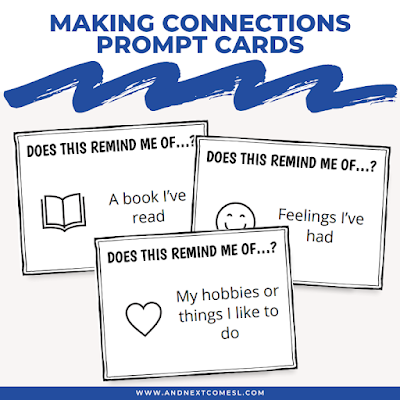
Making connections prompt cards

Grab your copy of these prompt cards here

A Quick Summary of the Making Connections Reading Strategy

Since that was quite a bit of information, lets do a quick recap of this reading comprehension strategy.

  • This strategy is all about making sense of what you're reading by making connections between your background knowledge and the text that you are reading.
  • You can make connections with any part of the text: cover, title, author, characters, plot, and more!
  • There are three different types of connections that can be made: text-to-self, text-to-text, and text-to-world.
  • To use this strategy with hyperlexic readers, you'll want to model the strategy explicitly and use written or visual cues to support them while they make connections.

As you learned, this comprehension strategy can be quite helpful, especially for hyperlexic learners. So are you going to give this making connections reading strategy a try?

Looking for strategies for reading comprehension? Try using this making connections reading strategy

Continue reading "How to Use the Making Connections Reading Strategy"

March 04, 2024

What are Signal Words? What You Need to Know

What are signal words? Here's what you need to know about signal words and why they're important for comprehension and even writing. Plus, grab the free printable list of signal words.

Given that comprehension challenges are common amongst hyperlexic learners, it's important to prioritize and support comprehension from a young age. That includes explicitly teaching them different comprehension strategies and using visual supports to do so.

One strategy that can be particularly helpful is to teach them about signal words or key words or phrases that can help boost understanding of a text. (Although you can use these signal words to help writing writing assignments too!)

But what are signal words? Why are they important? And how do you use signal words at home or in the classroom? Well, that's what we'll cover below.

You'll also find a free printable list of signal words because visual supports are so important to use with hyperlexic readers.

What are signal words? Why are they important? Plus, free printable signal words cards

So...What are Signal Words?

Signal words are specific key words or phrases in a text that give you clues or hints about what is going to happen next, the structure of the text, and/or the relationships between ideas.

These signal words are used to show cause and effect, compare and contrast ideas, help us determine fact from opinion, show a specific sequence, allow us to transition to a new idea, and more.

We'll go through specific examples in a bit, but, in the meantime, let's take a closer look at the benefits of signal words and why we want to use them.

What are signal words? A definition

Why are Signal Words Important? A Look at the Benefits

First of all, signal words can boost comprehension and understanding of a text. Something that is incredibly important if you have a hyperlexic learner, given their difficulties with comprehension.

Signal words can boost comprehension for hyperlexic learners

By the way, signal words can also help with understanding math word problems, especially if you know what math signal words to watch out for.

You can also use signal words to help with writing assignments. Another area that many hyperlexic learners need support with too (learn more here). After all, using signal words can give kids a bit more structure for communicating their ideas.

Here's a more detailed list of why signal words can be important for all learners, not just hyperlexic ones:

  • Supports reading comprehension
  • Provides cues for summarizing text
  • Helps kids remember the key points in a text
  • Provides context for what follows next in the text
  • Highlights relationships between ideas
  • Helps organize information
  • Improves writing skills by providing more structure and organization
  • Improves note-taking skills because key points are easily identifiable

Why signal words are helpful for reading comprehension and writing

How to Use Signal Words for Reading, Comprehension, &/or Writing

Okay, signal words seem important for both reading and writing, but how do you use them exactly?

Well, let's imagine you are reading a story with your child. While reading, you can point out the signal words that you see and explain their meaning. That might mean explaining that the word "because" tells us why something happened or that the phrase "the next day" tells us that we're reading about a sequence of events.

You can also use signal words to help with summarizing or retelling a story. For instance, you might summarize a story like so: First, the girl did this. Then, this event happened. Next, she did this. Then finally, she did this to solve the problem. It's similar to using something like this somebody wanted but so then graphic organizer.

Another idea is to do a signal word scavenger hunt. Before reading, quickly scan the text and point out or highlight any signal words that you spot. Do the words seem to be related to an opinion or are they showing a sequence of events? Do the words seem to be more factual in nature or are they comparing something? A quick glance through the words can usually give you an idea of the text before you read it closely.

How about for writing though?

Well, you can use signal words to format and organize your ideas that you are going to write about. Let's say you're writing an opinion piece. You can start off with a signal phrase such as "I believe" and then follow it up with "one reason" or "another reason." Or let's imagine you are writing a short story. You could rely on sequence words like first, next, then, and finally to sequence the events of the story.

You probably remember being taught this type of method for writing back when you were in school...

Now that you know what signal words are, why they're important, and how to use them, let's take a look at some of the actual key words to watch out for. There's also a free resource that you'll want to print off and keep handy.

It is worth noting, though, that some signal words can indicate more than one type of relationship. For example, a word like "also" could signal that a comparison is happening, but it could also highlight part of a sequence or that something is being described in more detail. So it's important to look for multiple key words in a text to help narrow things down.

And, obviously, these lists are not-exhaustive. There are lots of other example signal words that you can look out for, which is why there's lots of empty space to write your own on the free cards.

Ideas for how to use signal words

Words that Signal Compare & Contrast

Sometimes a writer wants to show how some things are the same or different. Maybe something is bigger or wider. Maybe two items use the same materials or are similar in shape. Whatever it is, the following list of words can indicate that two or more ideas or items are being compared and contrasted.

  • Same
  • Also
  • Like
  • Both
  • Alike
  • Similar
  • Similarly
  • As well as
  • More
  • Less
  • Different
  • Difference
  • But
  • Unlike
  • However
  • While
  • On the other hand
  • In contrast
  • Compared to

List of signal words for compare and contrast

Sequencing Signal Words

Sometimes there are key words or phrases that tell the specific order of events or give you a better idea of the structure of the text. For instance, here's the first reason why you should do something and here's the next one. And finally, here's the last one. That kind of idea. Either way, you can learn a lot about the sequence of the text by looking out for the following words.

  • First
  • To begin
  • In the beginning
  • It all began
  • To start with
  • One day
  • Next
  • Secondly
  • Afterwards
  • After a while
  • Later that day
  • Suddenly
  • Then
  • Also
  • Additionally
  • All of a sudden
  • The next day
  • Last
  • At last
  • Finally
  • Eventually
  • In conclusion
  • After that

List of signal words for sequencing

Signal Words for Facts

It's important to be able to tell the difference between a fact and an opinion in a text. In order to spot facts in particular, you can look for mentions of specific numbers, names, places, dates, and times. Or watch out for any of these signal words.

  • Numbers
  • Names
  • Places
  • Dates
  • Times
  • The fact that
  • In fact
  • Indeed
  • The truth is
  • As a matter of fact
  • It is proven
  • True

List of signal words for facts

Signal Words for Opinions

There are also lots of clues you can look for when it comes to whether something's an opinion or not. Just look for one of these example signal words.

  • Think
  • Believe
  • In my opinion
  • Best
  • Worst
  • Favorite
  • Good
  • Bad
  • Love
  • Hate
  • Probably
  • Should
  • Hard
  • Easy
  • Greatest
  • Seems
  • I am convinced
  • I am confident that
  • Prefer
  • Guess
  • Point of view
  • Interpretation
  • I'm sure that
  • It's likely that

List of signal words for opinions

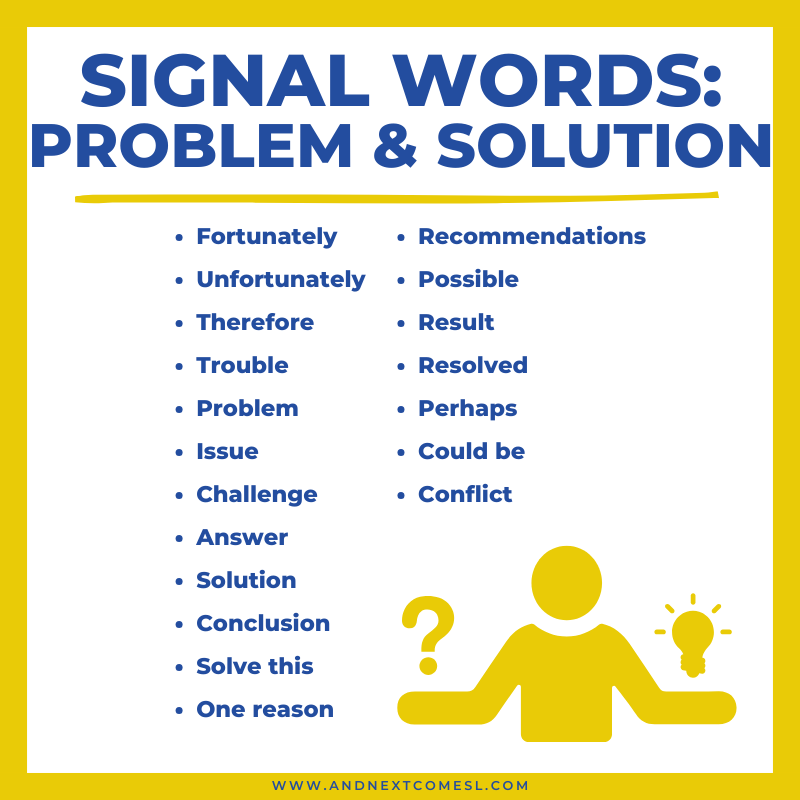
Signal Words for Problem & Solution

Sometimes you need to be able to identify the problem and solution in a text, but how do you do that? Well, you look for words like these that can indicate whether something is a problem or solution.

  • Fortunately
  • Unfortunately
  • Therefore
  • Trouble
  • Problem
  • Issue
  • Challenge
  • Answer
  • Solution
  • Conclusion
  • Solve this
  • One reason
  • Recommendations
  • Possible
  • Result
  • Resolved
  • Perhaps
  • Could be
  • Conflict

List of signal words for problem and solution

Signal Words for Descriptions & Details

There are also lots of words that can be used as evidence to support things like a fact or an opinion. And that's where these signal words for descriptions and details come in handy. Keep your eyes open for the following words that can indicate that something is being described in more detail.

  • For example
  • For instance
  • In addition
  • Also
  • Too
  • Some
  • Most
  • All
  • Other
  • Means
  • Specifically
  • Such as
  • Furthermore
  • Characteristics
  • Appears to be

List of signal words for description and details

Cause & Effect Signal Words

Sometimes ideas in a text are related in a causal relationship. Not sure if they are or not? Well, looking for the following words can help you determine what is the cause and what is the effect.

  • Because
  • Since
  • If...then...
  • Due to
  • So
  • Therefore
  • Thus
  • As a result
  • Consequently
  • In order to

List of cause and effect signal words

Download the Free Printable Signal Words Cards

This two page printable contains 8 cards, including a cover page and 7 cards with the above signal words.

Free printable list of signal words cards

There is room to write any other words or phrases on all of the cards. That way you can add any that you think should be included. Simply print, cut, and arrange into a little booklet and keep them handy while reading with your child. Feel free to laminate for durability too.

To get a copy of the free signal words list, click the link below:

>> Click here to download this free printable


Free printable list of signal words cards

What are signal words? Why are they important? Plus, free printable signal words cards

Continue reading "What are Signal Words? What You Need to Know"