Showing posts with label IEPs. Show all posts

January 19, 2026

Free Hyperlexia Teacher Letter Template

A simple free printable hyperlexia teacher letter template for you to fill in to introduce hyperlexia to your child's teacher, IEP team, or other support person.

While you and I obviously know what hyperlexia is, that's not the reality for most of the general population, including many teachers, professionals, doctors, therapists, etc. that will work with or support your child. You might mention hyperlexia and be met with a response of, "Huh...haven't heard of that before."

Or worse, they might not believe you when you say your child taught themselves to read at age two or they might dismiss your concerns entirely.

This lack of awareness around hyperlexia can make it both challenging and frustrating for parents to navigate school for their hyperlexic children. Trust me, convincing the school system to support them can be so hard some days!

So, that's where this simple hyperlexia teacher letter template can come in handy. You simply print it off, fill in a few details, and hand it to your child's teacher or IEP team to explain hyperlexia and some support strategies quickly. It can be a great way to open up the conversation about hyperlexia with your child's teacher, without overwhelming them.

A simple free printable hyperlexia teacher letter template for you to fill in to introduce hyperlexia to your child's teacher or other support person.

About this Hyperlexia Teacher Letter Template

This hyperlexia letter template is designed to introduce hyperlexia to those who may be teaching or supporting your hyperlexic child. That may mean a school teacher, a coach, a professional unfamiliar with hyperlexia, a SPED teacher or resource room teacher, a daycare worker, the IEP team, an SLP, a music teacher...the list goes on an on.

Basically, if someone will be working closely with your child and would benefit from knowing more about hyperlexia and how your child learns, this form letter is for them.

The letter provides a high-level and brief description of what hyperlexia is, without being overwhelming. It touches on possible areas of support during this description and encourages open dialogue and collaboration between them and yourself.

The letter also lists four strategies for supporting hyperlexic learners, including the most important one of leveraging their strength in decoding written language by writing things down and making things as visual as possible.

While this template is not editable, there are blanks for you to fill in once printed. Simply add the receiving person's name, your child's name (in multiple blanks), and the age at which your child began reading into the corresponding blanks.

Free hyperlexia teacher letter template to help you quickly introduce hyperlexia to your child's teacher

Download the Free Hyperlexia Teacher Letter Template

This printable teacher letter template includes two versions, one that mentions hyperlexia only and one that mentions both hyperlexia and autism. Feel free to use the version that best suits your needs. Once printed, fill in the appropriate blanks and provide it to your child's teacher, coach, support person, daycare worker, or similar.

To get your copy of the hyperlexia teacher letter template, click the link below:

>> Click here to download the free printable


A simple free printable hyperlexia teacher letter template for you to fill in to introduce hyperlexia to your child's teacher or other support person.

Continue reading "Free Hyperlexia Teacher Letter Template"

November 28, 2023

Tips & Strategies for Presuming Competence

A list of tips and strategies for presuming competence. Actionable things that parents, teachers, therapists, and other professionals can do.

A phrase that you might hear a lot in special education, speech therapy, or AAC circles is presumed competence.

But knowing what presumed competence means and why it's important is one thing.

On the other hand, knowing how to put it into practice is a whole other thing.

Perhaps you already know the basics of what presuming competence means and maybe you're like, "Okay, it all sounds great and all, but now what?" What are some actionable things that you can actually do? Where do you start? What should you avoid doing? How can you advocate for inclusive education settings? Those are the kinds of questions that we're going to explore and answer below.

Specifically, we're going to look at some tips and strategies for presuming competence in a wide variety of settings. That might be at home, in therapy, in special education or a general ed classroom, or somewhere else entirely.

Think of these ideas as a bit of a checklist of sorts to make sure you're doing what you need to be doing to best support a wide variety of individuals and accommodate a wide array of abilities. Building inclusive educational settings and classrooms is always important. So let's dig in!

A list of tips and strategies for presuming competence

Tips & Strategies for Presuming Competence

Please note that the following list of tips is pretty thorough. So, you might find all of this information about presumed competence overwhelming. Remember, you can always start with one or two strategies first and then go from there.

Keeping that point in mind, let's take a look at some of the actionable things that you can do when it comes to presuming competence:

  • Speak to them normally and in age appropriate ways (e.g., avoid baby talk and over simplified language, consider tone and speed, use age appropriate vocabulary)
  • Honor and support all forms of communication (e.g., gestures, AAC, pictures, spelling, sign language) and find ways to help an individual communicate
  • Adapt your own communication styles and be flexible (e.g., modeling scripts and gestalts, modeling on a communication device, acknowledging echolalia)
  • Encourage them to speak or communicate for themselves (e.g., do not speak for them, teach them self advocacy skills, provide extra time for them to process and communicate - see the power of waiting)
  • Acknowledge them like you would any other person
  • Include them in conversations (i.e., do not speak about them in front of others as if they aren't there and instead talk directly to them)
  • Take a strengths-based approach and focus on what they can do (there's often too much focus on what someone can't do, which can lead to viewing some individuals as incapable)
  • Respond to and acknowledge all attempts to communicate (a simple nod or yeah can go a long way, even if you aren't sure what they are trying to communicate - especially important for our gestalt language processors)
  • Tailor support to their individual needs and preferences vs. tailoring them to the disability or diagnostic label
  • Shift your mindset and attitude to make sure that you're setting them up to succeed rather than assuming they will just fail
  • Focus on an individual's abilities and needs instead of describing them using functioning labels or by developmental levels (i.e., avoid referring to someone as high-functioning or low-functioning and instead say concrete things like "they can read at a 5th grade level" or "they find visuals helpful")
  • Avoid making assumptions about what they can or can not do based on their disability, neurodivergence, or diagnosis
  • Reject and question stereotypes, consider your own biases, unlearn harmful practices, and reserve judgment
  • Keep learning about best practices related to disability, neurodiversity, and related topics in order to continue to improve support and inclusivity. Doing so will also help you with the previous bullet point. (e.g., read books by disabled and neurodivergent authors, stay up to date on the latest research and best practices, follow disabled and neurodivergent creators on social media)
  • Use respectful and inclusive language (e.g., opt for neurodiversity affirming language and avoid deficit language)
  • Ask for permission before offering assistance or sharing information with others (i.e., respect their privacy and their boundaries)
  • Resist the urge to withhold information out of fear that they might not grasp it or understand it (i.e., if you would share it with any other child/person, share it with them too)
  • Recognize that they might not be able to demonstrate what they truly know or understand (i.e., there could be a big gap between what they understand and what they are able to show that they know - especially when it comes to standardized tests)
  • Expose them to age appropriate content like you would anyone else their age
  • Observe an individual's behaviors, actions, and expressions and try to determine what those behaviors might be trying to communicate (e.g., yelling or hitting when they are feeling overwhelmed or anxious)
  • Offer them a variety of opportunities to demonstrate their skills, abilities, and talents
  • Provide choices for how they can demonstrate their skills, abilities, and talents (e.g., typing out an assignment vs. handwriting it)
  • Provide appropriate educational supports and accommodations that will help an individual reach their full potential
  • Use their strengths to encourage the individual to show their understanding (e.g., for hyperlexic learners, that means relying on written language vs. just spoken)
  • Recognize that standardized tests have limitations and may not accurately capture an individual's true abilities or potential (the book Drawing a Blank touches on this issue in relation to hyperlexia and comprehension)
  • Set expectations that reflect the individual's potential vs. setting low expectations based on assumptions or stereotypes
  • Prioritize safety and trust (e.g., follow the child's lead, don't withhold favorite objects, focus on connection over compliance, use trauma informed care or therapy)
  • Advocate for inclusive environments and celebrate diversity (e.g., accommodate various abilities and sensory needs, use a variety of diverse books in the classroom, use neurodiversity affirming practices, reduce sensory triggers, celebrate differences)
  • Be patient and remember that progress may take time (i.e., every individual develops at their own different pace)

Example tips and strategies for presuming competence

Some Final Notes on Presuming Competence

As you can see, there are a variety of actionable ways to presume competence on this list. Some of these strategies are things that you will do behind the scenes. For instance, shifting your mindset or continuously learning. However, a bulk of them are things that you need to be constantly monitoring - in the moment - while working directly with someone.

Quote about presuming competence

You'll also notice that some of these tips for presuming competence will be relatively easy to do, such as speaking to kids in age appropriate ways. And others might require a lot more work and patience, such as unlearning harmful practices.

It's also a good idea to consider these strategies and tips during IEP meetings as well. After all, they can be a great way to guide educational goals and outcomes. So, be sure to discuss them with the special education teacher, resource teacher, general education teachers, and other support staff on the IEP team.

Speaking of which, presuming competence is something that all members of the IEP team should be on board with. Unfortunately, that's not always the case. So, sometimes a lot of advocacy might be required to get the team on board. In this case, you might have to start small or simple.

It's also especially important to keep these tips in mind when it comes to working with individuals who are nonspeaking or have limited verbal communication skills. Too often, they are presumed incapable of learning or understanding and that's simply not the case.

Remember, presuming competence is the "least dangerous assumption" (source) so we need to see all individuals as capable of learning.

Presuming competence is the "least dangerous assumption" quote

Now, will you make mistakes along the way? Absolutely! You're human after all. No one expects you to be able to master all of these overnight. So keep the last tip about presuming competence in mind for yourself: be patient and remember that progress may take time. Having a growth mindset will also help tremendously.

Good luck incorporating these strategies for presuming competence into your teaching, your therapy sessions, your parenting, and so on. Your efforts and your dedication to learning, growing, and doing better are much appreciated.

A list of tips and strategies for presuming competence

Continue reading "Tips & Strategies for Presuming Competence"

November 27, 2023

Presume Competence: What Does it Mean & Why is it Important?

A look at what presume competence means and why it's important.

There are a lot of different terms and phrases that you might come across when learning about topics like autism, hyperlexia, neurodiversity, gestalt language processing, disability, and so on. There's also a lot of acronyms to navigate. It feels like learning a whole new language some days!

Then there are also some terms that you might encounter as your child starts therapy. Or there are the terms that get tossed around during meetings with the special education team.

One specific term or concept that you might come across frequently - especially as it relates to augmentative and alternative communication (AAC) - is the term presumed competence. It's quite an important concept and term to discuss, I might add. It's also a term that you might see popping up more and more on social media lately.

But what exactly does it mean to presume competence? And why is it important? Well, that's what we're going to discuss below.

Presume competence: what does it mean & why is it important?

Presume Competence Definition

First, let's break the phrase down into its two words:

  • Presume = assume, believe, expect
  • Competence = ability, capacity, proficiency

In other words, presuming competence is the belief that an individual is capable of thinking, learning, and understanding, even if there's no tangible evidence, they aren't able to show it yet, or regardless of what standardized test scores show. 

Presumed competence definition

Basically, presuming competence is about:

  • Giving people the benefit of the doubt
  • Offering support and providing opportunities for individuals to show their skills and their potential
  • Not making assumptions based on their challenges, weaknesses, disabilities, and/or diagnostic label
  • Treating people with respect
  • Valuing everyone's unique strengths, abilities, and contributions

What does presuming competence mean?

Why is Presuming Competence Important?

Now that you have a better idea of what it means to presume competence, let's look at the benefits of doing so. Here's why it's important to always presume competence:

  • It's the "least dangerous assumption" (source) as presuming incompetence, for instance, would be much more harmful
  • Reduces stigmas and rejects stereotypes that are associated with disabilities
  • Supports inclusion
  • Improves communication
  • Strengthens relationships
  • Values and respects individuals for who they are, as well as their unique strengths and contributions
  • Gives people a chance and provides opportunities instead of making assumptions about what they can and cannot do
  • Prevents underestimation because you are setting appropriate and high expectations (vs. setting low expectations based on stereotypes or a diagnostic label)
  • Recognizes that traditional or standardized assessments may be flawed and don't always give an accurate representation of what one can do
  • Strengthens self-esteem and fosters independence
  • It's empowering

Why presuming competence is important

Obviously, this list is not exhaustive. Yet, you can see how powerful presuming competence can be. Especially with minimally speaking or non-speaking individuals who, too often, aren't always seen as capable.

But what does presumed competence look like in practice?

What Does Presuming Competence Look Like?

To avoid overwhelming you with too much information, I'm only including a small list of examples below. I will have another post that is much more detailed. But here is a simple list of what it looks like to presume competence. It means:

  • Supporting all forms of communication (including AAC)
  • Using a strengths-based approach
  • Tailoring supports and accommodations to the individual vs. tailoring them to the disability or diagnostic label
  • Seeing individuals as capable of learning
  • Providing opportunities
  • Offering choices
  • Fostering an inclusive environment
  • Celebrating diversity
  • Not making assumptions
  • Rejecting stereotypes and reserving judgment
  • Building authentic relationships based on safety and trust
  • Recognizing that sometimes there's a difference between what someone understands and what they are able to show and finding ways to support individuals in showing their understanding
  • Setting expectations that reflects the individual's potential vs. setting low expectations based on assumptions or stereotypes
  • Recognizing that behavior is communication and has a purpose

You might already be doing some of these things naturally, especially if you are taking a neurodiversity-affirming approach to your parenting, teaching, or therapy. And that's great! But unfortunately, presuming competence still isn't standard practice for some professionals or in certain fields.

If you'd like to learn more about how to presume competence, read these tips and strategies for presuming competence.

What does presuming competence look like?

A Quick Recap of Presuming Competence

Just to recap all that was discussed above, here are some key takeaways:

  • Presuming competence is about believing that all individuals are capable of thinking, learning, and understanding
  • Presuming competence is important because assuming otherwise is much more harmful. In other words, presuming competence is the "least dangerous assumption."
  • There are lots of ways to show that you are presuming competence, including: supporting all forms of communication, taking a strengths-based approach, providing opportunities, rejecting stereotypes, not making assumptions, being respectful and inclusive, and giving people the benefit of a doubt.

Thanks for taking the time to learn more about what it means to presume competence. Hopefully you found this information helpful.

Presume competence: what does it mean & why is it important?

Continue reading "Presume Competence: What Does it Mean & Why is it Important?"

October 27, 2023

The Benefits of Flexible Seating in the Classroom

What are the benefits of flexible seating? Why should you use it? Find out below.

Once you know what flexible seating is, as well as the pros and cons, it's helpful to look at the benefits to using different seating options in the classroom. And there are certainly a lot of benefits, as you will see.

We saw some of these benefits first hand when my oldest son was in kindergarten. Or was it grade one? I can't keep all of those younger years straight any more...

Anyway, the school was able to provide him with an orange and gray wobble/balance stool and, goodness, did it ever help him stay focused and well regulated. As a vestibular sensory seeker who loved to spin and swing, that stool really helped him get his sensory needs met in the classroom.

So let's take a closer look at what some of those benefits of flexible seating might be. You know, beyond meeting a child's sensory needs like I mentioned.

A look at the benefits of flexible seating and why you should use it in the classroom

Benefits of Flexible Seating

You'll notice that there a wide range of benefits on the following list, from meeting sensory needs to improving classroom performance and physical health. It really does help in a variety of areas.

Sure, most of the benefits on this list are student-oriented. However, there are actually a lot of benefits for teachers as well.

Here are just some of the benefits of using flexible seating in the classroom:

  • Allows for more movement
  • Helps kids stay regulated (often because their sensory needs are being met)
  • Reduces the amount of time spent sitting (i.e., you can switch things up by laying on the floor, kneeling, rocking, bouncing, standing, etc.)
  • Improves focus and concentration (remember, not all kids learn best sitting still or learning at a traditional desk)
  • Gives students more autonomy by allowing them to make choices and be more independent (i.e., they can sit where and how they want)
  • Improves posture, core strength, and other aspects of physical health
  • Increases student collaboration (e.g., they can sit on a couch with other students when working together on an assignment)
  • Reduces distracting behaviors and classroom disruptions (after all, their needs are being better met and supported and the students are more regulated)
  • Boosts classroom engagement (e.g., they no longer have to focus on trying to sit still and can instead focus on listening to the teacher)
  • It's inclusive and neurodiversity-affirming (i.e., there is something for everyone, considers different learning styles, no child feels singled out because they use a different chair, meets a wide variety of needs, etc.)
  • Helps kids feel more comfortable and safe (e.g., they can sit where and how is most comfortable to them, which will reduce the need to mask at school)
  • Allows teachers to try out new teaching strategies

Keep in mind that this list is just a starting point. There are lots of other potential benefits to using flexible seating in your classroom so you might think of some other ideas that aren't included above.

Flexible seating benefits

Flexible Seating Benefits: A Quick Recap

Once you start incorporating some flexible seating in your classroom, you're likely to notice a lot of benefits.

Not only is it an inclusive practice, but offering flexible seating can help kids stay better regulated. And that means fewer behavior problems or disruptions and an improvement in classroom engagement. It's a win, win really.

Students will also feel more comfortable and safe, not only because they're better supported and well regulated, but because they'll have more autonomy and independence. They'll love having more flexibility and freedom to make choices when it comes to how they're learning in the classroom.

Hopefully, learning about these flexible seating benefits will give you some encouragement to give it a try and incorporate it into your classroom.

Or, at the very least, help you better understand why it's being recommended as an accommodation in a student's IEP.

A list of the benefits of flexible seating in the classroom

A look at the benefits of flexible seating and why you should use it in the classroom

Continue reading "The Benefits of Flexible Seating in the Classroom"

October 26, 2023

Flexible Seating Pros and Cons: Things to Consider

Flexible seating pros and cons: a look at the advantages and disadvantages of using flexible seating in the classroom.

When deciding whether or not flexible seating is something you want to incorporate into your classroom, it's helpful to weigh the pros and cons. That way you know if it's a good fit or not for your classroom, your students, and your teaching style.

There are so many things to consider, both good and bad, when it comes to offering different seating options. 

But, keep in mind, there are always things you can do to counteract any disadvantages on this list. For instance, if money is a concern, you could apply for grants and funding, try some DIY alternatives, and/or look for second hand items. Or, if safety is concern, you could go over safety rules with your class.

Hopefully, though, this list of flexible seating pros and cons can help you make a decision, one way or another.

Flexible seating pros and cons: a look at the advantages and disadvantages of using flexible seating in the classroom

The Pros of Flexible Seating

Let's first talk about the advantages. The good things. The pros. Essentially, we're going to look at some of the reasons why you would probably want to incorporate some type of flexible seating options into the classroom.

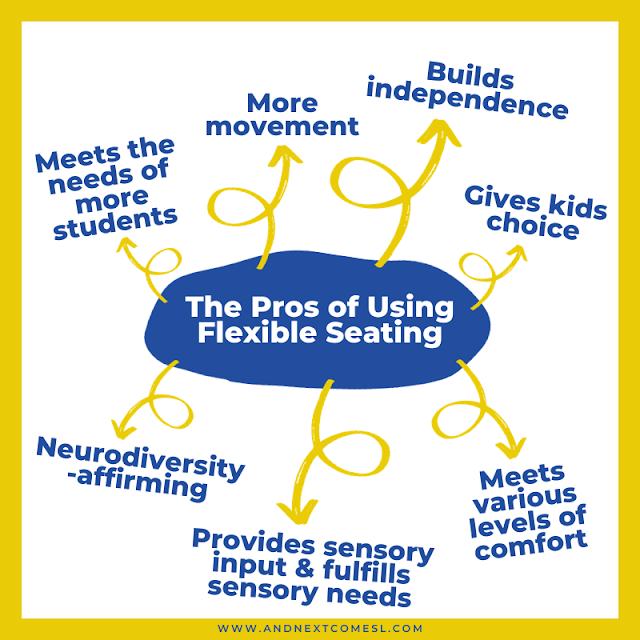
First of all, flexible seating can better meet the needs of more students. In a class of 30 kids, you know there are going to be a wide range of educational needs and sensory needs. Plus, there will be a plethora of learning styles too. Some kids will need to wiggle, rock, or move. Some will need some proprioceptive or tactile sensory input. And so on...so offering different seating arrangements can better help meet a wide range of needs.

Flexible seating is also neurodiversity-affirming. That's because it recognizes sensory needs, allows for stimming behaviors such as rocking, helps with regulation, focuses on body autonomy, celebrates differences in learning styles and comfort levels, and more.

Speaking of comfort levels...every student's idea of what's comfortable is different. Some will be okay sitting in a hard plastic chair while others will be slouching, sliding, or falling off because they can't get comfortable. Some kids might be more comfortable standing or moving while they work, while others might prefer to hang out in a quiet spot in a bean bag chair.

As was already quickly touched on earlier, some most kids can't sit still and need more movement when relying solely on traditional seating. So skipping the crisscross applesauce and opting for wiggle cushions, rocking chairs, and scoop chairs will be better alternatives.

Finally, flexible seating is a good way to give kids choice and build independence. They have the freedom and flexibility to choose where to sit, who to sit with, how to sit, and so forth.
The pros of using flexible seating in the classroom

The Cons of Flexible Seating

While there are a lot of advantages to using flexible seating (as you learned), there are also a lot of disadvantages to be aware of. So let's take a look at some of the negatives, or cons, to using flexible seating.

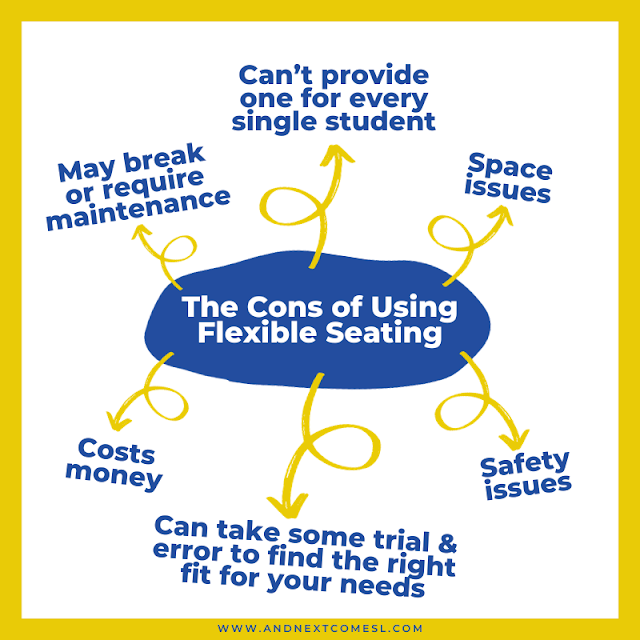
Perhaps the biggest negative would be the financial cost involved. Adding different chairs and seating options to the classroom obviously costs money and some alternatives can be quite expensive. Especially if you need to purchase multiple for the classroom.

Then there are budget constraints to also be aware of. So sometimes it doesn't make sense to invest in flexible seating due to the financial costs.

Then there's also the potential for additional costs to be added for things like maintenance, repair, and replacement. After all, sometimes things break. You might find yourself having to buy frequent replacements due to improper use, daily wear, etc. However, putting together a list of flexible seating rules for the class might help reduce breakage.

Also, it's unrealistic to have enough flexible seating options for every single student in the classroom. Not only would that cost a lot of money, but it would be nearly impossible to fit every single student's needs by providing them with what they may need and finding the space in the classroom to do that. So while you can provide a variety of options, you wouldn't necessarily be able to accommodate every single student in the classroom with a unique seating option.

As I touched on in the last paragraph, another issue would be space. The classroom simply might not have the space to add a small couch, a couple of rocking chairs, and a few bean bag chairs. Even storing smaller things like scoop chairs, wiggle cushions, etc. isn't always manageable. Sometimes it's easier to stick to chairs that are easily stackable due to space constraints.

Speaking of space, maybe you don't even have a designated classroom or you share a classroom with another teacher (current realities for where we live). That might make it impossible to even consider flexible seating.

Another issue with flexible seating is safety. Things like wobble stools, for example, can come with their own sets of risks. For instance, kids might fall while they are trying to balance on a wobble stool. Although you could always do things to minimize any risks, such as going over some basic safety rules with your class.

Another thing to consider is that it can take a lot of trial and error to find the right types of seating for your students. Would rocking chairs or bean bag chairs be better? Or would wiggle cushions and mats be a better fit? It can take a lot of experimentation and time to find the right fit for your students.
The cons of using flexible seating in the classroom

A Recap of the Flexible Seating Pros and Cons

As discussed above, there are lots of advantages to using flexible seating in the classroom. There are also some disadvantages though too. Here's a quick overview of those pros and cons:

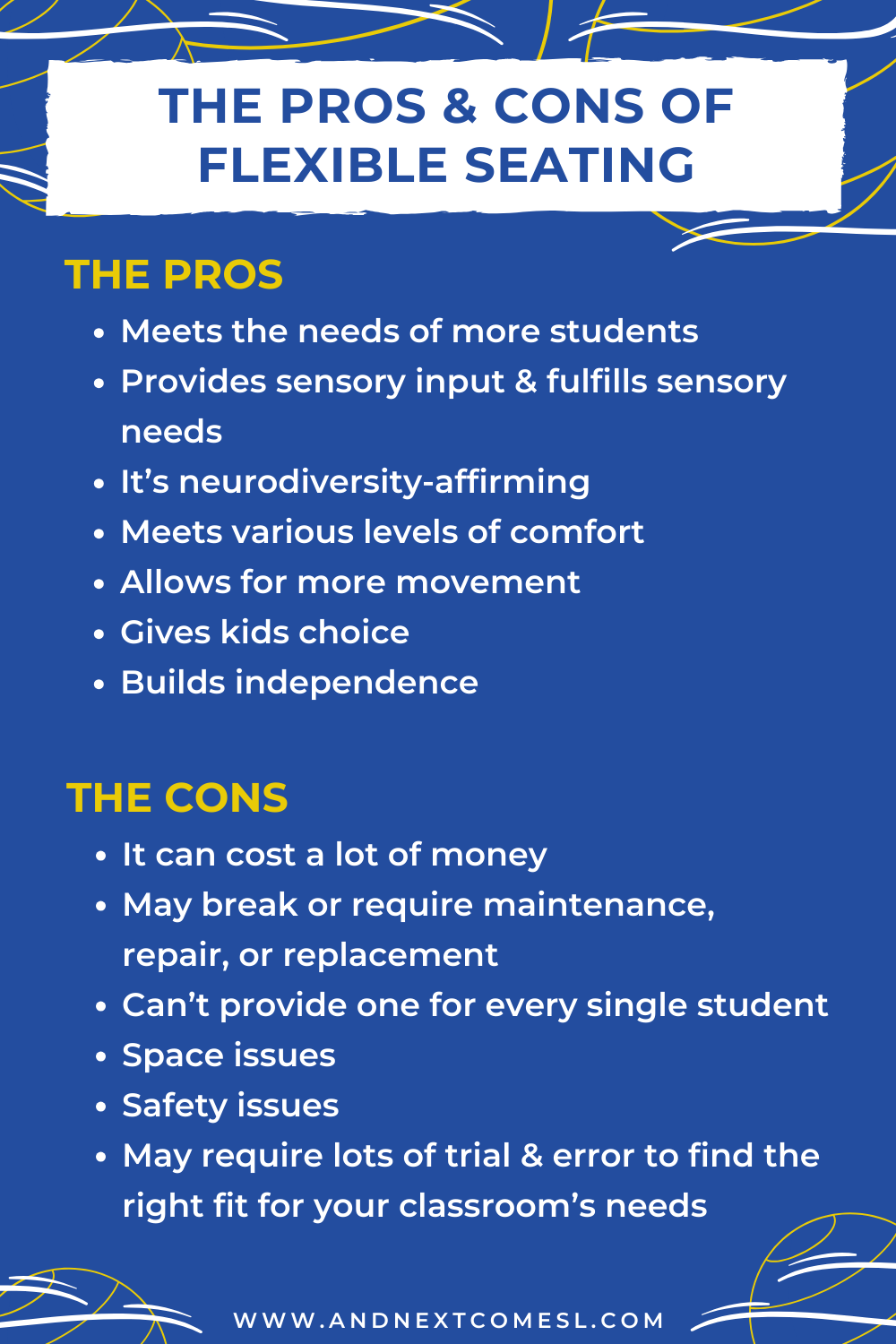
  • Perhaps the best reason to consider flexible seating is that it can help meet the needs of more students (think sensory needs and educational needs, for instance). It's also neurodiversity-affirming.
  • Since flexible seating is great for kids who can't sit still, it's an easy way to incorporate more movement into your school routine.
  • Other pros to using flexible seating include: providing choice, building independence, and meeting a wide range of comfort levels.
  • Flexible seating can be expensive and bulky, taking up a lot of space in the classroom.
  • It's unrealistic and impossible to provide flexible seating for every single student, especially since it can take a lot of trial and error to find the right ones for your students' needs.
  • Then there's the potential for things to break, which can cost even more money, and some flexible seating options, such as wobble stools, come with their own safety risks.
Flexible seating pros and cons list: a look at the advantages and disadvantages of using flexible seating in the classroom

So that's a look at some possible flexible seating pros and cons. Do you think you'll be implementing it in your classroom? Or do the disadvantages outweigh the advantages at this point?

Flexible seating pros and cons: a look at the advantages and disadvantages of using flexible seating in the classroom

Continue reading "Flexible Seating Pros and Cons: Things to Consider"

October 24, 2023

What is Flexible Seating? Overview & Definition

What is flexible seating in a classroom? You'll learn all about what it is and see a list of examples of flexible seating ideas.

Whether you are an educator or a parent (or some other professional who frequents school IEP meetings and whatnot), then you've likely heard of the term flexible seating. Maybe you're not entirely sure what is meant by that term and you're looking to learn more.

Well, you're in luck. Below we'll answer the question what is flexible seating? Then we'll look at a list of examples of what that looks like in the classroom.

That way you'll know whether or not it's something you want to include in your classroom (for any teachers reading this) or advocate for your child to have access to (for any parents reading this). So let's dig in!

What is flexible seating in a classroom? You'll learn all about what it is and see a list of examples of flexible seating ideas.

What is Flexible Seating? A Definition

Flexible seating is about providing choices and a variety of different seating options for students in the classroom.

Much like the name implies, it's about giving students the flexibility and freedom to choose where they want to sit, how they want to sit, with whom they want to sit, and picking what works best for them.

What is a flexible seating? A definition

Flexible seating allows for more movement and independence, while helping meet the needs of more students. After all, not all kids learn their best when forced to sit crisscross applesauce on a mat. Some kids need to move and wiggle while listening and learning.

Remember, kids have different learning styles and needs so flexible seating can be a great way to help support a wide variety of different learning styles and needs.

Kids have different learning styles and needs

Examples of Flexible Seating

Now that you have a better understanding of what flexible seating is, let's take a look at some examples of what that might look like in the classroom. Keep in mind that classrooms can use a mix of these ideas alongside conventional desks, tables, and chairs.

Classrooms can use a mix of flexible seating options alongside conventional desks, tables, and chairs

Also, if you are new to the idea of flexible seating and you aren't sure where to start when it comes to incorporating other seating options into your classroom, this list can be super helpful. 

Here are some example ideas that you might want to consider:

  • Sitting in a bean bag chair or in a sensory tent while reading
  • Laying on a mat or cushion on the floor while working on schoolwork
  • Collaborating with other students while sitting on a couch together
  • Rocking in a rocking chair while working at a table or desk
  • Working with other students at a standing desk
  • Kneeling or sitting cross-legged on pillows while seated at a low table
  • Using different types of stools, such as a wobble stool, while working at a desk or table

Examples of flexible seating

As you can see, there are lots of different seating options that you could include in a classroom. So you might have to weigh the pros and cons of each when deciding what to include.

Of course, you also have to consider your students' needs, the size and shape of the classroom, budgets, your teaching style and needs, etc. There are also lots of great DIY options out there if you are needing something more budget friendly.

When deciding what to include for flexible seating, there are a few things to consider

Recap of Flexible Seating in a Classroom

Whether you're a skim reader or just want a quick recap, here's what you need to know about flexible seating:

  • Flexible seating is about offering lots of different seating options and letting students choose where to sit, how to sit, with whom to sit, and, ultimately, picking what works best for them and their needs.
  • Kids have different learning styles and needs so flexible seating can be a great way to help support a wide variety of different learning styles and needs.
  • Classrooms can offer a mix of flexible seating options alongside conventional desks, tables, and chairs. It might be as simple as adding something to a chair (e.g., a wiggle cushion) or swapping a chair out for a different type of chair (e.g., a rocking chair).
  • When deciding to use flexible seating, you'll have to weigh the pros and cons of using different seating options, but you'll also have to consider your students' needs, the size and shape of the classroom, budgets, your teaching style and needs, and more.

So that's a quick overview and answer to the question: what is flexible seating? You can learn more about the pros and cons, as well as the benefits, in other posts.

What is flexible seating in a classroom? You'll learn all about what it is and see a list of examples of flexible seating ideas.

Continue reading "What is Flexible Seating? Overview & Definition"

October 19, 2023

IEP Red Flags: Things to Watch Out for & Avoid in IEPs

A look at some of the common IEP red flags and statements that you might hear during an IEP.

When you're first getting started with IEPs, it can be hard to know what to expect or what to watch out for. Especially if you're new to IEPs.

So, sometimes it can be helpful to have a list of warning signs that you can refer to. That way you can familiarize yourself with the difference between the best IEPs and the not-so-good or crappy IEPs.

Well, that's where this list of IEP red flags come in handy.

Reviewing these before you head into an IEP meeting can be helpful, especially since some of these negative signals might be quite subtle. Others, though, will be glaringly obvious and quite hard to miss.

Below, you'll also find a list of potential IEP red flag statements that team members might use and why they can be problematic. So let's take a closer look at what you want to watch out for.

A look at some of the common IEP red flags and IEP red flag statements that you might hear during an IEP

What are IEP Red Flags?

First a quick definition. An IEP red flag simply refers to the warning signs or negative things that you want to watch out for and avoid in IEPs.

They are the signs that an IEP might be poorly written, isn't neurodiversity-affirming, isn't individualized, isn't adhering to local laws and rights, and so forth.

What are IEP red flags? A definition

Ideally, you want to see mostly IEP green flags (aka the positive signals), not the following IEP warning signs. However, you will usually see a mix of both.

Green flags vs red flags for IEPs in special education

Regardless, it's still important to keep your eyes and ears peeled for these negative signs. Some of them might appear in the written IEP document and others might be something you specifically hear during the IEP meeting. And others might be the little details or actions that you pick up on during the IEP meeting itself.

IEP Red Flags to Watch Out for

Keep in mind that there are a wide variety of potential red flags in IEPs. You might see some of these signs, all of them, some variation of the following, or even more subtle variations.

But here are some potential red flags to watch for during the IEP process:

  • There is limited parental input and involvement
  • IEP goals seem to be copied and pasted from someone else's plan (i.e., the name, grade, teacher, and/or diagnostic labels of the student are incorrect)
  • Unmet IEP goals are repeated from previous years
  • Assessment data and progress monitoring reports aren't included or are missing altogether
  • Strategies, accommodations, supports, and services are inappropriate for the student
  • Goals seem generic instead of individualized (i.e., they aren't specific to the student and their unique needs at all)
  • The student's strengths aren't mentioned, discussed, or included
  • Not all IEP team members are present or stay for the full duration of the meeting (Although sometimes things come up, school-based professionals are understaffed, etc. that make it impossible to stay for the full duration or attend. If that is communicated to parents, then it wouldn't be a red flag.)
  • The IEP meeting seems rushed
  • Lots of deficit language is used
  • Parents aren't allowed to take the IEP home to review it before signing it
  • The IEP team requires a signature the day of the meeting, even if the goals aren't finalized or tweaks still need to be made
  • Copies of reports, assessments, and other documents aren't provided in advance
  • The IEP team has outlined and written their own goals without parental or student involvement
  • Access to specific resources, services, and classrooms are restricted or limited
  • Surprises occur during the IEP meeting (e.g., new team members are unexpectedly present, reports you've never seen before, goals you've not discussed before, etc.)
  • IEP team members don't seem to know what they're talking about (e.g., use outdated or incorrect definitions, think sensory diets refer to food diets)

Obviously, this list isn't exhaustive. There can be plenty of other signs that you might notice. Basically, if the entire IEP experience feels generic, rushed, dismissive, one sided, or inadequate, then it's probably not going to have the student's best interests in mind.

List of IEP red flags in special education

But sometimes it's not always about what is written or what the special education team does. Sometimes the red flags lie in the words that are spoken during the IEP meeting, which leads me to...

IEP Red Flag Statements: Examples of Things the IEP Team Might Say

If you're still not sure what to look for when it comes to bad IEPs, consider the following red flag statements that you might hear during the IEP writing process. Perhaps you've even heard or been told some of these yourself...

  • "We don't have/do that here."
  • "This is all we offer."
  • "This is what we do for all students with      ."
  • "The teacher does this for all students."
  • "We've always done it this way."
  • "We use this program for all kids with      ."
  • "We can't provide that service."
  • "It's not in our budget."
  • "We don't need to reevaluate your child."
  • "Your child should be on medication."
  • "Your child isn't entitled to       because they're in       classroom or environment."
  • "We don't need to include that in the IEP."
  • "Division/district policy doesn't let us      ."
  • "That option isn't available."
  • "Just sign it."
  • "Since your child is doing fine academically, they aren't eligible for      ."
  • "We've already written the goals."
  • "We know what's best."
  • "Your child doesn't have the prerequisite skills for AAC."
  • "We're reducing/stopping       because we've decided that your child no longer needs them."
  • "Your child is misbehaving/challenging/difficult so we can't move them to that other classroom/environment."
  • "Let's keep this goal since they haven't made progress yet."
  • "We need to get permission from       first."
  • "We can't do that because your child isn't grade level yet."
  • "We don't have the resources to offer that."
  • "We take away her AAC device."
  • "We take away       when they      ."
  • "I don't think that will work."
  • "All students with       get      ."
  • "We can't provide copies of that report."
  • "We can't share that information with you."
  • "We're not allowed to      ."
  • "We disagree so we're not going to do that."

These statements can be problematic for a lot of reasons. For instance, some of them are problematic because they outright break specific disability or IEP rights and advocacy laws.

Others on this list purely signal that the IEP isn't individualized when it should be. It should be individualized after all. It's literally right there in the name: Individualized Education Program/Plan.

Other statements might be based on incorrect assumptions (e.g., that you have to have certain prerequisite skills for AAC) or promote harmful strategies (e.g., taking away a child's only way to communicate).

And then there are others that just aren't meaningful IEP goals. Goals that certainly won't meet the student's educational needs.

Regardless, if you hear any of these types of statements during the school year, consider it a red flag for a potentially bad IEP.

Examples of IEP red flag statements

So, What Should You Do if You Spot these Red Flags?

Start by speaking up. Tell them why you won't sign it or why you don't agree with what they are saying.

Share your ideas, values, and suggestions and what you would like to see in the IEP. Remember to be vocal, firm, and respectful when advocating for your child/the student. And be sure to tell them why you are asking for certain goals, services, and accommodations.

You should also familiarize yourself with what the laws are and what your rights are for where you live. Every school division/district, country, province/state, etc. will have different rules and laws that pertain to education, disability, students' rights, and so forth. So be sure to take some time to educate yourself about any applicable laws and rights.

You could also consider hiring an advocate to speak on your behalf and/or to join you at IEP meetings. They might be more familiar with the process, how to ask for particular services, what your rights and the applicable laws are, and so on.

Finally, trust your gut. If something seems off or makes you uncomfortable, don't settle. Be firm and advocate for what you believe is right for your child/the student.

Things you can do if you notice lots of red flags in IEP meetings

A Quick Recap of Red Flags You Might See During an IEP Meeting

If you want to make the most of the IEP process, it's important to watch out for any red flags, whether they're little or big. Here are some things to keep in mind:

  • IEP red flags are the negative things or warning signs that tell you that an IEP might be poorly written, isn't neurodiversity affirming, isn't individualized, and/or even a good fit for your child or the student.
  • Some IEP red flags can include a lack of collaboration and parental input, generic non-specific strategies, lots of deficit language, limited access to specific resources or services, continuing on with goals from a previous IEP, and a pressure to sign the IEP without proper review.
  • You should also watch out for IEP red flag statements such as "We don't do that here" or "This is all we offer."
  • Remember to speak up, familiarize yourself with laws, educate those around you about your values and your child's strengths, consider hiring an advocate, and always trust your gut when it comes to IEPs.
  • Don't sign anything you don't agree with, especially if there are a lot of red flags.

List of IEP red flags in special education

Now that you are familiar with some potential IEP red flags, it might be helpful to read through this list of IEP green flags. That way you also know what a good solid IEP looks like.

A look at some of the common IEP red flags and IEP red flag statements that you might hear during an IEP

Continue reading "IEP Red Flags: Things to Watch Out for & Avoid in IEPs"

October 18, 2023

IEP Green Flags: Things You Want to See in an IEP

A look at some of the common IEP green flags for special education or, in other words, the positive signals that you want to see in an IEP.

IEPs don't have to be stressful or negative experiences, but often that is the reality...

Sometimes IEPs are rushed, have inappropriate goals and accommodations, and are anything but student centered.

Maybe you've noticed one red flag after another and it makes you extremely nauseous and uncomfortable.

But how do you know what to look for in a good IEP? Or what a productive and healthy IEP meeting looks like?

Surely, there have to be some positive signals that you can look for. Well, there are!

Below you'll find a list of IEP green flags. Things you want to see during the IEP process that can lead to more productive and healthy meetings and better IEPs for students. But first, a definition...

A look at some common IEP green flags or, in other words, the positive signals that you want to see in an IEP

IEP Green Flags Meaning

You're probably familiar with the idea of red flags, right? Red flags refer to the negative things that you want to watch out for and avoid at all costs. In other words, they are the warning signs.

Green flags, on the other hand, are the opposite. They are the positive signals. The good things. The things you want to see. They are a sign that things are healthy and productive.

Green flags versus red flags for IEPs in special education

So, in this particular context, IEP green flags are the positive signals and good things that you want to see in an IEP. 

IEP green flags meaning

IEP Green Flags: What to Look for

Now there are lots of different green flags to look for in an IEP document and during an IEP meeting. Keep in mind that you might see only some of these signs, all of them, some variation of the following, more subtle forms of the green flags, or sometimes, sadly, none of them at all (obviously we don't want that!).

Here are some green flags that you might notice during the IEP process:

  • It is student centered and individualized
  • Neurodiversity-affirming and strengths-based language is used in place of deficit language
  • Collaborative team approach
  • Parental concerns are considered and addressed
  • Values and seeks out input from parents, the student, and other support services
  • The goals and objectives are tailored to the student and their unique needs
  • The goals are specific, clear, and measurable
  • The student's strengths and abilities are recognized and discussed
  • Accommodations, supports, and IEP services are appropriate and align with the needs of the student
  • Data is shared with all members of the team, including parents (this includes providing copies of written plans, reports, goals, evaluations, etc. when requested)
  • The student's special interests are considered and incorporated into the plan, if possible
  • Communication remains open, transparent, and respectful, even when there are disagreements
  • Adequate time is given for the IEP meeting (i.e., it isn't rushed or cut short and all members are there for the entire duration)
  • Parents are allowed to take time to review the IEP before signing it (i.e., they can take the document home, read it over, and aren't pressured to sign it during the meeting itself)
  • The student has access to a supportive and inclusive learning environment

Obviously, there can be other signs, but you can see how this list focuses on using a collaborative approach to understand and support the individual.

IEP green flags examples

IEP Green Flags: Examples

It is worth noting, though, that sometimes the green flags might be subtle and hard to spot. Like how do you know if a goal is clear and measurable? How do you know if data is being shared with all members of the team? How do you know if your parental concerns are being adequately addressed?

Well, let's take a closer look at some specific examples of what a green flag in an IEP might look like. Keep in mind that the green flags might show up in the smaller, more minute details. So, for example:

  • The student is referred to by their name and the document doesn't appear to be just a copy and paste of someone else's plan (so be sure to check that it has the correct grade, teacher, diagnoses, etc.)
  • All important and relevant labels are considered (i.e., they don't just focus on the fact that a child is autistic, but also recognize their hyperlexia as well, for instance)
  • You see positive and identity-first language such as autistic person (vs. student with autism spectrum disorder) and/or neurodiversity-affirming phrases such as "benefits from" (vs. struggles with)
  • Multiple team members are present during the IEP meeting and are CC'ed on relevant emails
  • The team members actively listen to parents, answer their questions, ask them for their input, and take their feedback and concerns into consideration
  • IEP goals are rewritten after a team member or parent raises a concern instead of it being brushed off as a "we've always done it this way" kind of attitude
  • Strategies and accommodations seem to be tailored to the needs of the student and incorporate the student's interests
  • The student's strengths are discussed and outlined explicitly and are accurate (refer back to the first bullet point about copy and paste IEPs)
  • A signature isn't requested until all requested changes have been made
  • The team is open to exploring new ideas (e.g., "I'll look into that!" or "Let's see what we can do.") instead of shutting down different options (e.g., "We don't do that here" or "That option isn't available")
  • The team addresses the parent by their name (trust me, being called "Mom" instead of Dyan during a meeting is so degrading and disrespectful)

You can see how subtle some of these are.

So, take notice of who is or isn't in attendance at the IEP, how others on the team refer to the parent or the student, and the wording of things. All of those little details can be important green flags and make a huge difference in the IEP writing process.

What if There are No Green Flags?

Remember, you don't have to sign anything you don't agree to. So, if all you see are inappropriate goals, mistakes, negative language, and/or any other red flags, then keep pushing for changes to the IEP.

It's also important to educate yourself, specifically about what the laws are and what your rights are for where you live. Every school division/district, country, province/state, etc. will have different rules and laws that pertain to education, disability, students' rights, and so forth. You should try to be familiar with what these rights and laws are.

Parents can also educate the IEP team members on what values are important and why. For example, explain why neurodiversity-affirming language, a strengths-based approach, and individualized supports are important to you.

You can also consider hiring an advocate to speak on your behalf and/or join you at IEP meetings.

Finally, trust your gut. If something seems off or makes you uncomfortable, don't settle. Be firm and advocate for what you believe is right for the student.

What if there are no IEP green flags? List of strategies and tips

A Quick Recap of IEP Green Flags

IEPs can often be a stressful and negative experience for parents, but they don't have to be. Here's a quick recap of what was discussed above:

  • There can be lots of red flags to watch out for during the IEP process, but there can also be a lot of green flags or positive signals to look for. Obviously, you want to make sure you see more green flags than red flags.
  • IEPs should be student centered, individualized, collaborative, and tailored to the individual student.
  • A team approach should be taken when it comes to IEPs. That means seeking input from all team members, sharing data amongst the entire team, and communicating openly and respectfully.
  • You might not notice many green flags or any at all. Or, sometimes, they might be subtle. Sometimes it's the little details that are the biggest green flags.
  • Remember to familiarize yourself with laws, educate those around you, stick to your values, hire an advocate, and always trust your gut when it comes to IEPs.
  • Don't sign anything you don't agree with, especially if there are a lot of red flags.

A list of some examples of IEP green flags or the things you want to see in an IEP

Now hopefully you'll be better equipped to notice some of these IEP green flags in your future IEP meetings and documents. And here's hoping that those green flags always outnumber the red ones.

A look at some common IEP green flags or, in other words, the positive signals that you want to see in an IEP

Continue reading "IEP Green Flags: Things You Want to See in an IEP"