August 24, 2020

Hyperlexia: How is Early Reading a Problem?

How is early reading in hyperlexia a problem? Clearing up confusion about hyperlexia and how it's more than just early reading by looking at some of the common challenges that accompany hyperlexia.

There was a discussion about hyperlexia in a Facebook group where the person was seeking more information about hyperlexia and what it is. More specifically, though, they were trying to understand how early reading could possibly be viewed as a problem.

It was a good question. (And one, I hadn't really seen before either. What can I say? I like new questions.)

Now, first things first, it's important to understand that the early reading of hyperlexia itself isn't the issue per se.

Either is the intense fascination with letters. Although there are some "professionals" who will try to tell you it is and, therefore, you should discourage it or take their letters away. Please don't listen to this advice. See why here.

Anyway, so, what exactly is the problem here then? Why is it important to identify hyperlexia at all? Why are we slapping a label on this remarkable ability to read?

Well, the thing is, hyperlexia is so much more than just early reading. And it's more than just an intense fascination with letters.

There are issues and challenges that come along with this precocious self-taught reading ability and there are areas where hyperlexic learners need extra support. That's what we're going to explore here. So let's dig in and answer: how is early reading a problem?

How is early reading in hyperlexia a problem? Clearing up confusion about hyperlexia and how it's more than just early reading by looking at some of the common challenges that accompany hyperlexia.

Incomplete Definitions of Hyperlexia Might Be Leading to Confusion

It's quite possible that a lot of the confusion around hyperlexia is that, oftentimes, people are given incomplete (or even incorrect!) definitions about what hyperlexia is in the first place.

A lot of confusion about hyperlexia stems from people being given incomplete or incorrect definitions of what it is

Too often, people assume that hyperlexia just means early reading. But there's so much more to hyperlexia than that.

Defining hyperlexia in such a simplistic manner fails to capture the difficulties that can accompany hyperlexia and minimizes the experiences of hyperlexic individuals.

There's more to hyperlexia than just early reading

Instead, hyperlexia is defined by three main traits or characteristics, one of which is the early ability to read. The other two traits that often get left out of definitions - or overlooked - are the difficulties in acquiring, understanding, and using language and the difficulties with social interactions. In other words, language differences and social differences.

It's these two other groups of traits that really define the issues, problems, or challenges that come along with hyperlexia. And that's precisely what the person in the Facebook group was really trying to discover and learn about.

In other words, it's not the early reading that necessarily causes problems (although the intensity of their interest in the written word can be overwhelming for many parents!). Instead, it's the difficulties with language and social skills that can lead to challenges or require extra support that are often deemed the "problems" of hyperlexia.

So...What are the Issues that Accompany Hyperlexia?

It's also helpful to keep in mind that hyperlexic kids learn language differently. They are gestalt language processors, for starters. And most of the challenges that come along with hyperlexia have to do with language skills (see a full list here) and, sometimes, even their spiky learning profile.

Hyperlexic kids learn language differently

Here are just some of the issues or challenges that are common in hyperlexia:

  • Comprehension issues
  • Difficulties understanding and answering WH questions (i.e., who, what, where, when, etc. questions)
  • Auditory processing issues (i.e., difficulties processing what is said to them, which is why they're often described as selective listeners)
  • Difficulties with abstract language and inferencing
  • Picking up language and/or grammar rules doesn't come easy or naturally so they need to be taught specifically
  • Difficulties formulating thoughts and expressing oneself (not only through spoken words, but through written/printed or gestural as well)

Decoding the written word comes easy to hyperlexic learners, but understanding and using the language around them doesn't.

Decoding the written word comes easy to hyperlexic learners

So you can see how it might be challenging to carry on a conversation when you find it difficult to answer questions, formulate a response, or understand what is being spoken or communicated.

It's also worth noting that these issues might play a role in other difficulties that hyperlexic children have, such as why they "rarely initiate social conversation" (source: What is Hyperlexia?) and have difficulties with social skills. They might not be able to pick up on the social cues, for instance.

How to Separate Early Reading from Hyperlexia

Lots of kids read early, but not all would be classified as hyperlexic. Let me repeat that: not all early readers are hyperlexic.

Lots of kids read early, but not all are hyperlexic

But how can you tell? Well, on a basic level, if your early reader's decoding levels match their comprehension levels, then they're likely just an early reader. However, if there is a big gap between decoding and comprehension levels, then it's hyperlexia. To get a more in-depth understanding of hyperlexic versus precocious reading, read about the differences here.

Hyperlexic readers vs. other early readers

Now, differentiating between the two is incredibly important because hyperlexic readers often require extra support with language and social development and face difficulties with comprehension. And that's the "problem," so to speak, with hyperlexia.

Other early readers, on the other hand, do not experience difficulties with these areas and develop more typically. So they often don't require extra support (aka there are no ongoing "problems").

How is Early Reading a Problem? A Quick Recap

As was touched on, there is a lot of confusion surrounding hyperlexia, with people incorrectly assuming that all early readers are hyperlexic. And a lot of that confusion comes from incomplete or incorrect definitions of hyperlexia that are, unfortunately, being shared. Especially lately on social media.

There is a lot of confusion surrounding hyperlexia

But hyperlexic readers differ from other early readers. Our hyperlexic learners need support with language and social skills development and that's where the "problems" lie.

Hyperlexic readers differ from other early readers

So it's not the early reading that's a problem. It's just that hyperlexia comes along with some unique challenges that can make communicating and interacting with others quite difficult. Something that other early readers don't necessarily experience. And that's why it's important to not only identify hyperlexia, but separate it from other precocious readers.

How is early reading in hyperlexia a problem? Clearing up confusion about hyperlexia and how it's more than just early reading by looking at some of the common challenges that accompany hyperlexia.

Continue reading "Hyperlexia: How is Early Reading a Problem?"

August 20, 2020

Free Printable Self Advocacy Scripts

These free printable self advocacy scripts help autistic and hyperlexic individuals learn how to be a self advocate.

It's primarily parents who have to advocate for their autistic and hyperlexic children in the younger years, but one day, that child will need to be able to advocate for themselves on their own as well. 

It's an important skill to learn how to self advocate, which means, at some point, you've got to give your child the tools they need to be able to do so. And kids are never too young to start advocating for themselves.

These free self advocacy scripts are a great starting point for kids, teens, and even adults, as it provides the language they need to be able to advocate for their wants, needs, and dislikes. 

Free printable self advocacy scripts that teach kids, teens, and adults how to advocate for themselves and their needs

About these Free Self Advocacy Scripts

These social scripts cards use the same format as the other social scripts. They're small enough to fit in the palm of a hand or in a pocket so they can be taken on the go and/or used discretely.

Their main purpose is to give autistic and hyperlexic individuals - regardless of age - the prompts they need to communicate their wants, needs, and preferences.

You'll also find scripts to teach kids, teens, and adults to negate, which is an important part of self advocacy. It's just as important to ask for what you need as it is to set up boundaries, say no, and tell people to stop doing things that make you uncomfortable.

Download the Free Self Advocacy Scripts

This printable is seven pages. Blank cards have been included as well so that you can write down your own and customize the scripts to fit your needs.

Simply print, cut, and assemble the cards into little books so you can take them on the go, include them in a calm down corner, etc. You can either staple them together or hole punch and put on a key ring.

To get a copy of this printable, click the link below:

>> Click here to download this free printable


Want More Social Scripts?

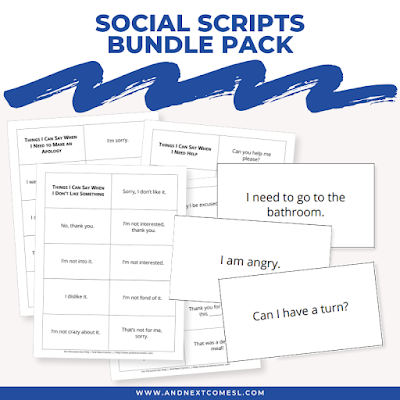
You'll find even more topics in the social scripts bundle.

Social scripts bundle

Click here to get your copy of the social scripts bundle

Free printable self advocacy scripts that teach kids, teens, and adults how to advocate for themselves and their needs

Continue reading "Free Printable Self Advocacy Scripts"

July 31, 2020

Free Printable Scripts to Help with Making Connections in Reading

These free printable scripts cards help autistic and hyperlexic kids with making connections in reading.

When I was doing research on the making connections reading strategy, I came across lots of free printable resources that did either one of two things. One, these listed a bunch of question prompts (specifically WH questions) to ask when reading. Two, they just had a definition of the three main types of connections with no concrete examples.

Now, if you have a hyperlexic kid, then you know that WH questions are hard for them. And giving them a vague idea and definition of something, without providing clear-cut examples, isn't going to be helpful either. It just doesn't play to a hyperlexic child's strengths.

However, me being me, I made something to help that does play to a hyperlexic child's strengths when making connections in reading.

The free speech scripts provided here are designed to help with the first issue I saw with other making connections printables: the use of question prompts.

With hyperlexic kids, it's better to rephrase the questions into fill-in-the-blank or cloze style sentences instead of using WH questions. So that's why these cards don't contain any questions. Instead, the kids can simply read a sentence and fill in the blanks to verbalize what they are thinking. They might still need help with making those connections while reading, but at least they'll have the language to describe them when they do.

Free scripts cards to help kids with making connections in reading

About these Free Making Connections in Reading Cards

These speech scripts cards use the same format as the other social scripts. They're small enough to fit in the palm of a hand or in a pocket so they can be taken on the go, put in your child's school desk, and/or used discretely (if that's what your child would prefer).

Their main purpose is to give autistic and hyperlexic kids the prompts they need to communicate any connections they make while reading.

Download the Free Making Connections in Reading Scripts

This printable is three pages long. Blank cards have been included as well so that you can write down and customize your own scripts.

Simply print, cut, and assemble the cards into little books so you can take them on the go, include them in a calm down corner, etc. You can either staple them together or hole punch and put on a key ring.

To get a copy of this printable, click the link below:

>> Click here to download this free printable


Want More Social Scripts?

You'll find even more topics in the social scripts bundle.

Social scripts bundle

Click here to get your copy of the social scripts bundle

Free printable scripts cards to help kids with making connections in reading

Continue reading "Free Printable Scripts to Help with Making Connections in Reading"

July 28, 2020

Where's the Support for Hyperlexic Adults?

There's not a lot of information about hyperlexia in adults so where can adult hyperlexics find support? Here are some resources to check out.

Like a lot of things in the autism community, there's a lot of information, resources, services, and support geared towards children, but practically nothing in place for the adults they eventually become. 

So I wasn't surprised to receive an email one day asking me where a hyperlexic adult could find support and resources. 

Thankfully, I have been curating a list in my mind over the past couple of years so I was able to quickly put together a list that she was rather excited about. It also helps that more and more hyperlexic adults are starting to talk about their experiences on social media and I've been taking notice, saving their posts so I can easily find them.

But I'm sure there are other hyperlexic adults out there who might be in the same situation, wondering where the resources and support for them are.

While this list isn't perfect by any means, it's a start. It will help you find others like you. Or, for the parents of hyperlexic children who are reading this, you'll be able to get the first-hand insight into hyperlexia in adults that I simply won't be able to offer you.

So here is a list of resources that might be helpful for you!

Hyperlexia in adults: where's their support?

🔎Is it Hyperlexia?

You've seen the signs in your own life: the letters, the early reading, the unique way you process information. Now to find out if hyperlexia is the name for what you've experienced and finally make sense of your story.

Hyperlexia in Adults: People & Blogs to Follow

This list isn't exhaustive, but it is a great starting point. I also highly recommend following the hastag #hyperlexia on Instagram as that is how I found a lot of these accounts and resources. 

1. Neurodivergent Rebel 
2. hvppyhands 
3. Yo Samdy Sam
4. Morénike Giwa Onaiwu
5. Autistic Sparkles

Support Groups for Hyperlexic Adults

While these groups aren't hyperlexia specific, they do have lots of hyperlexic adults in them. They're some of my favorite support groups to be in, simply to read, listen, and learn.


3. Hyperlexia + Autism Support Group - This group is run by me. I know there are quite a few hyperlexic adults in it, just probably not to the scale of the other two groups.

Hyperlexia in adults: where's the support for hyperlexic adults?
Continue reading "Where's the Support for Hyperlexic Adults?"