October 07, 2020

Free Printable Video Game Controller Themed Coping Skills Worksheets

Do your kids love video games and need help with self-regulation? Then these video game themed coping skills worksheets are perfect for them!

It's no secret my family loves video games. Like a lot. So much so that I've even made a handful of video game themed birthday cakes by this point, the most recent being a Mario coin block and a NES console (neither of which are on the blog yet, but either are last year's cakes...).

If you know me well, or even follow me on Instagram, then you also know that I'm a big proponent of using your child's interest to teach new skills

So if I can combine my kids' interests with something else, it's going to be a big win.

That's where these video game themed coping skills worksheets come in. They get my boys thinking about what they can do to help them stay regulated (or "in control"), all while appealing to their love for video games.

Free printable coping skills worksheets for kids and teens that are inspired by video games!

About these Video Game Controller Themed Coping Skills Worksheets

These worksheets are based on this brilliant idea from Crozet School Counseling. She used it specifically with her class to come up with strategies for test taking. Unfortunately, there was no printable version and some kids might prefer something other than PlayStation controllers.

Since I already had some video game controller clipart that I used for this I spy game, I thought it would be fun to put it to use again.

The idea is to have the kids brainstorm their favorite strategies that help them stay "in control" of their body and emotions. Then they can pick one of the seven different controller worksheets and fill in the boxes with their favorite coping strategies. 

Ideas to Help Your Kids & Teens Fill in these Coping Skills Worksheets

These coping skills worksheets are great for teens, tweens, and kids who love video games and can be used to discuss anger strategies, worry strategies, coping strategies, impulse control, or anything else you can think of. 

But if you need some ideas to help your kids with the brainstorming part, here are some useful resources:

Download the Free Video Game Controller Themed Coping Skills Worksheets

This printable pack includes 7 different video game controllers with spots for kids to write down their favorite coping skills and calm down strategies. The number of spots to write varies from controller to controller.

To get a copy of this printable, click the link below:

>> Click here to download the free printable


Free printable coping skills worksheets for kids and teens that are inspired by video games!

Continue reading "Free Printable Video Game Controller Themed Coping Skills Worksheets"

October 06, 2020

Free Stretch a Sentence Poster & Graphic Organizers

Make stretching a sentence a breeze with this free printable poster and graphic organizer worksheets.

Writing assignments have proven challenging for my son for a variety of reasons, but he has found using graphic organizers and breaking down the task into chunks helpful. 

He has also found the exercise of stretching a sentence particularly helpful because it helps him expand his thoughts and ideas into more detailed sentences and longer paragraphs.

While we use this exercise primarily for writing, it can certainly be helpful for speech and talking as well.

So how does this work? Let's find out!

Teach your kids how to stretch a sentence with this free printable poster and graphic organizers

How to Stretch a Sentence

Basically, you take an idea or thought the child has and use the 5 Ws to help expand the sentence into something longer and more detailed. You are essentially prompting them to ask themselves the 5 questions and write some kind of detail that answers each.

For example, the child wants to write about their dog Charlie. We have the who, but let's touch on the other WH questions to expand it further.

  • Who? My dog Charlie.
  • Doing what? My dog Charlie ran towards a tree.
  • When? Yesterday, my dog Charlie ran towards a tree.
  • Where? Yesterday, at the park, my dog Charlie ran towards a tree.
  • Why? Yesterday, at the park, my dog Charlie ran towards a tree because he wanted to chase a squirrel.
You can see how the sentence now has a lot more depth and detail. It's more interesting and informative. 

It's a really easy and straightforward exercise, one that my son has found particularly helpful. I created this poster to hang up at his school/homework station so that he can remember to do this exercise on his own when writing. You can grab a copy of the printables below.

Download the Free Stretch a Sentence Poster & Graphic Organizers

This printable pack includes one stretch a sentence poster with an example. It also includes two stretch a sentence graphic organizer worksheets, one with lines and one without, that your child can fill in.

To get your copy of these resources, click the link below.

>> Click here to download the free printable


Looking for More Graphic Organizers?

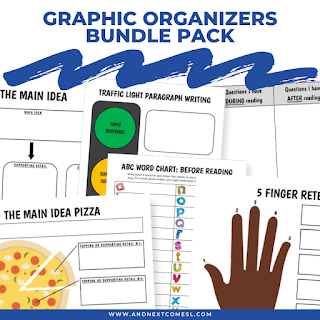
You'll find even more graphic organizers for reading and writing in the graphic organizers bundle pack.

Graphic Organizers Bundle Pack

Click here to get your copy of the graphic organizers bundle pack

Free stretch a sentence poster

Free printable stretch a sentence graphic organizers

Continue reading "Free Stretch a Sentence Poster & Graphic Organizers"

October 02, 2020

What is a KWL Chart and How Can it Help Hyperlexic Kids with their Comprehension?

What is a KWL chart and how can it help hyperlexic kids with their comprehension? Below you'll learn what the purpose of a KWL chart is. Free KWL chart printables included.

The biggest challenge for a lot of hyperlexic learners is the comprehension piece. They often need a lot of support in this area. 

But what makes working on comprehension particularly challenging is that comprehension is made up of so many things. There are so many skills that you can be simultaneously working on, which might seem overwhelming. However, on the flip side, that means there are multiple different strategies and tools that you can use to work on comprehension.

Graphic organizers are just one tool that can be used, just like activating prior knowledge and schema is one strategy you can use. Now, a KWL chart is a great combination of the two.

But what is a KWL chart exactly? And how can it help hyperlexic kids with their comprehension? Well, that's what you'll learn below. Plus, I've included some free KWL graphic organizers that you can use with your hyperlexic child.

Free KWL charts & how they can help hyperlexic kids with their comprehension

What is a KWL Chart?

A KWL chart is a graphic organizer that can be used to organize information. KWL stands for Know, Want to know, and Learn. It can be a great tool for activating schema or prior knowledge and for checking comprehension and understanding.

To make a KWL chart, you need to make three columns, one for each letter of the KWL acronym. But don't worry, I have some free printable KWL graphic organizers for you to download below. Some digital versions too.

How Does a KWL Chart Work?

Before reading, you encourage kids to make a list of things they already know about the topic, as well as anything they want to know about that topic. Then after reading, they can make a list of things they learned about the topic.

What is the Purpose of a KWL Chart?

You can use KWL charts to:

  • Help kids organize information
  • Activate schema and background knowledge (and thus, increase comprehension!)
  • Recall knowledge
  • Track learning
  • Reveal whether or not there are gaps in understanding
  • Get kids interested and engaged in a new topic

Why You Should Use KWL Charts with Hyperlexic Kids

If you're already familiar with how hyperlexic kids learn, then you know that it's important to support their language learning by using written language. You know they learn best visually. 

That's why using graphic organizers, such as KWL charts, can be extremely helpful for hyperlexic children. It plays to their strengths.

Besides, comprehension difficulties are common in hyperlexic kids. So one of the main reasons you want to use KWL charts with hyperlexic kids is to help activate that schema and background knowledge. Doing so can help boost their comprehension and understanding.

The first two columns of the KWL chart are designed to encourage hyperlexic kids to really think about what they know and make connections, if they can. It gets them thinking about the topic ahead of time and helps prime them for learning before reading the book.

The third column can reveal whether or not there are gaps in their comprehension. You can use it as a tool to check whether or not they understand the main points of the book.

Download the Free KWL Graphic Organizers {Printable & Digital Versions}

This freebie includes: 3 printable KWL charts without lines, 3 printable KWL charts with lines, and 3 different digital Google Slides versions. You get to pick which design and format best suits your needs.

To get your copy, click the link below.

>> Click here to download the free printable


Looking for More Graphic Organizers?

You'll find even more graphic organizers for reading and writing in the graphic organizers bundle pack.

Graphic Organizers Bundle Pack

Click here to get your copy of the graphic organizers bundle pack

Free KWL charts & how they can help hyperlexic kids with their comprehension

Continue reading "What is a KWL Chart and How Can it Help Hyperlexic Kids with their Comprehension?"

October 01, 2020

What You Need to Know About Hyperlexia & Air Writing

Air writing with a finger seems to be a common hyperlexia and autism trait, but what exactly is it? Below you'll learn more about hyperlexia air writing and why it can be beneficial for your child.

Have you ever noticed your hyperlexic child writing letters and words in the air with their finger before? 

Well, it seems this air writing is quite common among hyperlexics, which is something that I've discussed before. I've even referred to it as a missing trait of hyperlexia, meaning it's a trait that you won't find on the list of official characteristics or signs of hyperlexia, but it seems so common that I feel like it should be included on the list.

Anyway, someone recently reached out to me to learn more about this air writing and what it means. They wanted to better understand why their child did it and whether or not it was something that should be encouraged or discouraged.

So let's take a closer look at this whole hyperlexia air writing thing and learn more about what it is and the reasons why they do it (and why it's beneficial). I've also answered a few commonly asked questions about writing in the air.

Hyperlexia & air writing: what you need to know

So, What is Air Writing Exactly?

Basically, imagine your finger is an invisible pen that you use to write in the air. That's air writing. It's when you use your finger to "write" words or letters in the air. It is often done unconsciously or automatically by hyperlexic learners.

What is air writing? A definition

Now, while it's often written in the air, as the name implies, it can also be written on a surface like a table or even on their body such as their palm or upper leg. I've even had hyperlexic adults share with me that their air writing sometimes takes the form of air typing, where they're typing on an invisible keyboard, or they might do air writing using their toes so it's more discreet.

If you watch your hyperlexic learner closely, you can actually see them writing letters and/or complete words in the air as if they were writing it down on paper. You might be able to tell what words they are writing. I know that I always could with my son (and sometimes I'd write back)! You'll also discover that this air writing isn't random scribbling or drawing. They are usually writing something specific.

It's worth pointing out that, if your hyperlexic learner also has hypernumeracy, then their air writing might take the form of numbers and math problems instead of letters and words. I've even had parents tell me that their child's air writing takes the form of writing music notes. But, most of the time, for hyperlexic learners, it's letters and words.

Why Your Hyperlexic Child Could Be Air Writing

So, why do hyperlexic learners do air writing? And why is it beneficial? Well, there are a few explanations...

1. Self-Regulation Tool

Air writing is often used as a tool for self-regulation (aka as a stim or self-stimulatory behavior). That means, writing letters and words in the air can be a coping strategy as it is calming and soothing for hyperlexic learners. So, it's important to note that you might notice an increase in air writing whenever they're excited, overwhelmed, or feeling anxious.

2. Language Processing Strategy

Air writing can also be used as a strategy for processing language. They may use it to rehearse familiar phrases, decode new words, or silently script what they want to say, especially given that they're gestalt language processors. In other words, they might be using air writing to compose or organize language before verbalizing.

3. Visual Learning & Comprehension

Hyperlexic learners are strong visual learners and air writing is a great way to visualize language and improve comprehension. Writing in the air with their finger can help them see the words they hear or want to say.

Remember, with hyperlexia, if it isn't written down, it might not exist. In that sense, air writing can be used as a tool to help them "write it down" and see the words they are hearing, improving recall and comprehension.

4. Provides Stability

Air writing can also provide stability. And we know that hyperlexic learners have a strong preference for stable routines and predictable structures.

As the following quote from the book The Reason I Jump illustrates, letters and symbols are comforting because they never change, providing these learners with a way to feel grounded when everything around them might feel unpredictable or uncertain. Naoki writes:

"People with autism often write letters in the air...In my case, I'm writing to confirm what I want to remember. As I write, I'm recalling what I've seen - not as scenes, but as letters, signs and symbols. Letters, symbols and signs are my closest allies because they never change...When I'm writing them out, I can forget everything else." - Naoki Higashida, The Reason I Jump

So, in a way, air writing creates a sense of stability when everything else feels uncertain or overwhelming because letters, signs, and symbols themselves are always consistent. They never change.

Reasons a hyperlexic learner might use air writing

Should Air Writing Be Encouraged or Discouraged?

As you can see, air writing is beneficial for hyperlexic learners for a variety of reasons. So, it's something that should definitely be encouraged, not discouraged. After all, it's a helpful (and harmless!) strategy that hyperlexic learners use to make sense of the world around them

In other words, air writing needs to be respected as a tool that supports language, communication, and regulation for these types of learners.

However, if it seems to increase in frequency or begins to interfere with daily functioning, it might be a sign that something else is going on. For instance, are there any changes at school, at home, etc. that might be causing an increase in anxiety, stress, or sensory dysregulation? In this case, you should be observing when the child uses it and look for patterns to see if you can find out what might be causing a sharp increase in using air writing.

Other people such as family, friends, teachers, therapists, etc. might misunderstand your hyperlexic learner's air writing and try to discourage or redirect it. In these instances, you can offer simple explanations for why your child finds air writing comforting and helpful and why it's something that should be encouraged rather than squashed or redirected.

Air writing is beneficial for hyperlexic learners and should be encouraged, not discouraged.

Does Air Writing Go Away with Age?

This is a common question that parents ask me about air writing. And the answer is...sort of. It really depends on a few factors.

Air writing tends to be especially common in younger hyperlexic children (like those under age 8-10ish). During these years, it's often much more visible and frequent.

Air writing tends to be especially common in younger hyperlexic children

However, as language and communication skills improve, and as they develop other ways to regulate and process information, many hyperlexic children begin to rely on air writing less often. That doesn't mean it disappears completely though. It may just show up differently or less frequently. And it's not unusual for air writing to resurface during times of stress, excitement, or overwhelm.

It's also worth noting that sometimes air writing evolves and changes. For example, it might become more discreet (e.g., writing on their palm instead of writing big letters in the air) or it might take another form (e.g., air writing with their toes). There are a few reasons why this shift happens, ranging from years of therapy that tried to discourage or suppress it, social awareness or masking (i.e., they don't want to stand out), motor development (i.e., they can make their air writing smaller and more precise), development of alternative strategies (i.e., they might just write things down physically in a notebook instead), and environmental expectations.

So, yes, you might see it decrease with age. Or it might take more discreet forms or get replaced by alternative coping strategies.

For hyperlexic learners, you might see air writing decrease with age. Or it might take more discreet forms or get replaced by alternative coping strategies.

A Summary of Air Writing in Hyperlexia

Here's a quick recap of what was discussed above regarding hyperlexia and air writing:

  • Air writing is when you use your finger to "write" words or letters in the air.
  • It can be used to support regulation, language processing, and comprehension, while also providing stability.
  • It's something that should be respected for what it is and encouraged as it's a helpful and harmless strategy for hyperlexic learners.
  • You might notice an increase in air writing (or a return to, if the child is older) when the child feels overwhelmed, anxious, or excited.
  • Air writing is especially common in younger hyperlexic children and can decrease with age, but sometimes it just changes form, gets replaced by other coping strategies, or becomes more discreet. It may also resurface during times of stress, excitement, or overwhelm.

And that's what you need to know about hyperlexia air writing.

Hyperlexia & air writing: what you need to know

Continue reading "What You Need to Know About Hyperlexia & Air Writing"