Friday, November 06, 2020

Free Printable Answering WH Questions Cheat Sheet

This free printable WH questions cheat sheet gives examples of how to answer different types WH questions. It's a great tool for supporting comprehension.

When it comes to teaching WH questions to hyperlexic kids, it's important to teach them directly. That includes teaching them both how to ask and how to answer WH questions. 

One of the ways to do that is to give them a visual support that shows examples or lists out how to answer each type of question. Having it all written out is so helpful for hyperlexic kids.

That's where this free printable answering WH questions cheat sheet comes in. 

It takes these WH question word cards one (very detailed) step further by giving clear examples of possible answers for a variety of WH questions. And I'm talking beyond who, what, where, when, why, and how here. Those types of questions are just a small sampling of possible WH questions your child will encounter.

This free printable WH questions cheat sheet gives examples of how to answer different types WH questions. It's great for supporting comprehension!

About this Answering Wh Questions Cheat Sheet

This cheat sheet breaks down 18 different types of WH questions and variants, including:

  • Who questions
  • Whose questions
  • What questions, including: What kind/type? What time? What for?
  • Why questions
  • When questions
  • Where questions
  • Which questions
  • How questions, including How much? How many? How old? How long? How often? How far? How come?

Then it gives concrete and specific ways to answer each.

This free printable WH questions cheat sheet gives examples of how to answer different types WH questions. It's great for supporting comprehension!

For instance, we know "who" questions are asking for information about a person, but that could be the name of a person (real or imaginary), an animal, an occupation, a role, a description, a title, or even a pronoun.

So your child can scan the list for the type of WH question they are being asked and then look at the possible ways to answer it and (hopefully!) feel more confident formulating a response. Or, alternatively, if they are wanting to ask a specific question, they could look at the answer column and use those examples as a clue for which WH question word to use when asking a question.

This free printable WH questions cheat sheet gives examples of how to answer different types WH questions. It's great for supporting comprehension!

Download the Free Printable Answering WH Questions Cheat Sheet

This printable includes two pages of types of WH questions along with possible ways to answer each. It would be great to print double-sided and laminate for durability. Then it can be kept handy at school or at home.

To get a copy of this printable, click the link below:

>> Click here to download this free printable


This free printable WH questions cheat sheet gives examples of how to answer different types WH questions. It's great for supporting comprehension!

Continue reading "Free Printable Answering WH Questions Cheat Sheet"

Wednesday, November 04, 2020

How to Teach WH Questions to Hyperlexic Kids

Is your hyperlexic child struggling with WH questions? Here are some strategies for teaching WH questions that incorporate their strengths in reading and decoding the written word.

Most hyperlexic kids "have difficulty understanding and/or answering questions with: who? why? when? where? and how?" (source: What is Hyperlexia? pamphlet). 

But you probably already know that if you're a parent of a hyperlexic kid. I mean there is a reason you are here reading this right now...right? 

WH questions are really hard - bordering on impossible some days - for hyperlexic kids. You've seen the blank look on their faces when you ask them one of these dreaded WH questions. It's almost as if you were speaking gibberish to them. 

So how do you go about teaching WH questions to these hyperlexic kids? 

Below you will find four simple ways to teach WH questions, but also lots of specific strategies and tips within these four categories. And, of course, some free printables along the way because that's how I roll around here.

Tips & strategies for teaching WH- questions to hyperlexic kids

4 Simple Ways to Confidently Teach WH Questions to Hyperlexic Kids (By Playing to Their Strengths)

Hyperlexic kids learn differently. That's why they need strategies that are tailored to them and their unique learning style. Using their ability to decode and to read is super important. Same goes for writing things down. 

Remember, with hyperlexia, if it isn't written down, it might not exist. 

The strategies and suggestions that you find below play to these strengths. 

1. Teach the Rules of WH Questions Through Direct Instruction

One of the best ways to teach hyperlexic kids about WH questions is through direct instruction. That includes teaching what information each question is asking for, what types of answers they require, and how questions are structured. This includes reading about WH questions and how they work, writing down lists of rules, using written supports, or similar.

Here are some specific strategies and suggestions you could try:

  • Be sure to provide lots of specific and concrete examples for answering the different types of questions (free cheat sheet here) because there are so many different ways to answer a question (e.g., a "who" question usually means we have to answer with a person or living thing, but that might mean saying a person's name such as Steve, a profession such as the math teacher, a type of person or relationship such as my friend or my neighbor, a pronoun such as him or her, or even something that isn't a person like my dog Frank)
  • Look for a video on YouTube or read a book that explains the rules of WH questions and/or provides examples of how to answer them

2. Use Scripts to Teach WH Questions

Take advantage of your hyperlexic child's ability to read/decode and provide them with functional ways to answer WH questions by using scripts and written patterns. Seriously, written scripts are an incredibly powerful tool for hyperlexic kids!

Try these ideas:

  • Use a fill-in-the-blank format to show possible answers (e.g., "Why...?" could be answered with "Because..." or "To..." or "So that..." )
  • Practice with frequently asked questions like "What is your name?" or "Where do you live?" as these questions follow a standard format for replies (that is, most people answer them in the same way), are common questions your child might get asked, and, since they are so common, can help build your child's confidence in answering WH questions (free printable here to help)
  • Start off by writing out questions and answers in full for them to read, then gradually fade to fill-in-the-blank answers and, eventually, move to using just verbal prompts
  • Teach them scripted answers that will help them ask for clarification (and also show them that it is okay not to know the answer to every question) such as: I don't know, I'm not sure, What does that mean?, Can you explain that again?, Give me a clue, I don't understand the question, Can you repeat the question?, etc.

3. Work On Developing Other Tricky Language Concepts

WH questions can be quite abstract and the possible ways to answer them are wide and varied. Sometimes other language concepts such as prepositions, pronouns, cause and effect, sequencing, attributes, inferencing, and vocabulary might be impacting the comprehension and understanding of WH questions. And, if you have a hyperlexic kid, you know that your child might also be struggling with some - or all - of these types of language concepts.

Here's a bit more insight on how these concepts might be impacting your child's ability to answer WH questions and how you can use the hyperlexic child's strengths to build these skills:

  • Pronoun reversals are common in hyperlexic kids, which means "who" questions can be difficult if your child is still struggling to understand which pronouns refer to which people. It's important to make sure your child is learning about and practicing pronouns. So write down pronoun rules for them.
  • Teaching about prepositions (in, on, behind, under, before, after, etc.) can help with "where" questions and even some "when" questions. Find some visual cards that show what these different prepositions mean or try a simple activity like this using a favorite toy.
  • Developing sequencing skills and helping your child better understand how things work (think, cause and effect here) can also help improve your child's WH question skills. If they have a better understanding of sequences, then answers to "when" questions might make more sense to them. Same goes for "why" questions if they have a better grasp on cause and effect relationships. Using a cause and effect graphic organizer or first, then, next charts can be helpful for building these skills. Visual schedules also help build these sequencing skills.
  • Working on vocabulary, attributes, features, and descriptors can all make a huge impact on your child's ability to answer WH questions too so be sure that you are also developing these skills. It's a lot easier to answer a WH question like "What animal has a long neck?" if you have a better understanding of the attributes and features of a giraffe. Write out lists of attributes and features of different words and practice pointing out different features of things you see around you. Do sensory bins together and narrate the play, highlighting different sensory features, textures, colors, shapes, etc. (e.g., "Oh this water is so cold and wet!").

4. Practice, Model, & Repeat!

Lots and lots of repetition and practice will lead to mastery, just like with any skill you want to work on. Thankfully, there are lots of opportunities to practice WH questions while reading, through play, by modeling everyday activities, using visual supports, and with printable WH question cards.

Here are some ideas to try:

  • While reading books, point to different images in the book and ask questions like "What is this?" or "Where is...?", etc. Wait for them to answer or answer your own question if they can't answer it, making sure to point to the answer. You can do the same with books without pictures by pointing directly to the answers in the text. To make this strategy even more effective, write down the questions on a sticky note or whiteboard.
  • After reading a book, encourage your child to go through the book and find all of the people in the book (the "whos") or all the places in the book (the "wheres"). Work together to write down a list of all the "whos" and "wheres" on a piece of paper or on a whiteboard.
  • Dictate your day by posing WH questions, giving your child a chance to respond, and modeling how to answer the questions if they find it difficult to answer (e.g., while fixing a bowl of cereal for breakfast, ask "What do I need to eat my cereal?" -> "I need a spoon!" or while playing a game, ask "Who's turn is it next?" -> "It's my turn!")
  • Take a recent event (vacation, birthday party, or similar) and make a small book about it with your child, targeting each WH question. Make a page dedicated to all the people who attended (the "who"), a page dedicated to the location of the event (the "where"), etc. Write down the names, places, objects, time, etc. and include any photos, if possible.
  • Download an app that targets WH questions, such as the WH Question Cards app from Super Duper Publications
Finally, remember to be patient. These skills take time to develop and master.

Other Comprehension Related Resources You'll Love

Picture Walk Reading Strategy

Resources to Teach Reading Comprehension, WH Questions, & Making Inferences

Free WH Questions Social Story

Simple strategies and tips on how to teach WH questions to hyperlexic kids

Continue reading "How to Teach WH Questions to Hyperlexic Kids"

Tuesday, November 03, 2020

Do Autistic or Hyperlexic Kids Really Need Therapy?

So many parents are told that their kids need to be in certain therapies simply for being autistic or hyperlexic and that's the wrong approach. Here's what needs to be done instead.

When your child receives their autism or hyperlexia diagnosis, people start recommending a bunch of therapies. Some good, some bad, lots without any scientific evidence, and a whole bunch of woo. Try this, try that…blah, blah, blah.

It's so easy to become overwhelmed by all the “should do's” that people recommend. And before you know it, you're confused about the path you should be following.

So many parents are told that their kids need to be in certain therapies simply for being autistic or hyperlexic and that's the wrong approach. Here's what needs to be done instead.

But here's the thing, a diagnosis of autism or hyperlexia itself doesn't necessarily mean your child needs therapy.

And there's certainly no one-size-fits-all approach to therapy because, guess what, each child is different and has their own set of unique needs that might need addressing.

So anyone who tells you that you need to put your child in x type of therapy simply because they are autistic or hyperlexic is missing the point for the two reasons I mention above.

Instead, it's important to sit down and figure out what kind of supports and accommodations your child needs and what issues your child might be facing. Then pick therapies accordingly. For instance:

  • Are you concerned about their speech and language skills? Then speech therapy might be what you need.
  • Does your child need help with self-regulation or a sensory diet? Then it might be time to consult with an occupational therapist.
  • Dealing with anxiety? Maybe it's time to connect with a psychologist.
  • Struggling to get your kid to eat anything that isn't beige? Perhaps it's time to reach out to a feeding therapist.
  • Dealing with reading comprehension issues? Research your options and talk to your child's resource or special education teacher at school to see what programs might be available or look for a speech path trained in a program such as Visualizing & Verbalizing.
Do you see the pattern here? Your child's therapy program should be tailored to them and their unique needs. Therapy should be sought out based on whatever challenges you are facing instead of just signing up for some therapy simply because someone told you to because of their autism diagnosis.

And this might mean that your child might need blocks of therapy here or there as new challenges or issues arise instead of being assigned x amount of hours simply for being autistic or hyperlexic. Or there might be times where your child might not need any therapy at all.

I'm not trying to dismiss the importance of therapy here. Goodness, no.

Instead, I want you to think about and consider what the reasons are behind pursuing certain therapy options. 

  • Are you pursuing it because it can genuinely help your child and it supports their needs?
  • Do the goals of that therapy align with the goals you have for your child?
  • Does the therapy respect your child and their interests?
  • What is the scientific evidence supporting said therapy?
Be critical and diligent here because not all therapies are created equal. Nor do many have your child's best interests in mind.

Other Resources You'll Love


So many parents are told that their kids need to be in certain therapies simply for being autistic or hyperlexic and that's the wrong approach. Here's what needs to be done instead.
Continue reading "Do Autistic or Hyperlexic Kids Really Need Therapy?"

Tuesday, October 27, 2020

Free Printable Mario Themed Graphic Organizer for Writing

Here's a fun graphic organizer for writing that's inspired by Mario! Free printable and digital Google Slides versions available.

Graphic organizers have been an invaluable tool to help my son with both his reading comprehension and his writing. 

I recently made this hamburger graphic organizer and I wondered if it was possible to take that format and structure and create other themed organizers for my son. Ones that might be even more interesting to him than a hamburger. 

I always try to include his interests in some way, if possible. It increases buy-in. And Mario is a current interest/passion of his.

So, after making the hamburger graphic organizer, it dawned on me that I could adapt the structure of a paragraph to the layout of a Mario level. After all, a Mario level needs supporting details too. Otherwise, it's just a boring piece of land to walk across. 

So if your kids love Mario like mine do, they're going to love this Mario themed graphic organizer for writing paragraphs.

Free Mario writing graphic organizer for kids

About this Graphic Organizer for Writing

A level in Mario would be pretty boring without details like warp pipes, question blocks, and the flag at the end of the level. The same goes for writing paragraphs. A paragraph without details, isn't much of a paragraph. 

This graphic organizer is designed to help kids plan out and organize their thoughts into sentences and ideas before writing a paragraph by building a level for Mario. 

First, you fill in the topic sentence for the question block by asking yourself, "What is this paragraph about?" Then you add three supporting details, one for each of the different pipes. Then you need to finish the paragraph off by sliding down the flag at the end of the level.

Download the Free Mario Themed Writing Graphic Organizer

This printable includes two Mario themed graphic organizers for writing, one with lines and one without, that your child can fill in to plan out their paragraphs. A digital Google Slides version is included as well.

To get your copy, click the link below.

>> Click here to download the free printable


Looking for More Graphic Organizers?

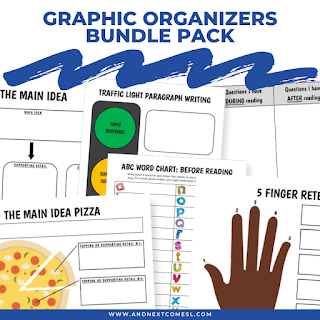
You'll find even more graphic organizers for reading and writing in the graphic organizers bundle pack.

Graphic Organizers Bundle Pack

Click here to get your copy of the graphic organizers bundle pack

Free Mario themed graphic organizer for writing paragraphs

Continue reading "Free Printable Mario Themed Graphic Organizer for Writing"

Monday, October 19, 2020

Free Printable Hamburger Graphic Organizer for Paragraph Writing

Use this free hamburger graphic organizer to help kids with paragraph writing.

Writing paragraphs is challenging for lots of kids, my son included. So we've been making use of graphic organizers to help him with his writing. Basically, I want it to be less stressful and anxiety-inducing for him. 

I really like using this hamburger graphic organizer for writing because it helps my son plan out his paragraphs before actually writing them. It helps break down the writing process into smaller, bite-sized pieces and helps him visualize what his paragraph should look like.

The idea is to make a nice juicy hamburger, loaded with toppings, instead of a boring bunwich with no "meat." As delicious as buns are, they're a bit boring on their own...

Free hamburger graphic organizer printable for writing

About the Hamburger Graphic Organizer

This graphic organizer is designed to help kids plan out and organize their thoughts before writing a paragraph. 

Hamburger paragraph writing follows the format of writing a paragraph with an opening sentence about the topic, supporting it with three details, and wrapping it up or closing the paragraph with a concluding sentence. 

Basically, they're building a hamburger where the buns are the opening and concluding sentence and the meat and toppings are the supporting details. 

The hamburger would be pretty boring with just the buns, right? Same idea goes for paragraphs. A well-written paragraph needs details to support the topic or argument. Essentially, it needs a bit of "meat."

So encourage kids to think about the "meat" of their paragraph ahead of time by writing it down on this blank hamburger graphic organizer and they'll be that much closer to writing a better paragraph.

Download the Free Hamburger Graphic Organizer Printable

This printable includes two hamburger graphic organizers, one with lines and one without, that your child can fill in. A digital Google Slides version is included as well.

To get your copy, click the link below.

>> Click here to download the free printable


Looking for More Graphic Organizers?

You'll find even more graphic organizers for reading and writing in the graphic organizers bundle pack.

Graphic Organizers Bundle Pack

Click here to get your copy of the graphic organizers bundle pack

Free hamburger graphic organizer for paragraph writing


Continue reading "Free Printable Hamburger Graphic Organizer for Paragraph Writing"

Thursday, October 15, 2020

Free Printable Mario Question Block Deep Breathing Exercise for Kids

Inspired by square breathing, this free printable Mario question block deep breathing exercise is perfect for kids!

I'm a huge advocate of using your child's interests as a hook to engage your child in learning other things. 

This Mario question block deep breathing exercise for kids is a perfect example. It takes my kids' interest in Mario to teach self-regulation and coping skills. That means, teaching something like deep breathing is instantly more appealing to my kids because they recognize that it's Mario themed.

Also, fun fact: I made my oldest son a question block cake this year for his birthday. One day I'll post it on the blog...

Square breathing exercise for kids inspired by Mario question block

About this Mario Themed Deep Breathing Technique

It's probably pretty obvious at this point that this deep breathing exercise for kids is inspired by the famous question mark block from the Mario franchise...

You can also quickly tell it's based on the popular square breathing technique, where you follow the outline of a square, breathing in and out. In this exercise, you start by breathing in for 4 counts. Then you hold. Then you breathe out for 4 counts. And finally, you rest.

But don't worry, everything is outlined on the printable poster, which you can find below.

Free printable Mario themed deep breathing exercise for kids that's based on the square breathing technique

Download the Free Printable Mario Inspired Deep Breathing Exercise for Kids

This one page printable outlines how to use this deep breathing technique. It includes written instructions and visual guides/cues to help you or your child use the technique.

I highly recommend laminating the poster for durability. Then feel free to include it in a calm down kit or calm down corner.

To get a copy of this printable, click the link below:

>> Click here to download the free printable


Free printable Mario themed deep breathing exercise for kids that's based on the square breathing technique

Continue reading "Free Printable Mario Question Block Deep Breathing Exercise for Kids"

Wednesday, October 14, 2020

Free Printable 5 Senses Graphic Organizers

Free printable 5 senses graphic organizers for kids to work on describing and writing. Digital Google Slides versions are included too!

Graphic organizers are incredibly helpful, especially for hyperlexic kids. I think, at this point, they're becoming the best tools for helping my son with writing and reading comprehension while we're home educating this year. So expect more and more of these types of printables on the blog in the coming months...

One area that graphic organizers are helping with is writing. We've been using graphic organizers to help stretch a sentence with great success. And now we're working on adding more details using our senses to describe the topic, which is where these 5 senses graphic organizers come in.

5 senses graphic organizer pdf

About the 5 Senses Graphic Organizer

This describing graphic organizer has a space to write the topic your child is writing about and 5 boxes to make a list of ways to describe that topic using the 5 senses: sight, taste, sound, touch, and smell.

How it works is your child writes down all the sensory related things that they can think of before writing a paragraph about the topic as a way to plan out all of their ideas. Then, as they write, they try to incorporate these sensory details into their sentences. It will help give their sentences more depth and interest.

Download the Free 5 Senses Graphic Organizers

This printable includes four describing graphic organizers (with two types of clipart), two with lines and two without, that your child can fill in. It also includes two digital Google Slides versions.

To get your copy, click the link below.

>> Click here to download the free printable


Looking for More Graphic Organizers?

You'll find even more graphic organizers for reading and writing in the graphic organizers bundle pack.

Graphic Organizers Bundle Pack

Click here to get your copy of the graphic organizers bundle pack

Free 5 senses graphic organizer printable (digital Google Slides version included too!) that helps kids with describing and writing

Continue reading "Free Printable 5 Senses Graphic Organizers"

Wednesday, October 07, 2020

Free Printable Video Game Controller Themed Coping Skills Worksheets

Do your kids love video games and need help with self-regulation? Then these video game themed coping skills worksheets are perfect for them!

It's no secret my family loves video games. Like a lot. So much so that I've even made a handful of video game themed birthday cakes by this point, the most recent being a Mario coin block and a NES console (neither of which are on the blog yet, but either are last year's cakes...).

If you know me well, or even follow me on Instagram, then you also know that I'm a big proponent of using your child's interest to teach new skills

So if I can combine my kids' interests with something else, it's going to be a big win.

That's where these video game themed coping skills worksheets come in. They get my boys thinking about what they can do to help them stay regulated (or "in control"), all while appealing to their love for video games.

Free printable coping skills worksheets for kids and teens that are inspired by video games!

About these Video Game Controller Themed Coping Skills Worksheets

These worksheets are based on this brilliant idea from Crozet School Counseling. She used it specifically with her class to come up with strategies for test taking. Unfortunately, there was no printable version and some kids might prefer something other than PlayStation controllers.

Since I already had some video game controller clipart that I used for this I spy game, I thought it would be fun to put it to use again.

The idea is to have the kids brainstorm their favorite strategies that help them stay "in control" of their body and emotions. Then they can pick one of the seven different controller worksheets and fill in the boxes with their favorite coping strategies. 

Ideas to Help Your Kids & Teens Fill in these Coping Skills Worksheets

These coping skills worksheets are great for teens, tweens, and kids who love video games and can be used to discuss anger strategies, worry strategies, coping strategies, impulse control, or anything else you can think of. 

But if you need some ideas to help your kids with the brainstorming part, here are some useful resources:

Download the Free Video Game Controller Themed Coping Skills Worksheets

This printable pack includes 7 different video game controllers with spots for kids to write down their favorite coping skills and calm down strategies. The number of spots to write varies from controller to controller.

To get a copy of this printable, click the link below:

>> Click here to download the free printable


Free printable coping skills worksheets for kids and teens that are inspired by video games!

Continue reading "Free Printable Video Game Controller Themed Coping Skills Worksheets"

Tuesday, October 06, 2020

Free Stretch a Sentence Poster & Graphic Organizers

Make stretching a sentence a breeze with this free printable poster and graphic organizer worksheets.

Writing assignments have proven challenging for my son for a variety of reasons, but he has found using graphic organizers and breaking down the task into chunks helpful. 

He has also found the exercise of stretching a sentence particularly helpful because it helps him expand his thoughts and ideas into more detailed sentences and longer paragraphs.

While we use this exercise primarily for writing, it can certainly be helpful for speech and talking as well.

So how does this work? Let's find out!

Teach your kids how to stretch a sentence with this free printable poster and graphic organizers

How to Stretch a Sentence

Basically, you take an idea or thought the child has and use the 5 Ws to help expand the sentence into something longer and more detailed. You are essentially prompting them to ask themselves the 5 questions and write some kind of detail that answers each.

For example, the child wants to write about their dog Charlie. We have the who, but let's touch on the other WH questions to expand it further.

  • Who? My dog Charlie.
  • Doing what? My dog Charlie ran towards a tree.
  • When? Yesterday, my dog Charlie ran towards a tree.
  • Where? Yesterday, at the park, my dog Charlie ran towards a tree.
  • Why? Yesterday, at the park, my dog Charlie ran towards a tree because he wanted to chase a squirrel.
You can see how the sentence now has a lot more depth and detail. It's more interesting and informative. 

It's a really easy and straightforward exercise, one that my son has found particularly helpful. I created this poster to hang up at his school/homework station so that he can remember to do this exercise on his own when writing. You can grab a copy of the printables below.

Download the Free Stretch a Sentence Poster & Graphic Organizers

This printable pack includes one stretch a sentence poster with an example. It also includes two stretch a sentence graphic organizer worksheets, one with lines and one without, that your child can fill in.

To get your copy of these resources, click the link below.

>> Click here to download the free printable


Looking for More Graphic Organizers?

You'll find even more graphic organizers for reading and writing in the graphic organizers bundle pack.

Graphic Organizers Bundle Pack

Click here to get your copy of the graphic organizers bundle pack

Free stretch a sentence poster

Free printable stretch a sentence graphic organizers

Continue reading "Free Stretch a Sentence Poster & Graphic Organizers"

Friday, October 02, 2020

What is a KWL Chart and How Can it Help Hyperlexic Kids with their Comprehension?

What is a KWL chart and how can it help hyperlexic kids with their comprehension? Below you'll learn what the purpose of a KWL chart is. Free KWL chart printables included.

The biggest challenge for a lot of hyperlexic learners is the comprehension piece. They often need a lot of support in this area. 

But what makes working on comprehension particularly challenging is that comprehension is made up of so many things. There are so many skills that you can be simultaneously working on, which might seem overwhelming. However, on the flip side, that means there are multiple different strategies and tools that you can use to work on comprehension.

Graphic organizers are just one tool that can be used, just like activating prior knowledge and schema is one strategy you can use. Now, a KWL chart is a great combination of the two.

But what is a KWL chart exactly? And how can it help hyperlexic kids with their comprehension? Well, that's what you'll learn below. Plus, I've included some free KWL graphic organizers that you can use with your hyperlexic child.

Free KWL charts & how they can help hyperlexic kids with their comprehension

What is a KWL Chart?

A KWL chart is a graphic organizer that can be used to organize information. KWL stands for Know, Want to know, and Learn. It can be a great tool for activating schema or prior knowledge and for checking comprehension and understanding.

To make a KWL chart, you need to make three columns, one for each letter of the KWL acronym. But don't worry, I have some free printable KWL graphic organizers for you to download below. Some digital versions too.

How Does a KWL Chart Work?

Before reading, you encourage kids to make a list of things they already know about the topic, as well as anything they want to know about that topic. Then after reading, they can make a list of things they learned about the topic.

What is the Purpose of a KWL Chart?

You can use KWL charts to:

  • Help kids organize information
  • Activate schema and background knowledge (and thus, increase comprehension!)
  • Recall knowledge
  • Track learning
  • Reveal whether or not there are gaps in understanding
  • Get kids interested and engaged in a new topic

Why You Should Use KWL Charts with Hyperlexic Kids

If you're already familiar with how hyperlexic kids learn, then you know that it's important to support their language learning by using written language. You know they learn best visually. 

That's why using graphic organizers, such as KWL charts, can be extremely helpful for hyperlexic children. It plays to their strengths.

Besides, comprehension difficulties are common in hyperlexic kids. So one of the main reasons you want to use KWL charts with hyperlexic kids is to help activate that schema and background knowledge. Doing so can help boost their comprehension and understanding.

The first two columns of the KWL chart are designed to encourage hyperlexic kids to really think about what they know and make connections, if they can. It gets them thinking about the topic ahead of time and helps prime them for learning before reading the book.

The third column can reveal whether or not there are gaps in their comprehension. You can use it as a tool to check whether or not they understand the main points of the book.

Download the Free KWL Graphic Organizers {Printable & Digital Versions}

This freebie includes: 3 printable KWL charts without lines, 3 printable KWL charts with lines, and 3 different digital Google Slides versions. You get to pick which design and format best suits your needs.

To get your copy, click the link below.

>> Click here to download the free printable


Looking for More Graphic Organizers?

You'll find even more graphic organizers for reading and writing in the graphic organizers bundle pack.

Graphic Organizers Bundle Pack

Click here to get your copy of the graphic organizers bundle pack

Free KWL charts & how they can help hyperlexic kids with their comprehension

Continue reading "What is a KWL Chart and How Can it Help Hyperlexic Kids with their Comprehension?"

Thursday, October 01, 2020

What You Need to Know About Hyperlexia & Air Writing

Air writing with a finger seems to be a common hyperlexia and autism trait, but what exactly is it? Below you'll learn more about hyperlexia air writing and why it can be beneficial for your child.

Have you ever noticed your hyperlexic child writing letters and words in the air with their finger before? 

Well, it seems this air writing is quite common among hyperlexics, which is something that I've discussed before. I've even referred to it as a missing trait of hyperlexia, meaning it's a trait that you won't find on the list of official characteristics or signs of hyperlexia, but it seems so common that I feel like it should be included on the list.

Anyway, someone recently reached out to me to learn more about this air writing and what it means. They wanted to better understand why their child did it and whether or not it was something that should be encouraged or discouraged.

So let's take a closer look at this whole hyperlexia air writing thing and learn more about what it is and the reasons why they do it (and why it's beneficial). I've also answered a few commonly asked questions about writing in the air.

Hyperlexia & air writing: what you need to know

So, What is Air Writing Exactly?

Basically, imagine your finger is an invisible pen that you use to write in the air. That's air writing. It's when you use your finger to "write" words or letters in the air. It is often done unconsciously or automatically by hyperlexic learners.

What is air writing? A definition

Now, while it's often written in the air, as the name implies, it can also be written on a surface like a table or even on their body such as their palm or upper leg. I've even had hyperlexic adults share with me that their air writing sometimes takes the form of air typing, where they're typing on an invisible keyboard, or they might do air writing using their toes so it's more discreet.

If you watch your hyperlexic learner closely, you can actually see them writing letters and/or complete words in the air as if they were writing it down on paper. You might be able to tell what words they are writing. I know that I always could with my son (and sometimes I'd write back)! You'll also discover that this air writing isn't random scribbling or drawing. They are usually writing something specific.

It's worth pointing out that, if your hyperlexic learner also has hypernumeracy, then their air writing might take the form of numbers and math problems instead of letters and words. I've even had parents tell me that their child's air writing takes the form of writing music notes. But, most of the time, for hyperlexic learners, it's letters and words.

Why Your Hyperlexic Child Could Be Air Writing

So, why do hyperlexic learners do air writing? And why is it beneficial? Well, there are a few explanations...

1. Self-Regulation Tool

Air writing is often used as a tool for self-regulation (aka as a stim or self-stimulatory behavior). That means, writing letters and words in the air can be a coping strategy as it is calming and soothing for hyperlexic learners. So, it's important to note that you might notice an increase in air writing whenever they're excited, overwhelmed, or feeling anxious.

2. Language Processing Strategy

Air writing can also be used as a strategy for processing language. They may use it to rehearse familiar phrases, decode new words, or silently script what they want to say, especially given that they're gestalt language processors. In other words, they might be using air writing to compose or organize language before verbalizing.

3. Visual Learning & Comprehension

Hyperlexic learners are strong visual learners and air writing is a great way to visualize language and improve comprehension. Writing in the air with their finger can help them see the words they hear or want to say.

Remember, with hyperlexia, if it isn't written down, it might not exist. In that sense, air writing can be used as a tool to help them "write it down" and see the words they are hearing, improving recall and comprehension.

4. Provides Stability

Air writing can also provide stability. And we know that hyperlexic learners have a strong preference for stable routines and predictable structures.

As the following quote from the book The Reason I Jump illustrates, letters and symbols are comforting because they never change, providing these learners with a way to feel grounded when everything around them might feel unpredictable or uncertain. Naoki writes:

"People with autism often write letters in the air...In my case, I'm writing to confirm what I want to remember. As I write, I'm recalling what I've seen - not as scenes, but as letters, signs and symbols. Letters, symbols and signs are my closest allies because they never change...When I'm writing them out, I can forget everything else." - Naoki Higashida, The Reason I Jump

So, in a way, air writing creates a sense of stability when everything else feels uncertain or overwhelming because letters, signs, and symbols themselves are always consistent. They never change.

Reasons a hyperlexic learner might use air writing

Should Air Writing Be Encouraged or Discouraged?

As you can see, air writing is beneficial for hyperlexic learners for a variety of reasons. So, it's something that should definitely be encouraged, not discouraged. After all, it's a helpful (and harmless!) strategy that hyperlexic learners use to make sense of the world around them

In other words, air writing needs to be respected as a tool that supports language, communication, and regulation for these types of learners.

However, if it seems to increase in frequency or begins to interfere with daily functioning, it might be a sign that something else is going on. For instance, are there any changes at school, at home, etc. that might be causing an increase in anxiety, stress, or sensory dysregulation? In this case, you should be observing when the child uses it and look for patterns to see if you can find out what might be causing a sharp increase in using air writing.

Other people such as family, friends, teachers, therapists, etc. might misunderstand your hyperlexic learner's air writing and try to discourage or redirect it. In these instances, you can offer simple explanations for why your child finds air writing comforting and helpful and why it's something that should be encouraged rather than squashed or redirected.

Air writing is beneficial for hyperlexic learners and should be encouraged, not discouraged.

Does Air Writing Go Away with Age?

This is a common question that parents ask me about air writing. And the answer is...sort of. It really depends on a few factors.

Air writing tends to be especially common in younger hyperlexic children (like those under age 8-10ish). During these years, it's often much more visible and frequent.

Air writing tends to be especially common in younger hyperlexic children

However, as language and communication skills improve, and as they develop other ways to regulate and process information, many hyperlexic children begin to rely on air writing less often. That doesn't mean it disappears completely though. It may just show up differently or less frequently. And it's not unusual for air writing to resurface during times of stress, excitement, or overwhelm.

It's also worth noting that sometimes air writing evolves and changes. For example, it might become more discreet (e.g., writing on their palm instead of writing big letters in the air) or it might take another form (e.g., air writing with their toes). There are a few reasons why this shift happens, ranging from years of therapy that tried to discourage or suppress it, social awareness or masking (i.e., they don't want to stand out), motor development (i.e., they can make their air writing smaller and more precise), development of alternative strategies (i.e., they might just write things down physically in a notebook instead), and environmental expectations.

So, yes, you might see it decrease with age. Or it might take more discreet forms or get replaced by alternative coping strategies.

For hyperlexic learners, you might see air writing decrease with age. Or it might take more discreet forms or get replaced by alternative coping strategies.

A Summary of Air Writing in Hyperlexia

Here's a quick recap of what was discussed above regarding hyperlexia and air writing:

  • Air writing is when you use your finger to "write" words or letters in the air.
  • It can be used to support regulation, language processing, and comprehension, while also providing stability.
  • It's something that should be respected for what it is and encouraged as it's a helpful and harmless strategy for hyperlexic learners.
  • You might notice an increase in air writing (or a return to, if the child is older) when the child feels overwhelmed, anxious, or excited.
  • Air writing is especially common in younger hyperlexic children and can decrease with age, but sometimes it just changes form, gets replaced by other coping strategies, or becomes more discreet. It may also resurface during times of stress, excitement, or overwhelm.

And that's what you need to know about hyperlexia air writing.

Hyperlexia & air writing: what you need to know

Continue reading "What You Need to Know About Hyperlexia & Air Writing"

Friday, September 25, 2020

Free Printable List of Chat Rules & Texting Etiquette for Tweens & Teens

A free printable poster of chat room rules and texting etiquette for tweens and teens.

My son is using Google Hangouts to chat with classmates as part of his online schooling this year. Since this is really his first time using a messaging platform of any kind (he doesn't have a cell phone or anything), I wanted to set him up for success.

Obviously, the list of rules and etiquette I share below isn't a comprehensive one by any means, but it is a good starting point to help set some boundaries and expectations for using something that is new to him. 

Please note that I don't have tips pertaining to sharing photos or private information across chat on this list as that is something his class had already discussed together during the first couple of days as school.

Instead, my focus was more on the hidden aspects of social communication and the specific rules of etiquette that many teachers and parents might not mention or might not think would be important to discuss with their kids.

For instance, I noticed he was chatting with a classmate while the teacher was talking or he was sending long lists of the same emoji over and over again. And I've noticed in Zoom chats, both now and back in the spring, that a lot of his classmates would send just random words over chat. Usually the word reeeeeeeeeeee, whatever that means...So that's my inspiration for this little printable.

Anyway, here is the list of chat rules and texting etiquette that I came up with him. A free printable poster is also included because, after all, with a hyperlexic child, if it's not written down, it might not exist to them.

Free printable list of chat room rules and digital etiquette rules for teens and tweens

10 Chat Rules & Texting Etiquette for Tweens & Teens

1. Be kind.

2. Stay on topic and keep it appropriate.

3. Send messages when you think the person will be awake, which is usually after 8:00 AM, but before 9:00 PM.

4. No chatting or messaging during class time, especially when the teacher is talking, unless it is required for partner or group work.

5. Acronyms like LOL and OMG are okay to use, but try to stick to using real words and phrases.

6. Emojis are great to use too, but 1 or 2 emojis are more than enough at a time.

7. You can also send stickers or GIFs, but keep them relevant to the topic and stick to using just one at a time.

8. Don't click on unfamiliar links. You can always ask a trusted adult to find out if the links are okay to click.

9. Stop messaging if the person asks you to stop or tells you that they are busy.

10. If the person doesn't respond after 1 or 2 messages, stop messaging to give them time to respond. They might be busy or unable to respond right now.

A free printable list that teaches chat rules and texting etiquette for kids, tweens, and teens

Download the Free Printable Poster of Chat Rules & Texting Etiquette

This one page printable is designed to look like a real chat thread (I'll be honest, I spent waaaay too much time making it look that way, but so worth it!) and outlines the 10 tips from above.

To get a copy of this printable, click the link below:

>> Click here to download the free printable


A free printable list that teaches chat rules and texting etiquette for kids, tweens, and teens

Continue reading "Free Printable List of Chat Rules & Texting Etiquette for Tweens & Teens"